









The Galician Minister of Economy and Industry, María Jesús Lorenzana, has described it as “the largest international project to arrive in Galicia in recent decades.” It involves the construction in Ferrol (A Coruña) of the first plant in Europe of the largest Chinese electric vehicle manufacturer, SAIC Motor, owner of the MG brand, which sells more than 350,000 vehicles annually in the European market. Its goal is to avoid the high tariffs that the EU has imposed on Chinese cars ―up to 45%―, which are accused of flooding the community market with their low prices, by establishing themselves within the Union’s borders.
The initial budget for the project is 200 million euros and it is expected to create 1,000 direct jobs, with an annual production of 120,000 vehicles. The Galician Government has designated the future plant as a “strategic industrial project,” aiming to accelerate procedures so that construction can begin in 2027 and be operational before the end of 2028. In addition to the factory at the outer port of Ferrol, it is planned that the Mandiá industrial estate, 13 kilometers away, will host auxiliary industries in the medium term, and that a logistics center will be established in the municipality of As Pontes, which could generate another 300 jobs.
Its start-up requires approval from the Council of Ministers, as it is a foreign direct investment, but the president of the Xunta, Alfonso Rueda, is confident there will be no problems and has even thanked the central government for its “exemplary” cooperation in securing the project for Galicia.
The enthusiasm of the Galician authorities contrasts with the concern of the Ministry of Defense and the National Intelligence Center (CNI), where the arrival of the Chinese company has raised all alarms. The distance between the Ferrol arsenal and the outer port, where the SAIC Motor assembly plant will be located, is about 5 kilometers in a straight line. The arsenal is the main facility of the Spanish Navy in northern Spain and serves as the base for the five Álvaro de Bazán class frigates (F-100) and the two combat supply ships (BAC), Cantabria and Patiño.
Additionally, Ferrol houses numerous workshops and logistical support facilities for the Navy, some especially sensitive, such as the missile and torpedo certification and maintenance center, located in underground warehouses and powder magazines in Mougá. Adjacent to the Ferrol naval base is the Navantia shipyard, where the F-110 frigates, the latest generation of escort ships for the Navy, are being built, and the F-100s are being modernized. Both are equipped with the Aegis combat system from the American company Lockheed Martin, the most advanced in the world for missile detection and interception from naval platforms. The Navantia shipyard has also built warships for third countries, such as Australia, Norway, and the United Kingdom.
The possibility that the SAIC Motor factory, a company owned by the Chinese state, could be used as a platform to spy on the neighboring Navy and Navantia facilities is a risk that the Ministry of Defense takes very seriously. Minister Margarita Robles recently conveyed her concern to the Galician president, but he is very committed to the project, which he considers strategic for the industrial recovery of his community, according to sources consulted. Proof of this is that the Xunta has created a specific office to facilitate the Chinese company’s procedures with the affected municipalities and other administrations.
“It is enough to sit at the outer port of Ferrol [where the electric car plant will be] to take note of all the ships entering and leaving the naval base and shipyard,” argues a military officer familiar with the area. This is not the only factor raising suspicions among intelligence services: the Chinese company was offered other locations that also had ports and did not affect military interests, such as Vigo and Gijón, but it preferred Ferrol. Moreover, the pattern of choosing a location close to a military installation seems to repeat: the Chinese company plans to build a plant in Mexico and, according to some sources, the chosen location is Tijuana, only 25 kilometers from the San Diego naval base, the largest Navy base in the Pacific.
Read more A Government in Permanent Emergency
Both the Navy and Navantia, another source explains, will strengthen their protection systems to shield their facilities and avoid being victims of cyberattacks and other forms of electronic espionage. The greatest concern, however, lies with the auxiliary industries. The base and shipyard rely on the local industrial fabric to subcontract work ―Navantia’s activity generates more than 2,500 indirect jobs, in addition to 1,500 direct ones― and those same companies, mostly SMEs, will also work for SAIC Motor. The possibility that some worker might be recruited by Chinese intelligence services ―the human factor (Humint) of classic espionage― is the greatest worry.
It is not necessary for the risk of intrusion into Ferrol’s military-interest facilities to materialize. The mere perception that it exists can cause reputational damage and have very serious practical consequences, experts warn.
The image of Navantia as a secure company working with highly sensitive equipment could be damaged before its foreign clients, and the same applies to the Navy’s credibility with its American suppliers. The US has shown that what worries it most about Spanish foreign policy, more than the refusal to invest 5% in military spending or to cede the Rota and Morón bases for attacks on Iran, are its flirtations with China, which Washington considers its strategic rival. Spain did not fully dispel suspicions about buying storage servers for the SITEL judicial wiretapping system from the Chinese company Huawei, even though it explained that it was a sealed installation and recordings that did not affect national security. Now the issue is to provide guarantees that Chinese services will not have access under any circumstances to military technology classified as secret.
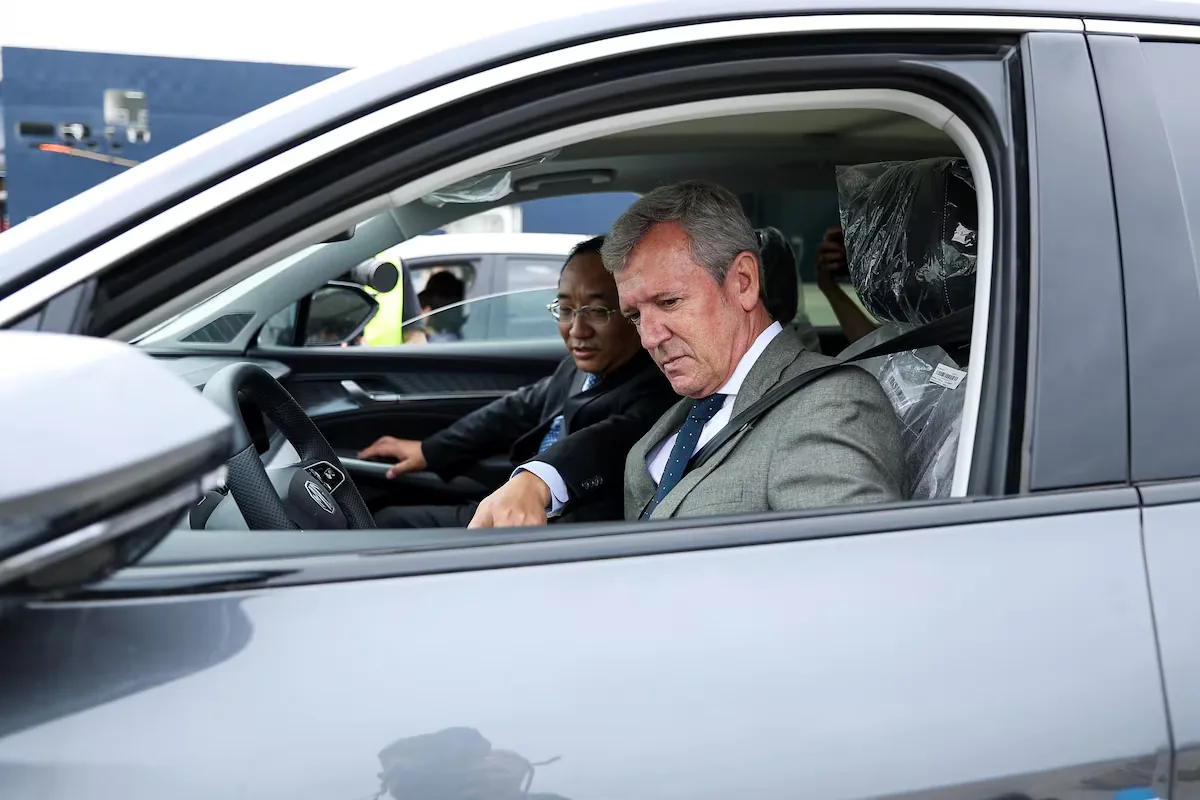
The difference is that the Popular Party, which made a scandal out of the Interior contract with Huawei and harshly criticized Pedro Sánchez for his approach to China, now remains silent. The reason for this change lies in the personal commitment of the Galician president to the project. Rueda and Sánchez compete for the credit of having secured the Chinese company’s choice of Galicia over other options in Europe, such as Hungary. Rueda traveled to China between April 22 and 26. Accompanied by Lorenzana, he visited the SAIC Motor plant in Zhengzhou, where he drove a car of the brand. Sánchez preceded him just a few days earlier. He was in China from April 13 to 15, where he met with President Xi Jinping and Prime Minister Li Qiang with one goal: to reduce the trade deficit and attract Chinese investments to Spain. Rejecting the investment in Galicia now is problematic.
The Xunta sees the arrival of the Chinese automaker as an opportunity for Ferrol, which in recent decades has suffered a strong process of deindustrialization and whose unemployment rate (12.1%) almost doubles the provincial rate (6.4%). Critics of the project believe, however, that SAIC Motor will barely provide employment, since, in an initial phase, it will be limited to assembling vehicles disassembled and arriving in containers from China, and the plant will be highly robotized. It remains to be seen whether the commitment that many components will be manufactured in Galicia or at least be Made in Europe is fulfilled.