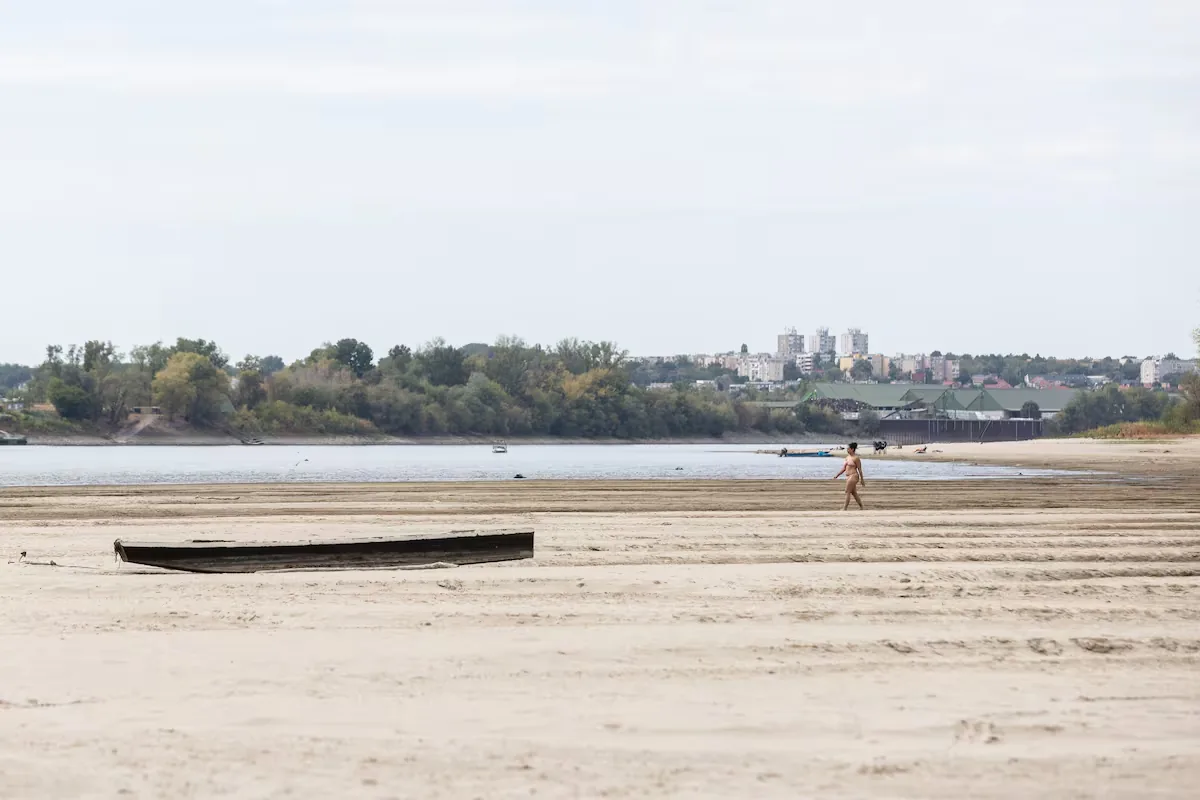
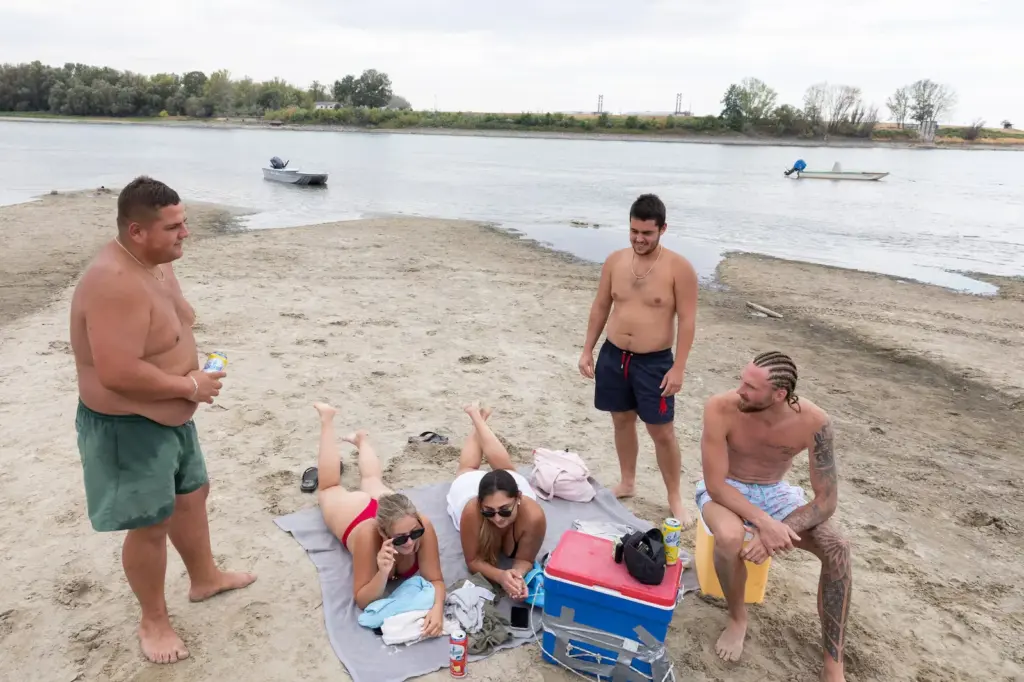
Budapest is a city accustomed to romanticizing disaster. Its famous ruin bars, cultural spaces that gave new life to buildings abandoned during communism, are an example. Another has been seen these days on the pillars of the Margaret Bridge. The historic drought sweeping through Europe this summer has stripped the Danube bare. Where there was once water, there are now large sandbanks, and many have decided to turn them into a beach substitute.
Last Friday, when the afternoon (and the 37-degree maximum) began to fall, dozens of people approached with beers and snacks, ready to improvise a picnic with unprecedented views of the national Parliament. The atmosphere was relaxed and cheerful, but it was enough to scratch a little to notice some concern. “I think we have never experienced a drought like this,” says Mike, a 45-year-old worker who came to spend the afternoon with two friends from the neighborhood. His perception is confirmed by Diana Urge-Vorsatz, a climatology professor at the Central European University in Budapest: “The Danube has always been a very stable river. There have been floods and droughts, but there is no precedent for such an extreme situation,” she explains.
Last June was the hottest in the great Hungarian plain since records began and the second hottest nationally. July became the tenth hottest and both months reached unusually low levels of precipitation, confirmed Hungaromet, the national meteorological service, to this newspaper. The stability in the Danube’s flow is due to its enormous length. The second longest river in Europe is 2,870 kilometers long and crosses 10 countries.
Normally, when it doesn’t rain in one place, it rains in another or is compensated by snow from the Alps. But this summer, the drought has been widespread. “This goes beyond the specific situation of one country,” explains Urge-Vorsatz, who is also vice president of the Intergovernmental Panel on Climate Change. “It is worrying overall, and it seems it will continue. Now it snows less in the Alps and higher temperatures cause the snow to melt earlier, and that means the river does not get water when it needs it most.” What is happening is not normal, she emphasizes. But it will be. So much so that some experts are beginning to call it the new normal.
Back on the ephemeral island of the Danube, Mike and his friends complain about the restrictions. “We are advised not to use air conditioning, not to wash the car, to use the shower and not the bath… but at least we have this place, this small territory to enjoy before it fills with tourists.” The recommendations he refers to were announced last week by the country’s prime minister, conservative Peter Magyar. They are motivated by the collapse of energy production at the Paks nuclear power plant, the only one in the country. The Danube drought has not only exposed part of its bed but also the energy dependence of a country on an increasingly scarce resource: water. This is necessary to cool the nuclear reactors, and with the lowest level in its history, last week they had to reduce their activity to a minimum.
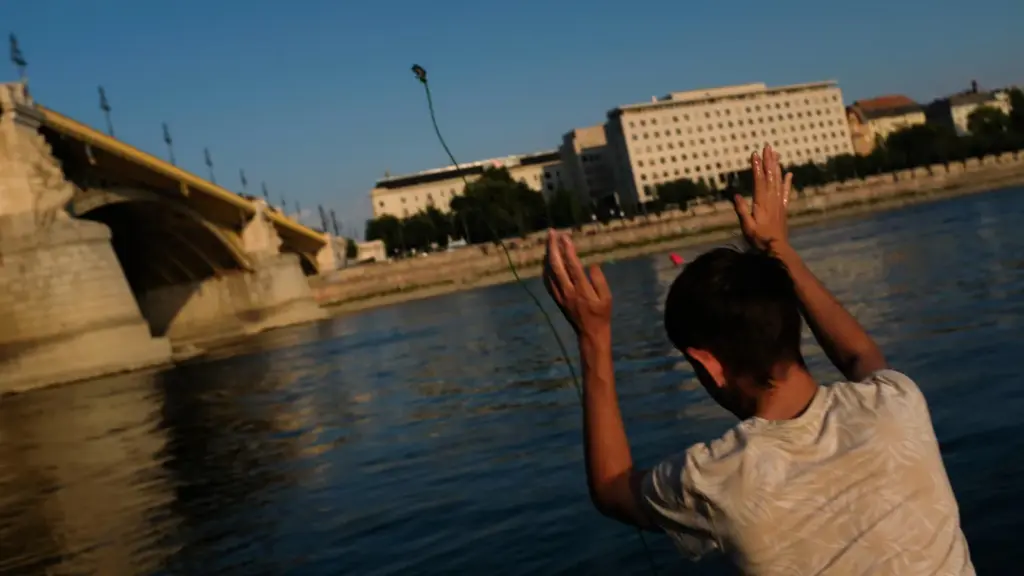
In hotels, a sign reminds customers that they may experience unexpected power outages. The local press has reported occasional blackouts in the city, although the reasons are unclear. Budapest’s monuments and bridges have been unlit for several days. That is why, when at 8:30 p.m. the lights of the Margaret Bridge and the Parliament turn on, a feeling of relief and surprise runs through the tiny island. There is time for one more beer. A group of teenagers fish for treasures with a metal detector tied to a rope. In other parts of the Danube, the water has revealed Nazi ships, mammoth bones, or Roman bridges. Just two weeks ago, in this same place, a World War II bomb appeared. Today the loot is much more prosaic: there are bikes, scooters, traffic signs, and dozens of odds and ends piled in a corner. Someone has rescued a trash can, which visitors use diligently.
The island is clean, dotted with stones with which Budapest residents have built small columns or love messages. On the other side of the river, Weiner Gergo, 25, has finished work earlier than expected. He is a waiter on one of the many boats that sail the Danube. “This last week, with the lights issue, we have had to cancel night outings,” he says resignedly. Gergo acknowledges that this has meant some loss, but he does not complain too much. “Those who have it bad are the big boats,” he says. Dozens of cruises have had to alter their course in recent days. Others have continued the route by changing the boat for a bus. The economic impact on the tourism sector is yet to be determined.
The Danube is much more than a river, says Gergo, whose work is somehow linked to its course. László Zsolt Garamszegi, ecologist and director of the Centre for Ecological Research in Hungary, explains that this river “plays a fundamental role in supplying drinking water, agriculture, industry, navigation, energy production, maintaining natural habitats, and recharging groundwater.” Therefore, he believes the real impact of the drought cannot be seen simply by observing the riverbed. It is also not well understood in the city, where the river has been tamed and caged. You have to leave Budapest.
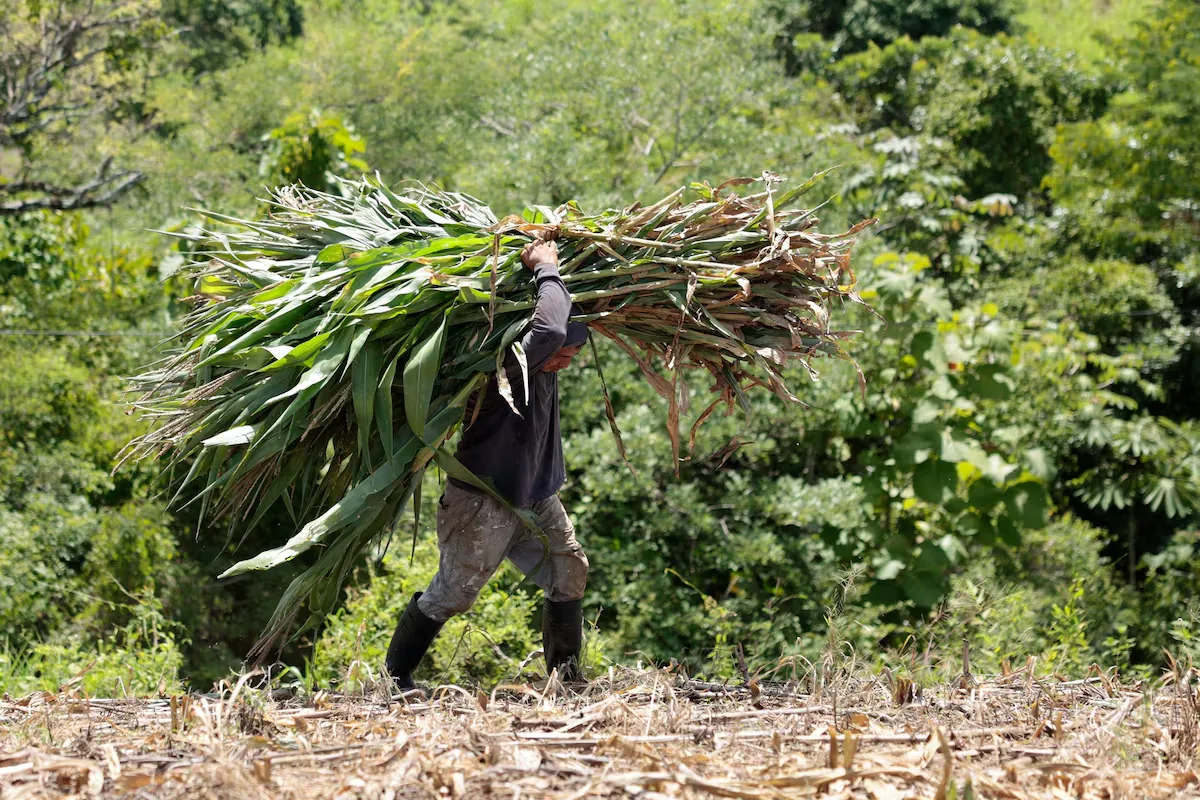
The fields are withered, faded in ochre tones. The sunflowers have stopped following the sun and look at the ground, defeated. The corn is dry, crunchy, and ruined. The Hungarian government has just approved an extraordinary package of 106 billion forints (about 291 million euros) to face the worst drought on record. It should help about 150,000 farmers. Csaba Gergely is one of them. He has spent his whole life in the countryside. And he believes that city people are not fully aware of what is happening. Droughts have become more severe in recent years, he explains. But he did not think they would affect his fields of corn, barley, wheat, rye, sunflower… “After all, they were on continental water,” he says. These are the underground springs the ecologist referred to. The same ones that have dried up this year. Gergely has lost nearly half of his crop. Two and a half tons. And he declares himself powerless. “Every summer I hope it will rain a little more, but every year the situation is worse,” he says.
You can check by resuming the journey. The dry crops extend to the sides of the road, like a carpet of disaster. The field gives way to the forest, lush but strangely autumnal, and then the Danube appears again. Or what remains of it. A huge sandbank embraces a scrawny and gentle river. On the opposite bank, behind the trees, the chimneys of the Paks nuclear power plant peek out. “I work there,” says a man pointing to it while sunbathing in his beach chair. He does not want to give his name. He should not speak to the press due to a confidentiality agreement.
He is a welder, as his father was before him. “Almost everyone in the village works there or knows someone who works there,” he says. A few days ago they stopped working. “We found out on TV, really, we didn’t know anything before.” The water level was too low to cool the reactors, so they reduced activity. Three of the four that make up the plant stopped. Many people were sent to work from home, ready to start up if the water level rose. “But that does not mean there is any risk,” the man emphasizes. The biggest proof is that he went to spend his day off with his wife just meters from the dormant reactor. It is not dangerous, but it is worrying. In Paks, everyone watches the river sideways, knowing that a few centimeters of flow can mean the difference between going back to work or not and also facing power cuts.
It has rained in Germany in recent days, so they begin to breathe a sigh of relief. The situation is so evident that not even a denier can deny it. In rural Hungary, it is easy to find them. Some blame their Austrian neighbors, accusing them of holding back water upstream. Others say this heat is the result of chemtrails, chemical trails from planes, referring to a conspiracy theory with no scientific basis. That this would not have happened with former Prime Minister Orbán, a populist aligned with Putin whose party, Fidesz, ruled with an iron hand for the last 16 years. They may not call it climate change, but no one can deny that the climate has changed.
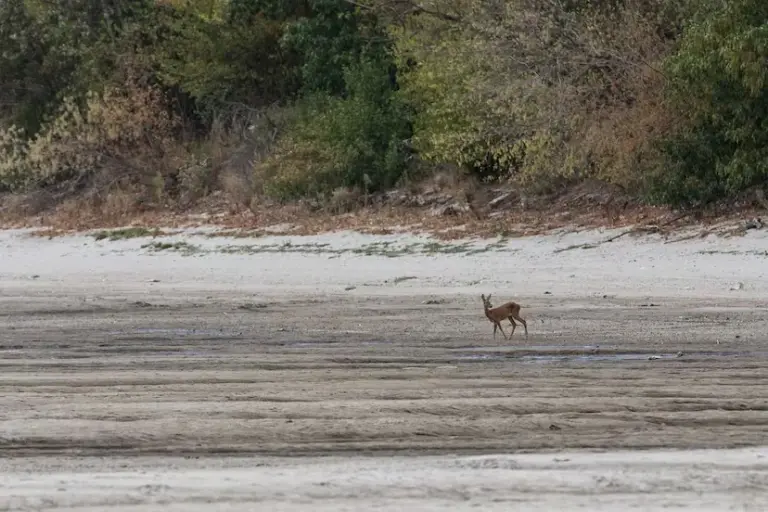
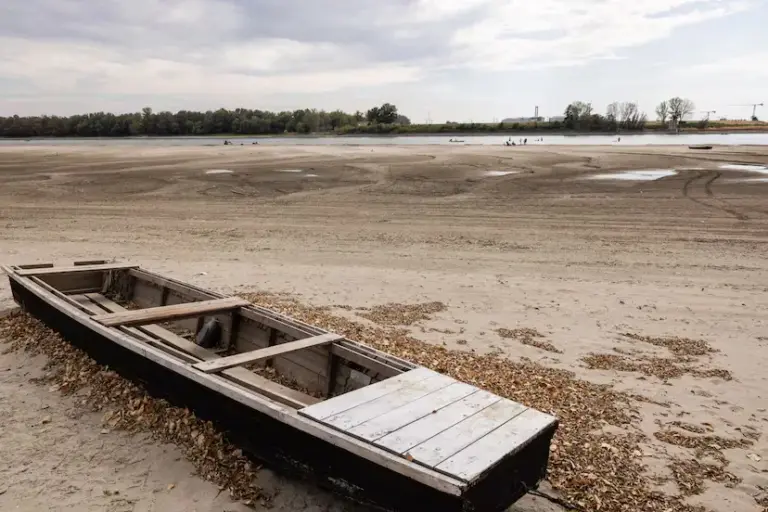
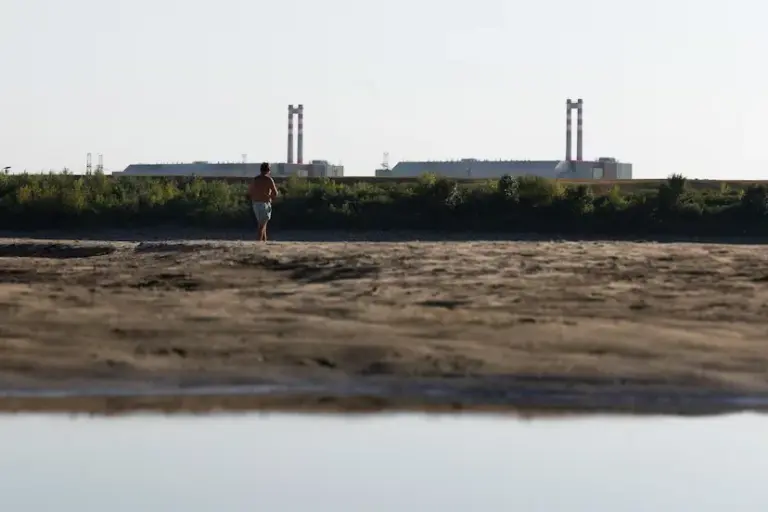
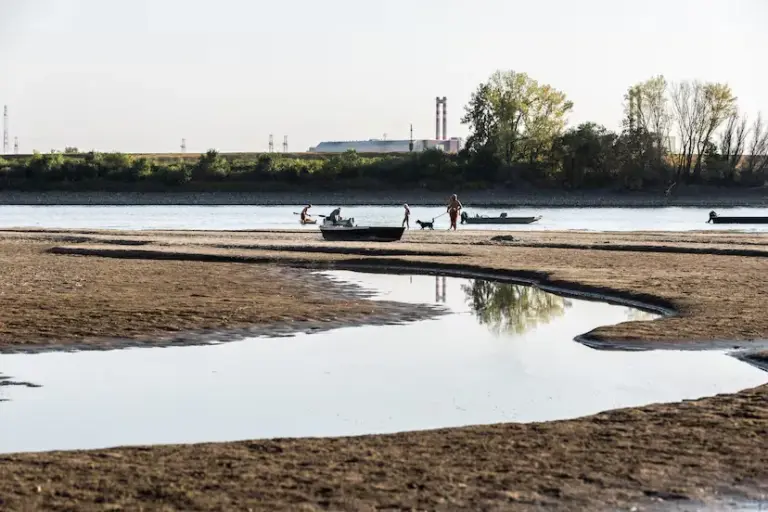
With highs of 42 degrees (the average maximum in July in recent years is around 28), dry rivers, and lost crops, the evidence is too overwhelming to ignore. Droughts, increasingly frequent in summer, are combined with spring floods that also do not subside. “If we plot the annual minimum and maximum levels, the two trends gradually diverge, creating a scissor effect,” explains Garamszegi. The annual maximum levels have increased little, remaining more or less stable throughout the century, but the minimums have dropped more than a meter. “This is important because it means the problem is not that the Danube is becoming a river with less water,” explains Garamszegi. It is becoming a more extreme river. The trend is general, but in places like Hungary, where life takes place on the bank, the consequences are clearly seen.
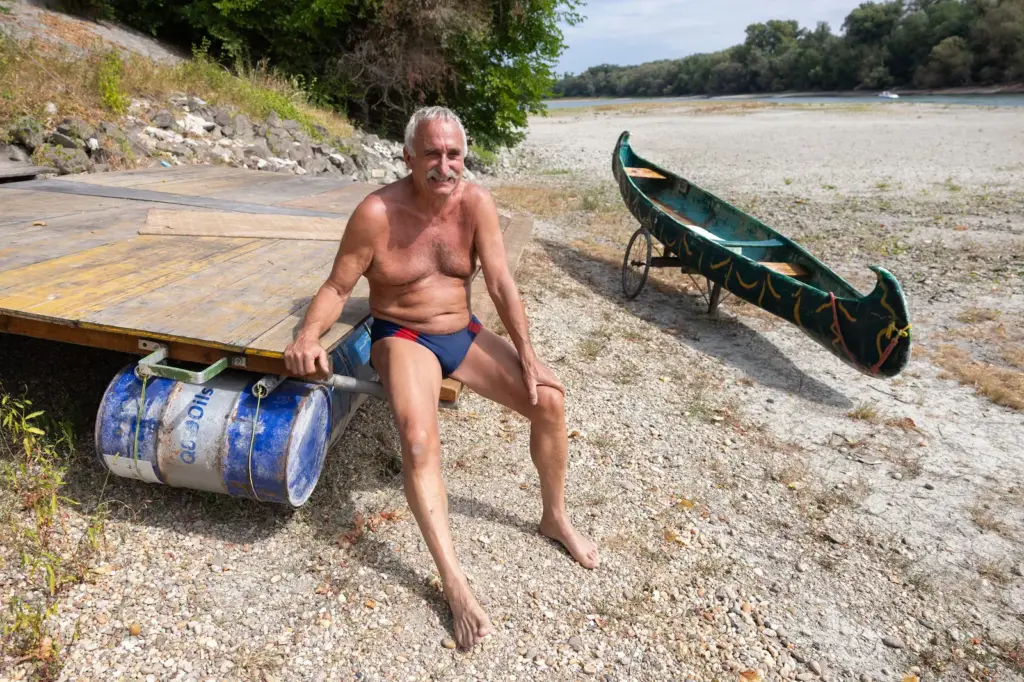
“I used to dive headfirst into the water from here,” says Antal Reti, a 70-year-old retiree, pointing to a pier stranded on land. On Luppa Island, on the outskirts of Budapest, about 80 families live, mainly during the summer. It is an idyllic place, with tall trees and traditional cabins. Many were built during the thirties. Reti’s, for example: “My family has been coming here for almost 100 years,” he says proudly. During this time they have endured some floods. Increasingly so. But no drought like this. Luppa is only connected to the mainland by a ferry that goes back and forth on the hour. If the level continued to drop, the place would be cut off. That is why Reti, like almost everyone on the island, checks the official government website daily to see the water level.
Maria, another resident, is calmer on the return trip on the ferry. “Almost everyone on the island has their own kayaks or canoes,” she says. “And in the worst case, you can cross on foot; you almost don’t need to swim anymore.” Downriver, the party continues. It is Saturday and, for the second consecutive night, the monumental buildings of Budapest are lit up. At the foot of the Margaret Bridge, there is a new light. A DJ livens up the evening and projects psychedelic images on the bridge’s facade. He calls himself Tomi Diamond and works in a nearby bike workshop. This very afternoon he agreed with friends and set up a mixing table on the river, he says. “This is something historic,” he says between songs. “This ephemeral island, these views… I wanted to contribute something,” he adds. He turns up the volume and the music rumbles in the metallic guts of the bridge. Today the boats do sail the Danube at night; young people dance on the riverbed. In Budapest, they are used to romanticizing disaster. One might almost say that if the end of the world comes, it will catch them dancing.
Read more A Government in Permanent Emergency