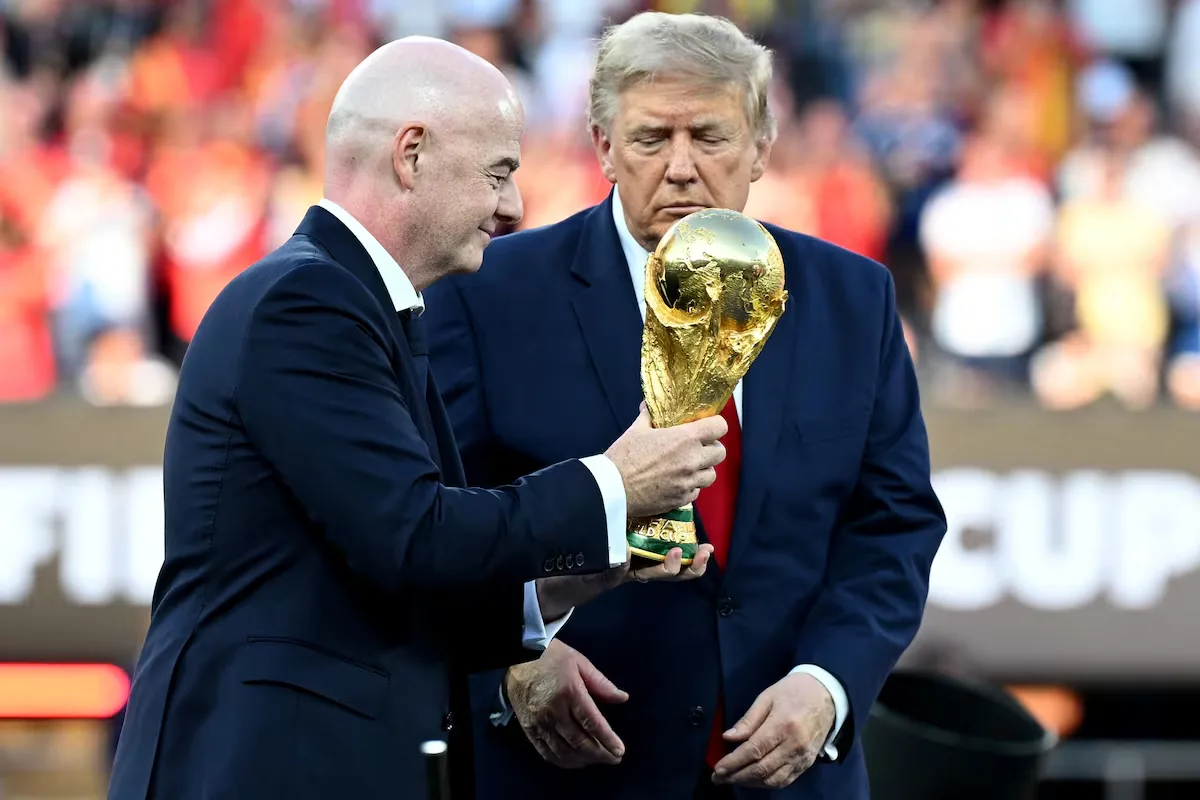
The Transparency and Democracy in Sport Association, chaired by Miguel Galán, the man who managed to bring down the former presidents of the Royal Spanish Football Federation (RFEF) Ángel María Villar and Pedro Rocha through his lawsuits, has filed a complaint this Monday before the FIFA Ethics Committee to investigate the president of the organization, the controversial Gianni Infantino. The text, accessed by EL PAÍS, requests the opening of proceedings against the Italo-Swiss leader to determine if he committed any violations in his failed plan to exploit World Cup rights, in the creation and awarding of the FIFA Peace Prize to Donald Trump, and in the Balogun case, that is, the unprecedented withdrawal of a red card from American Florian Balogun during the World Cup after a call from the US president so that the forward could play the round of 16 against Belgium.
Galán’s complaint was filed on the same day that UEFA, the Asian Football Confederation (AFC), and the Confederation of North, Central America and Caribbean Association Football (Concacaf) published a joint letter against Infantino stating that he broke “through deception” the trust in FIFA’s leadership with the now-abandoned proposal to create a company called FIFA Forward Enterprise (FFE) to commercially exploit the World Cups with 20% private capital. The plan, which faced formidable opposition from governments, institutions, leagues, and players, included potential investors such as Thrive Capital, founded by Josh Kushner, whose brother Jared is Trump’s son-in-law. “The strength of football has always resided in its unity. We demand that this unity be honored now, that leadership serving football be exercised, rather than one that seeks to control it,” says the letter, in which the three confederations urge the world football governing body that the report on what happened be conducted by an “independent third party, and not by FIFA itself, its staff, or any other football actor.”
In the 23-page complaint filed by Galán, the president of the Transparency and Democracy in Sport Association requests an investigation by the FIFA Ethics Committee — not yet a sanction — into three actions by Infantino that, in his opinion, may have harmed “the integrity and reputation of football.”
The first refers to the plan to create FFE, a subsidiary of the organization that was to be valued at about 20 billion dollars. The controversial plan, which would have provided the 211 member federations with 40 million euros annually between 2027 and 2031, was revealed by The Times on July 28 and sparked opposition from UEFA, the AFC, and Concacaf before being withdrawn. The leader himself met with the organization’s leadership on August 5 in Rabat. After the meeting, the institution issued a statement acknowledging that “mistakes” had been made, that “it was never intended for the FIFA Council and member federations to feel excluded from the process,” and that “it should have been managed differently.”
Galán requests in the complaint clarification on “who conceived, promoted, commissioned, and negotiated the project and with what prior mandate.” Also “which financial, legal advisors or investment banks were involved, with what mandate, remuneration, and selection criteria,” “which investors or potential investors participated in the discussions and what relationship they maintain, directly or indirectly, with the accused or related parties as defined,” and “whether economic incentives linked to institutional support for the project were offered to member associations and with what budget coverage.”
The second point Galán refers to is the creation and awarding on November 5 of the FIFA Peace Prize to Trump. The award was granted after the Italo-Swiss leader publicly campaigned for the US president to receive the Nobel Peace Prize, which did not happen. “The decision has been formally questioned by human rights organizations — which filed a complaint before the same Ethics Committee in December 2025 citing a breach of the duty of neutrality — by a member federation (the Norwegian Football Federation, which formally requested the opening of an investigation), by a group of 50 members of the European Parliament who also called for an investigation, and by international human rights organizations,” reasons Galán. “As far as this party knows, the legal title for the creation of the award, the body that approved it, its bases or criteria, the selection procedure, the budget allocated, nor the existence of any agreement by the Council or Congress supporting it are publicly known. The results of previous complaints are also not known,” adds the association president.
Read more Rebellion against Plater: the Govern’s renewable energy plan clashes with 1,300 municipal objections
The third matter on which Galán believes there are suspicions that Infantino breached the FIFA code of ethics and statutes is the withdrawal of the red card from Balogun after his expulsion in the round of 32 during the victory over Bosnia-Herzegovina (2-0). The decision, which occurred after Trump called the football chief, allowed the top scorer — three goals — of the team led by Argentine Mauricio Pochettino to be available to face Belgium in the round of 16 in a match that ended with a 4-1 defeat for the US. It was the second time in history — the first allowed Brazilian winger Garrincha to play the 1962 final — that FIFA reversed an expulsion in a World Cup. “The President of the United States publicly acknowledged having contacted FIFA regarding this expulsion, subsequently thanking the organization for correcting what he called a serious injustice,” recalls Galán, who requests an investigation into “the existence, date, time, channel, and content of communications between the FIFA presidency and US government authorities between the date of the expulsion and the decision; internal communications between the presidency, the general secretariat, and the Disciplinary Committee secretariat during the same period; and the complete disciplinary file.”
With the indicated evidence, Galán states that Infantino’s conduct could constitute several violations, including article 16 of the FIFA Code of Ethics, which imposes a fiduciary duty towards FIFA and is violated “when a person in a position of responsibility or trust acts to the detriment of the interests of those or behaves in a way likely to harm its image.” “The institutional crisis triggered, the public fracture with the confederations, and the acknowledgment of errors by the organization itself are objective elements of reputational damage that the investigation must assess,” he adds. Galán also points to article 14, which refers to the general duties of the president, article 20, which deals with conflicts of interest, and article 26, which refers to abuse of office “if it is proven that the powers inherent to the presidency were used beyond their functional limits to obtain a personal advantage or for third parties.”
Both Galán’s complaint and the letter from UEFA, AFC, and Concacaf are part of the growing opposition that has emerged against Infantino in recent weeks. The leader intends to run for re-election on March 18 next year, but the three confederations are maneuvering to find a candidate to challenge him and gather 106 of the 211 votes needed to overthrow him in March or earlier through the convening of an extraordinary FIFA Congress, for which only 43 signatures are needed.
The three confederations that mostly oppose Infantino gather 136 votes — 55 from UEFA, 46 from AFC, and 35 from Concacaf — out of 211. However, the Italo-Swiss leader maintains the support of North American federations such as influential Mexico, much of Asia, and for now some European countries that have decided not to speak publicly, as well as a large majority of the African Football Confederation (54 votes), the entire South American confederation (10), and Oceania (11). The total guarantees Infantino re-election despite the multiplication of scandals if no changes in position occur among the federations.
Read more An 83-year-old man drowns while bathing on a beach in Roses