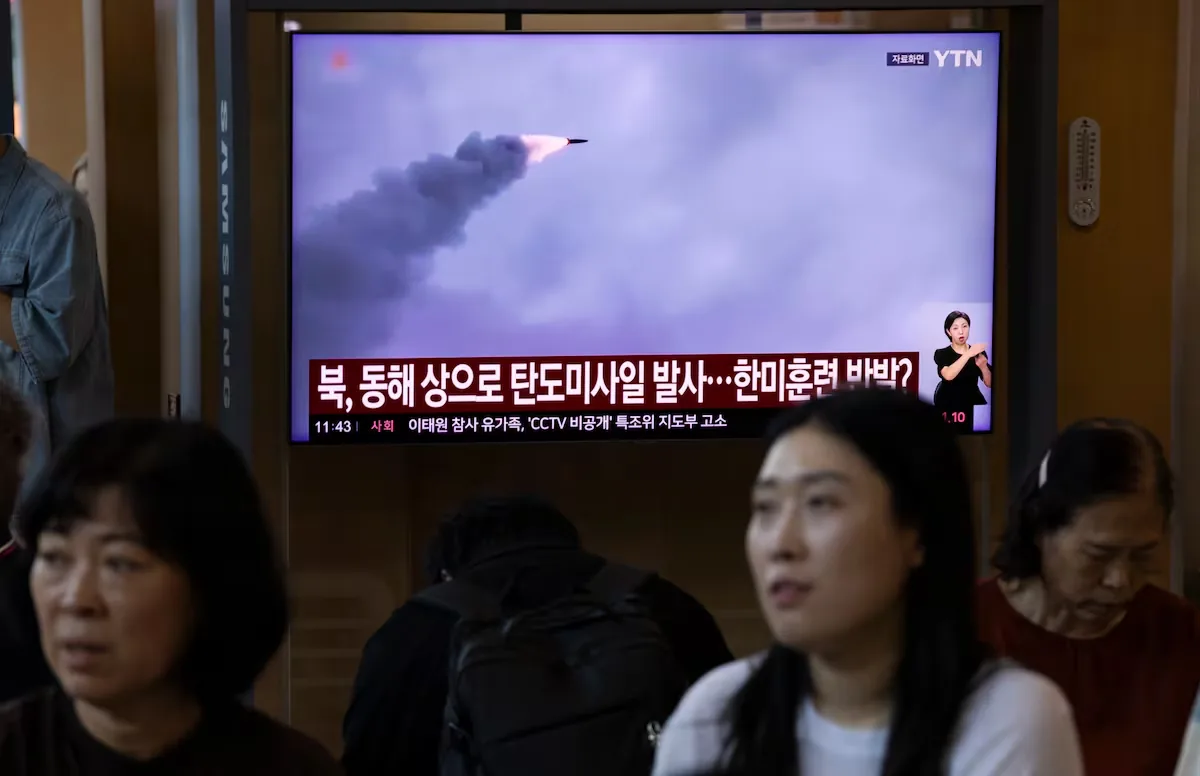
North Korea launched a ballistic missile on Wednesday towards waters east of the Korean Peninsula, according to authorities in South Korea and Japan. This is the second test of this kind in just six days and comes less than a week before the annual military exercises conducted by South Korea and the United States begin, which Pyongyang considers a rehearsal for a future invasion of its territory.
The South Korean Joint Chiefs of Staff detected the launch around six in the morning (local time, seven hours less in mainland Spain) from the vicinity of Wonsan, a port city in eastern North Korea. The projectile traveled more than 700 kilometers before falling into the Sea of Japan, according to information released by Seoul and Tokyo. North Korea has not yet commented on the launch.
The South Korean National Security Office has convened an emergency meeting and has called on North Korea to stop tests that violate United Nations Security Council resolutions. The South Korean military has assured that it maintains the necessary capability and readiness to respond “overwhelmingly” to any provocation. Meanwhile, Japan has lodged a diplomatic protest.
According to estimates from the South Korean military, this was the eleventh ballistic missile launch carried out by the secretive Asian country so far this year. Seoul has not specified the type of weapon used on this occasion and has limited itself to stating that South Korean and U.S. authorities are analyzing its characteristics. This lack of precision has opened several hypotheses about the type of weapon.
The South Korean agency Yonhap explains that projectiles with a range between 300 and 1,000 kilometers are usually classified as short-range ballistic missiles. Among the North Korean weapons capable of covering that distance is the KN-23, known as the North Korean Iskander, with a maximum estimated range between 700 and 800 kilometers. However, military sources cited by the South Korean agency do not rule out that it could be an as-yet unidentified model or a medium-range ballistic missile (between 1,000 and 3,000 kilometers) fired below its maximum capacity.
Shin Jong-woo, secretary general of the Korean Defense and Security Forum, told Yonhap that it could be an improved version of the KN-23 or the Hwasong-11Ma, a short-range hypersonic missile still under development. The expert believes that the pattern of the last two launches (a single projectile fired from the same place) suggests that it would rather be a test to improve the performance of a weapon and not so much a show of force.
North Korea launched another missile last Thursday from the same Wonsan area, but its state media also did not report on that test, a silence that deviates from the usual pattern of Kim Jong-un’s regime, which generally flaunts its technological and military advances with great fanfare. Hong Min, a researcher at the Korean Institute for National Unification, told Reuters that that test might not have reached the intended target.
Hong believes that Wednesday’s launch was part of North Korea’s weapons development schedule, although its proximity to the joint exercises of Seoul and Washington may also contain a warning: “Even if it was a test of a weapon in development, choosing when to carry it out is also a political decision,” he emphasized to Reuters.
The Ulchi Freedom Shield military exercises will take place between August 17 and 27. South Korea and the United States insist they are defensive in nature, but North Korea denounces them as preparations for an invasion and usually responds with missile launches, its own maneuvers, or threats against its neighbor.
According to South Korean media, this year’s edition will include 14 joint field exercises at battalion level or higher, a deployment lower than the 17 conducted in 2025. As happened last summer, the announcement of this year’s exercises also does not include expressions used during the previous South Korean government, such as the “growing North Korean nuclear and missile threat.” Park Won-gon, professor of North Korean Studies at Ewha University, interprets this omission as a sign of caution with which Seoul tries to manage inter-Korean relations, aware of Pyongyang’s rejection of these exercises.
Wednesday’s test also coincides with growing concern about the use of North Korean weaponry outside the peninsula. Ukrainian President Volodymyr Zelensky stated the day before that Russia had used North Korean-made ballistic missiles in an attack that killed seven workers at a steel plant in the Zaporizhzhia region.
Moscow and Pyongyang have significantly strengthened their military cooperation since the start of the Russian invasion of Ukraine and, in 2024, signed a comprehensive strategic partnership treaty that includes mutual assistance in case of aggression. Since then, North Korea has sent troops, artillery shells, rockets, and ballistic missiles to Russia. Seoul and its allies fear that, in return, Moscow is providing military technology and knowledge to the Kim regime, and that the use of North Korean weaponry in a real conflict is allowing them to improve their systems.