When at the beginning of 2024 Kim Jong-un, the leader of hermetic North Korea, called for a constitutional reform to bury the aspiration of reunification with South Korea, many analysts anticipated that Pyongyang would draft a text openly hostile towards its neighbor. The North Korean leader had even requested that the Magna Carta include the idea of “occupying, subjugating and fully claiming” the South and “annexing it” in case of war. But the document approved in March and released this week by the South Korean Ministry of Unification does not go that far, according to the interpretation offered this Thursday by South Korean intelligence services. Although the new North Korean Constitution enshrines for the first time the doctrine of “two separate States” and erases references to the reunification of the Korean peninsula, it avoids labeling Seoul as an enemy or a military target.
Read more Eurodreams: check draw for Thursday, May 7
The constitutional reform defines the territory of the Democratic People’s Republic of Korea (the official name of North Korea) as “the land bordering China and Russia to the north and the Republic of Korea to the south, along with its adjacent territorial waters and airspace.” The new wording is loaded with political significance: on the one hand, it removes from North Korea’s fundamental law the idea that the peninsula is pending unification; but, on the other hand, South Korea is described, for the first time, as a State located on the other side of the border.
In line with this new framework, the text removes expressions that for decades were part of North Korea’s official vocabulary, such as “peaceful reunification” or “great national unity.” The disappearance of these terms formalizes a break announced by Kim at the end of 2023, when he argued that inter-Korean relations should no longer be understood as an internal matter between compatriots but as a relationship between “two hostile States.” The Constitution, however, introduces this separation without reproducing all the warlike rhetoric that had accompanied the leader’s speeches.
This is the nuance highlighted this Thursday by officials of the South Korean National Intelligence Service in a closed-door session before the parliamentary intelligence committee, reports the Yonhap agency. According to lawmaker Park Sun-won, of the ruling Democratic Party, the South Korean agency has concluded that Pyongyang has “significantly lowered” hostility towards Seoul in the new constitutional text. Although the Magna Carta mentions that Pyongyang will not tolerate any violation of its territory, it does not contain expressions that openly promote discord, Park emphasized.
For South Korean intelligence, the document shows that the North Korean regime seeks to cut political ties with its southern neighbor, but without adopting an openly offensive constitutional stance. Their reading is that Pyongyang intends to “maintain the status quo” rather than prepare for an immediate escalation.
On the Korean peninsula, peace remains, strictly speaking, provisional, since the Korean War (1950-1953) ended with an armistice and not a peace treaty. For decades, even in moments of greatest tension, both States maintained in their official texts and speeches the idea of a future reunification.
The new territorial clause, however, leaves a particularly sensitive area of ambiguity. The text does not elaborate on what the maritime border between the two Koreas in the Yellow Sea is, particularly around the Northern Limit Line, the de facto demarcation established after the armed conflict and which Pyongyang has never fully recognized. That area has been the scene of naval clashes and episodes of tension in the past, so the absence of a precise definition keeps open one of the most explosive points on the peninsula.
More power for Kim
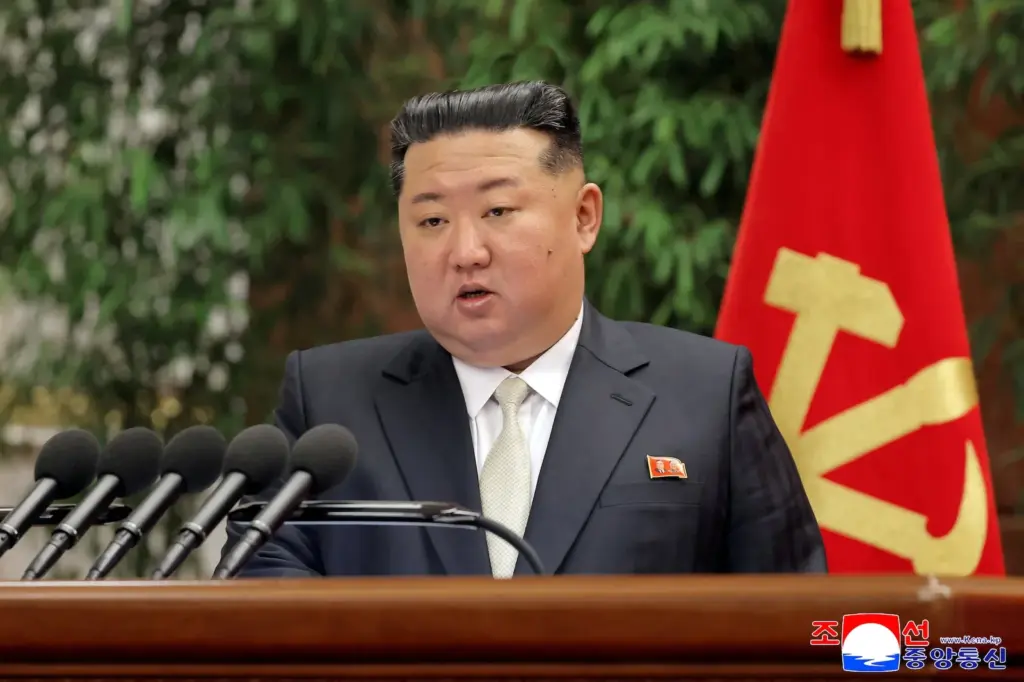
The constitutional reform includes changes that go beyond the relationship with Seoul. It also strengthens Kim Jong-un’s personal power, whose position in the institutional order is now placed above the Supreme People’s Assembly (the Parliament). The Constitution also incorporates a clause that grants him command over the country’s nuclear forces, including the authority to delegate that power, and removes the Assembly’s ability to revoke it, further reducing its already limited role as a check and balance.
Additionally, according to Yonhap, the new text removes references to the achievements of Kim Il-sung, the founder of North Korea and grandfather of the current leader, and his son and successor Kim Jong-il, replacing them with a greater emphasis on the principle of “the people first,” a slogan closely associated with Kim Jong-un. The modification does not erase the dynastic character of the regime but emphasizes the current stage.
The North Korean Constitution, which was first adopted in 1948 and replaced in 1972 by the so-called socialist Constitution, has been amended numerous times to accompany changes in power and regime priorities. The latest revision has removed the word “socialism” from the title, despite the country still defining itself as a socialist nation.
During the conference where the North Korean document was revealed, held Wednesday in the South Korean capital, Professor Lee Jung-chul of Seoul National University interpreted this adjustment as part of North Korea’s attempt to reinforce the appearance of a sovereign State with defined attributes, that is, with delineated borders, a clear head of State, and a security doctrine incorporated into its founding law.
Read more Illa prepares in Lyon the handover of the presidency of the Four Motors for Europe