









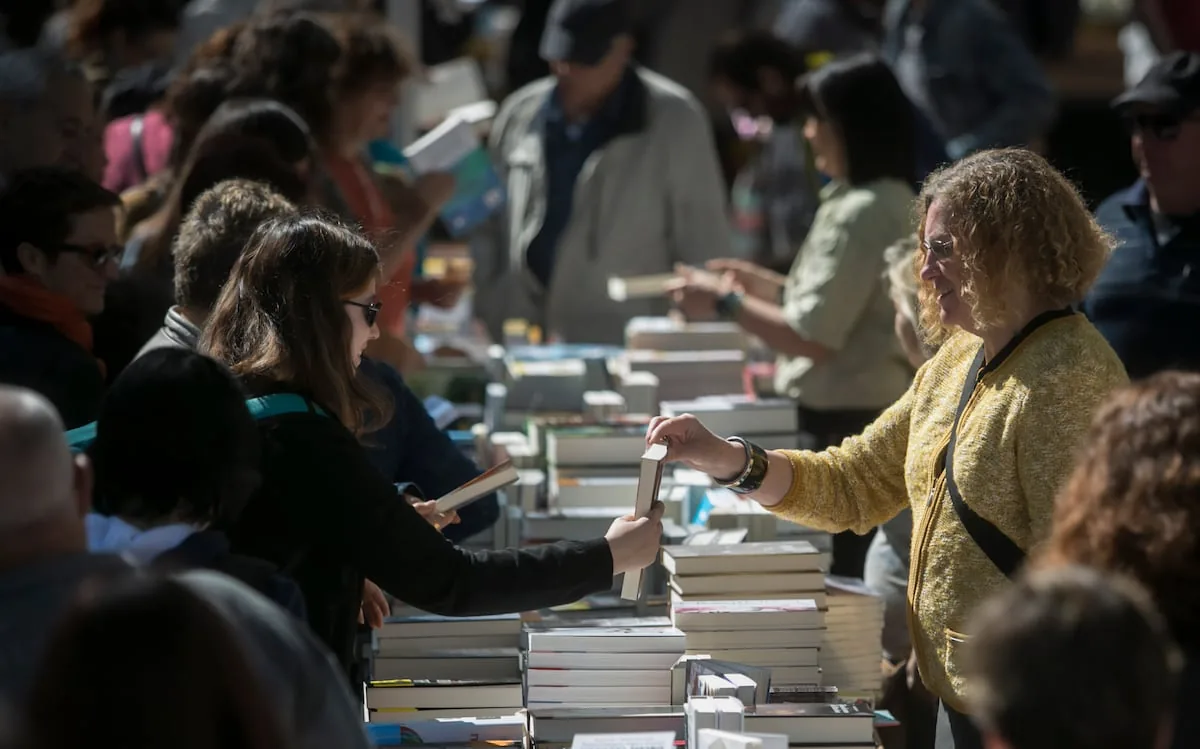
The country’s bookstores will be so overflowing with literature on Book Day that it will not be surprising if lovers of fine letters become disoriented by such a collection. Decades ago, when fewer books were published, the choice was a bit safer; today, on the contrary, it is most likely that an inexperienced buyer will enter a state of total alienation, in unfathomable perplexity. In this case, the reader might not buy any book; but that would do no favors to our publishing industry, on which — or by which — a group of people with a very commendable profession live.
Read more Why do you start exercising and then quit? The answer may lie in your goals
The first thing the reader should do is be wary of a very tall stack of books on the counter: these are the books that booksellers basically know will sell well thanks to the publicity they have received in the weeks before the marked day. In fact, the best thing a buyer can do is not to trust the tables full of books on the street and enter the corresponding establishment, where they will find a greater, diachronic variety of volumes.
Once inside, if the reader finds themselves in a not very large bookstore with qualified staff — that is, cultured, who may have studied humanities or comparative literature — it is advisable to address the clerk with a very simple question: “Could you recommend a book that is not a new release and that many generations of readers have highly praised, books in the original language or translated that have made history? I understand that the books found on the street are new releases, and we do not have enough perspective nor have enough readers or years passed to know if they will withstand the test of time.”
Then the clerk will show you the section of 20th-century classics: Proust, Kafka, Musil, Virginia Woolf, Joyce, Svevo, Marçal, Riba, Carner, Ruyra, and Thomas Mann. You will say you already know them and ask for something from earlier times. They will show you Flaubert, Jane Austen, Dickens, Poe, Stendhal, Melville, Katherine Mansfield, Maupassant, and Verdaguer. You will say: “Yes, this is starting to be solid… But these authors are all somewhat touched by romanticism and feelings. Let’s try to find things from the classical period of European letters.” The young man or woman will take you to the section of great authors from the 17th and 18th centuries: “Would Voltaire, Jonathan Swift, Fielding, the Baron de Maldà, Sterne, or the theater of the Grand Siècle suit you?” You might say: “Well, those you mention are fine, and I appreciate the insight and knowledge you show. However, could we go for more secure values? Good literature needs a lot of time to establish itself…” “Sir,” the cultured young man or woman will say, “it seems you lean towards the restoration of ancient letters: how about all this we have here, between Petrarch and Montaigne? They are enormously solid authors. Les Familiars of Petrarch, Bacon’s Essays, those of the solitary mountain dweller?”
Read more The 21st-century Spanish novel: the last great storytellers before artificial intelligence
You will say: “Girl, there is no doubt these are great authors, but they are still writers who returned to the genres, themes, and forms of the classics. Maybe we should go a little further.” The girl will say: “Sir, you surprise me. You must be a lover of medieval letters? Then take a Dante — the one by Sagarra, the one by Micó — or the anthology of troubadours by Martí de Riquer. I’m sorry to tell you, and it is unforgivable in a good bookstore, that at this moment we have no Arnaut Daniel, no Jordi de Sant Jordi, no Cavalcanti, no Villon, no Archpriest: they don’t sell much…” You might say: “Yes, these are also enormous, but a bit modern. We should go for ancient, solidly secure values.” He or she will say: “Well, for ancient and secure we have to go to Latin letters. Consider that, in Catalan, we have first-rate versions thanks to Bernat Metge and Adesiara.” You will think, furrow your brows, and perhaps say: “Friend, except for Virgil, and even then, Latin letters are too enslaved to those of Greece. What if we went to Athens of the 6th and 5th centuries?” “You are absolutely right,” the young man will say, “then good literature was made: a Sophocles, a Plato’s Symposium, Thucydides, an Aristophanes for a half-laugh?” Since our reader has a strict, incorruptible criterion, they will say: “Don’t you have an Odyssey, an Illiad that carry weight?” “Well yes, we have four or five of each epic, in Catalan, all increasingly good.” “Now we’re doing well,” you will say, “but in the world of letters it is advisable to go as far back as possible: they are the future of the renaissance of literature, today very disoriented. You know what? Give me a Poem of Gilgamesh, which is from the third millennium BC: if it has lasted so long, it must be good.”
And so it went: that man did not buy any freshly baked book for Saint George’s Day, but the most remote of universal literature, in cuneiform writing, translated into Catalan. He arrived home, served himself a drink, closed the window to distance himself from the most trivialized forms of culture, and read, in one sitting, the adventures of Gilgamesh and Enkidu. That night he slept lovingly.
Read more Mikel Oyarzabal, the footballer who appears when everything is decided