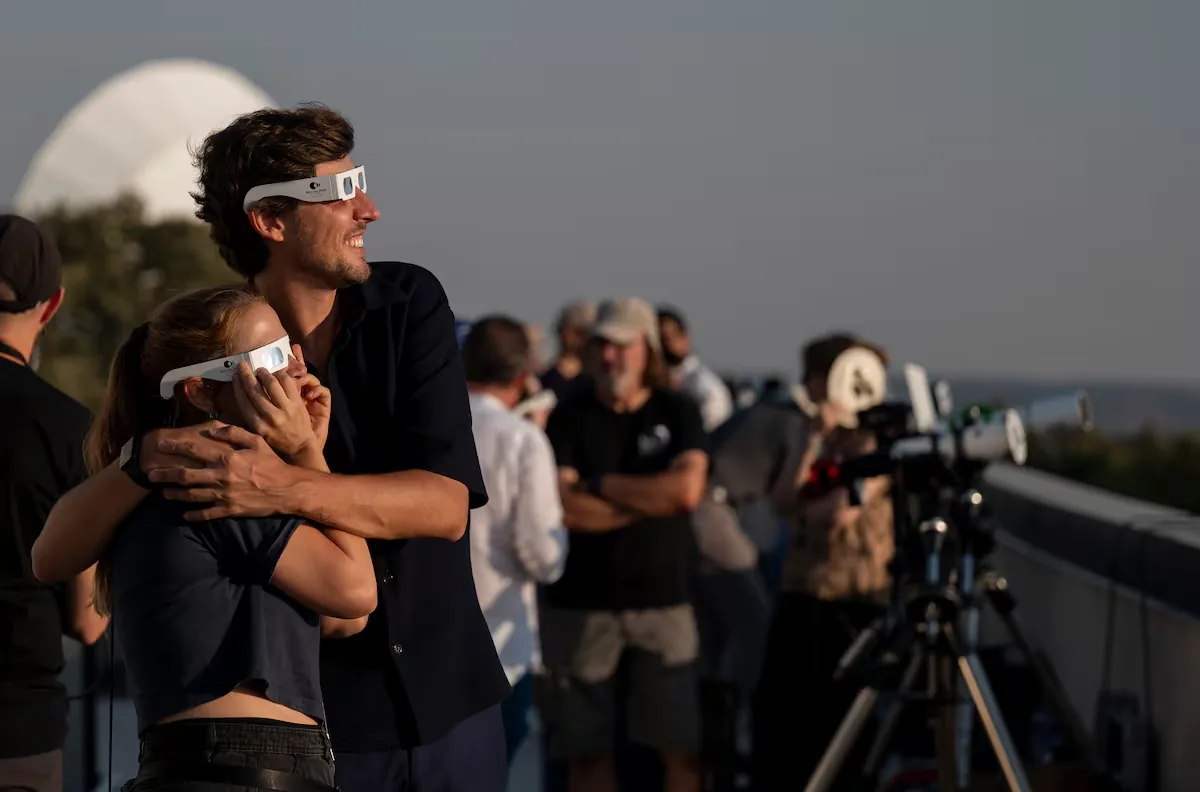
It is August 13 and Jaime Zamorano is exhausted. Yesterday he was finally able to experience a total solar eclipse in his town with his loved ones. It is a day that this 69-year-old retired astrophysics professor will never forget. He does not feel up to attending the media, but his adventure companion for 35 years, astrophysicist Jesús Gallego, from the eclipse hunters group at the Complutense University, confirms that “he is delighted, had a blast with his family, including his mother, and enjoyed it like no one else.” Because for scientists like them, who had been preparing for years to host an eclipse at home and educate Spanish society about its importance, experiencing this very special astronomical phenomenon was as important as finally being able to share their passion with their families.
Read more UIMP hosts in September the course ‘How is a newspaper made? 50 years of EL PAÍS’
“After anticipating the eclipse for so long, talking about what it is like, telling people they couldn’t miss it, narrating what they would be able to see and how to do it safely, and assuring them it was beautiful, the most beautiful part of this whole process has been witnessing that emotion,” says Eva Villaver, deputy director of the Canary Islands Astrophysical Institute, in statements to SMC. “For me, it has been very special to share the passion we have for the stars and see how the work we have been doing for months translated into people moved to tears or simply speechless, overwhelmed for a few seconds that they will never forget for the rest of their lives.”
Villaver, who saw it at the Yebes Observatory, the official eclipse monitoring point, assures that, as a ‘sky professional,’ this has been one of the most rewarding experiences of her life: “The cosmos is a beautiful place, we astrophysicists experience it every day, but yesterday we were also lucky to be able to share it; that is really what moved me. Getting millions of people to look up to see something that seemed out of this world.”
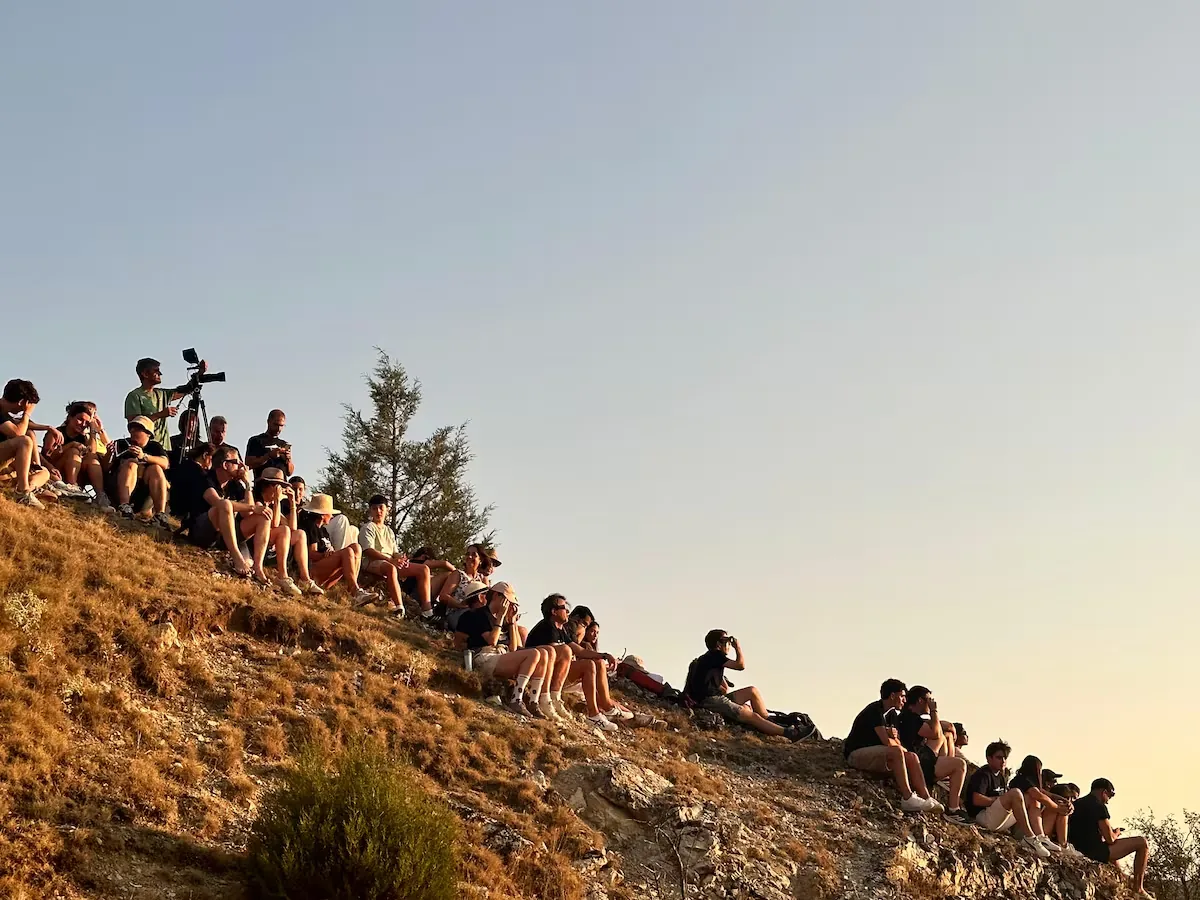
Astrophysicists Zamorano and Gallego saw it at a star party in Villaverde del Ducado, a hamlet of 20 inhabitants in Guadalajara, where they planned to share it with a group of eclipse chasers and their families. It was an event that looked appealing but lacked resources, and although the publication of an article in EL PAÍS attracted about a hundred unexpected visitors, everything was under control. “We were aware this could happen, but the report was published at just the right time, only three days before the event, so people had already made their family plans and were not going to change them,” adds Gallego, praising the months of prior information that facilitated logistics for everyone.
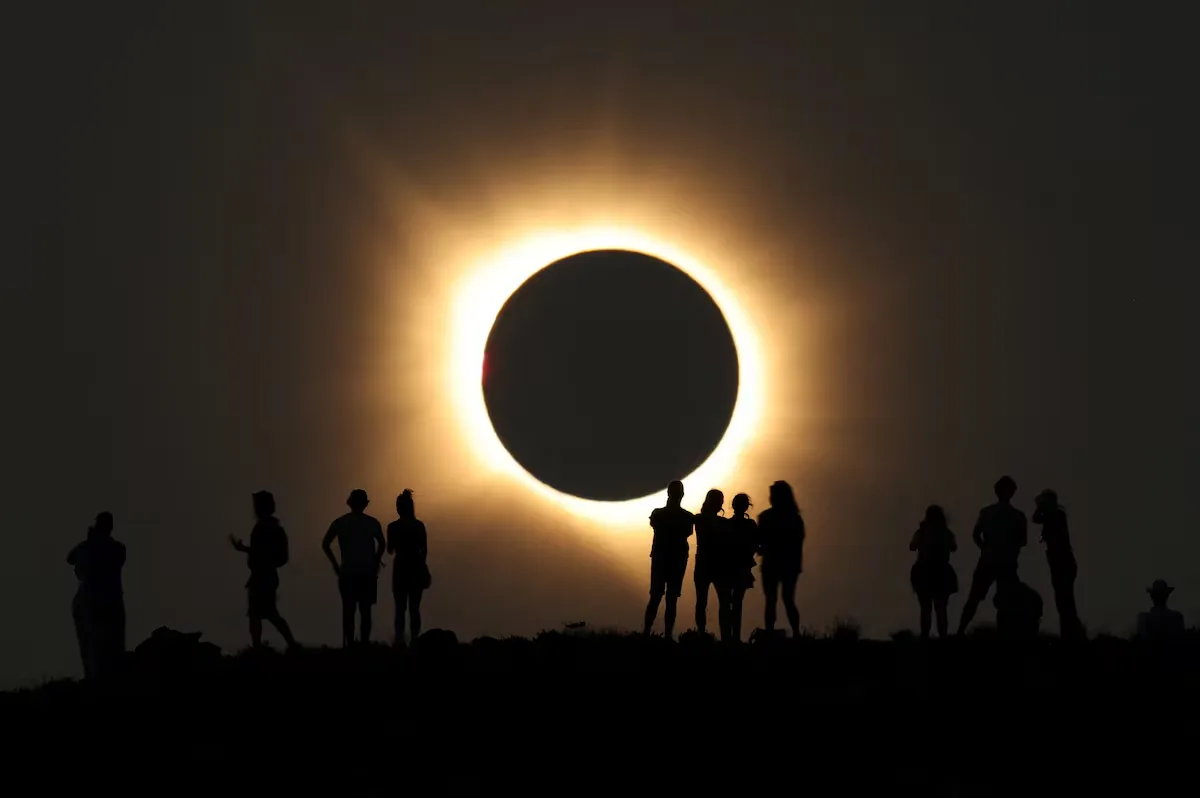
This was the sixth eclipse shared by Zamorano and Gallego, but it was no less special. Each eclipse is unique because it depends on hundreds of factors such as the sun’s altitude, atmospheric quality, or solar activity at the time, as Gallego describes, and this one, he says, had a very important detail: “Because the sun’s position was so low, it made it appear larger than it is and the solar corona had a warmer tone than usual, and this was new for us,” he admits, still emotional.
The astrophysicist wants to emphasize that the event we experienced on August 12 is “a unique social experience that brings you closer to anyone and that’s why it must be shared.” In Villaverde del Ducado, besides groups of professional astronomers, forest rangers and even popular science communicators on social media like Quantum Fracture or Alba Moreno came. “I gave a last-minute talk on how to use the glasses to some grandparents from the town, and to the forest rangers too, who later came to thank us,” he recounts. “We created a kind of improvised community, all united by the eclipse,” he recalls.
Nearby, in the depopulated region of Señorío de Molina-Alto Tajo, two hamlets of the same town, Maranchón, were very lucky to celebrate star parties guided by their own local astronomers. In Clares, astrophysicist Javier Alcolea managed to recover from a last-minute family scare that made him arrive in the town just in time and barely having slept, to be there for the “D day.” Upon arrival, he reminded the main safety tips via the town’s WhatsApp group, ensured that people with reduced mobility were placed in their reserved spots, and climbed one of the two hills in the town, where most people gathered. Next to him, his family, but also young people between 20 and 30 years old, who were incredulous before the spectacle that Javier, at that moment, focused on enjoying.
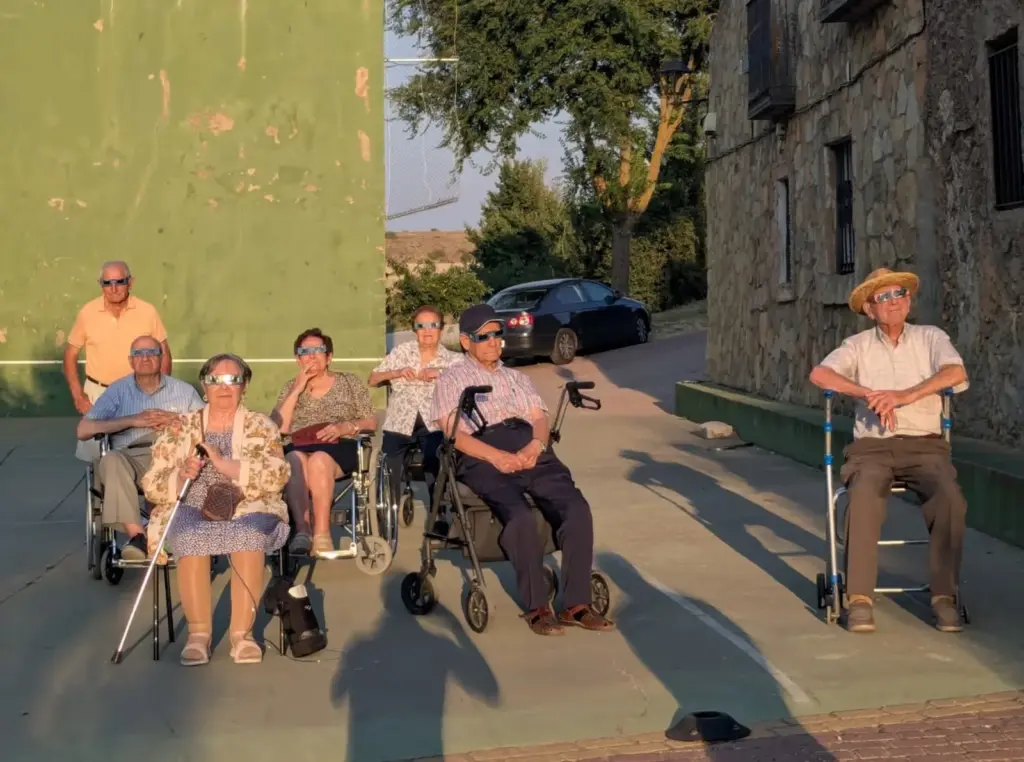
“It is a sensory experience that is difficult to convey,” confesses Alcolea, still amazed by his first total eclipse. As if everyone had the luxury of enjoying something like this, Alcolea says that after the eclipse, they enjoyed a communal meal, a vinyl music party, and at night, they turned off all the lights to watch the Perseids.
His colleague, astrophysicist Pedro García-Lario, from Turmiel, still has a big smile while digesting the flood of sensations and emotions from yesterday. “I was afraid, after promising everyone that they would experience something unforgettable, that it wouldn’t be so, but they told me it exceeded all their expectations, that they felt like they were in a movie,” he confesses emotionally. He himself did not expect it to be so beautiful. “At the end of the eclipse, people came to hug me and thank me as if I had brought the eclipse,” he says incredulously and satisfied to have been able to share those “so intense and memorable” seconds with the people he loves. “Here, in my town, it was amazing.”
A little over 400 kilometers northwest, from the province of León, science communicator José Vicente Casado also admits to being exhausted but happy. In fact, he struggles to find the words to describe what happened yesterday at La Camperona, a 1,606-meter-high mountain in the Sabero valley, with impressive views and also a challenging climb: 3.3 kilometers with a slope of up to 24%, which has earned it the honor of hosting a stage of three Vuelta a España cycling races.
Read more The Kast Government carries out a massive transfer of high-risk inmates in a Bukele-style operation
Those who climbed that mountain yesterday did so knowing it was an exceptional place that, by the way, had not been overly publicized. Casado estimates about 600 people reached the summit, half of them foreigners, many of whom arrived on their own: they took a map, calculated the path of totality, the maximum duration, and the probability of clear skies, and arrived alone (or so they thought) at the same mathematical conclusion as the organizers. “We didn’t know this was set up,” several told Casado, convinced they had discovered the best viewpoint in Europe on their own.
For this science communicator and organizer of astronomical events with his company litos.net, the eclipse has been more than an astronomical phenomenon, “a sociological experiment.” He tells it with a mix of pride and surprise: no one left trash, there was no noise, not a single security incident, and the physical demand of the climb, he says, acted as a filter that left only those who really wanted to be there at the top.
The emotion, he insists, caught him by surprise. And he remains moved. “My main reflection is that pleasure comes from knowledge. Many people had thought: ‘What is this nonsense, this idiocy?’ We live in strange times. But when we saw that moment of totality, that human reaction of surprise and shared excitement… It connected what we have in our hearts with what we had in the sky.”
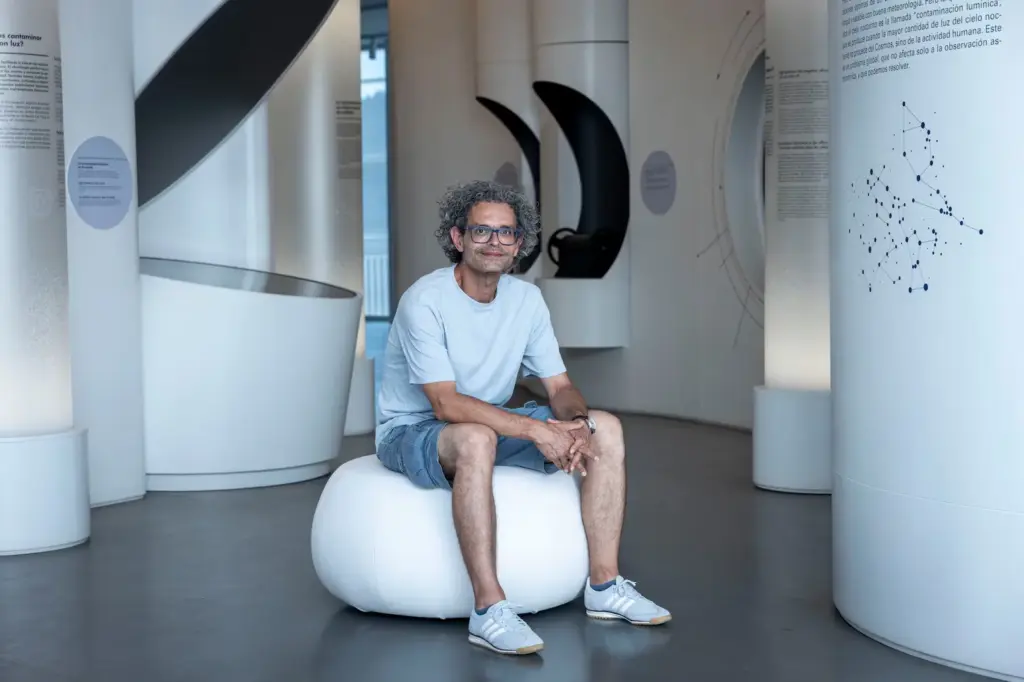
“I’m already looking forward to the next one,” says Stylianos Pyrzas from Arcos de Salinas (Teruel). The 43-year-old Greek astrophysicist is part of the team at the Center for the Study of the Physics of the Cosmos of Aragon (Cefca), which organized the observation from the Javalambre Astrophysical Observatory, among the Teruel mountain ranges. As totality approached, he lit a cigarette to experience those seconds of the first total solar eclipse of his life. “It is difficult to describe exactly what you feel at the moment, once you take off the glasses and see this spectacle of nature,” he says and celebrates: “Also, we were lucky to have a solar prominence visible to the naked eye.” When it ended and people approached to ask about his feelings, he had no words. “It will take me time to process everything we lived yesterday,” he admits. But he is happy. “The most important thing is all the emotions this wonder we experienced provoked in us.”
Now, he says, he oscillates between tiredness and the feeling of a mission successfully accomplished after two years of preparing and informing the public about what they would see and the safety measures. Now he feels a void: “It happened. And now, what do we do?” Everything went smoothly: the European Space Agency broadcast to the world; the Berlin Planetarium to Germany; a group of Italian researchers experimented with a prototype, and scientists watched it with their families. There was even a Nobel Prize winner and a rock star. For this astronomer, who started studying Physics until he saw Saturn through a telescope and was sure he wanted to spend the rest of his professional life observing the sky, the cosmos continues to offer new surprises. The culmination of these two years of work exceeded all Pyrzas’s expectations. He even has a photo with former Queen guitarist Brian May, who saw yesterday’s eclipse in Arcos de Salinas.
Astrophysicist and science communicator Borja Tosar recalls that when he first connected to the Internet from his home in 1995, one of the first things he did was download an astronomy program and ask it to calculate when the next total eclipse would be in Sarria, his hometown in the province of Lugo. The answer: August 12, 2027, at 20:28, was etched deeply in the mind of the then-teenager.
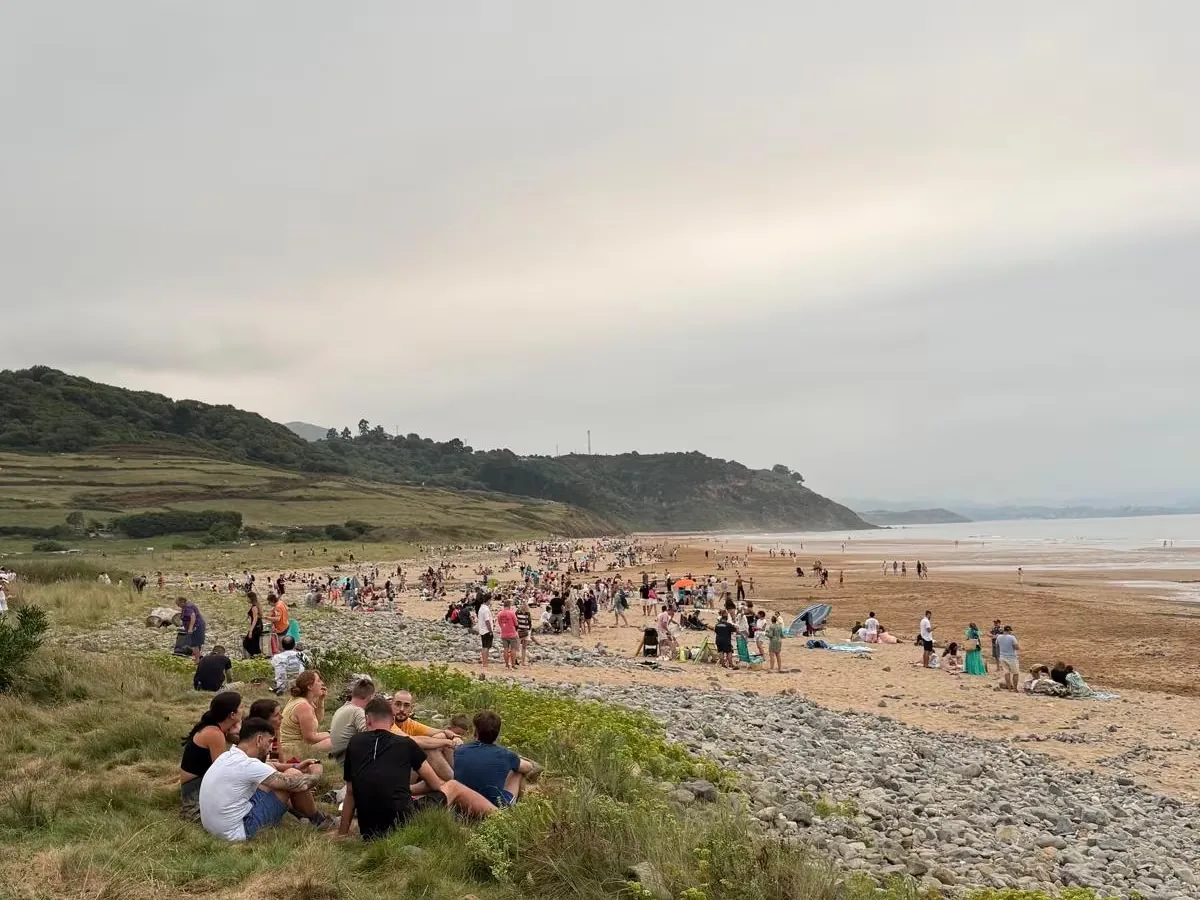
Thirty-one years passed and the big day finally arrived. This Wednesday he had the opportunity to fulfill the dream of seeing the total solar occultation in his hometown, which made him the town crier of its festivities this year. He was there early in the afternoon when some clouds with “very bad looks” began to arrive. “I wanted to be in my town, but I didn’t want to miss the opportunity to live the true experience of seeing the solar corona with my partner,” he says. So both got back in the car and traveled to Guitiriz, a little over 70 kilometers away.
They arrived shortly before the phenomenon began, to the surprise of a group of astronomers and enthusiasts from A Coruña, including his great friend and eclipse chaser Óscar Blanco. “That hug we gave each other had a little tear,” both admit. Together they had seen their first total eclipse in Turkey in 2006. Blanco saw his eleventh yesterday, while for Tosar it was the second. He has spent the last year giving talks throughout Galicia. “I focused a lot on explaining to people what they see and what they feel during totality. I wanted them to be prepared to enjoy it,” he says. But no matter how much he knew it, he was surprised again. The color of the sky and the height of the Sun were very different than in Turkey. He assures that every eclipse is experienced differently: “This time, I felt like I was on another planet.”