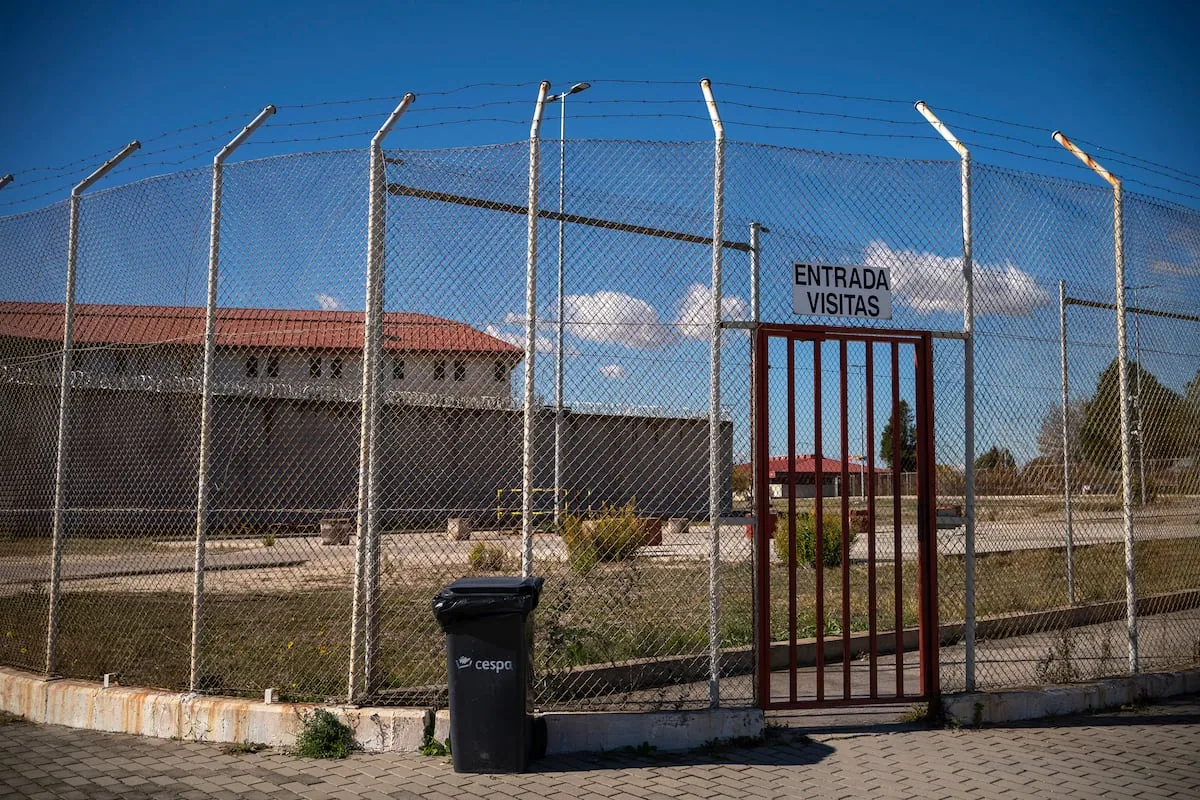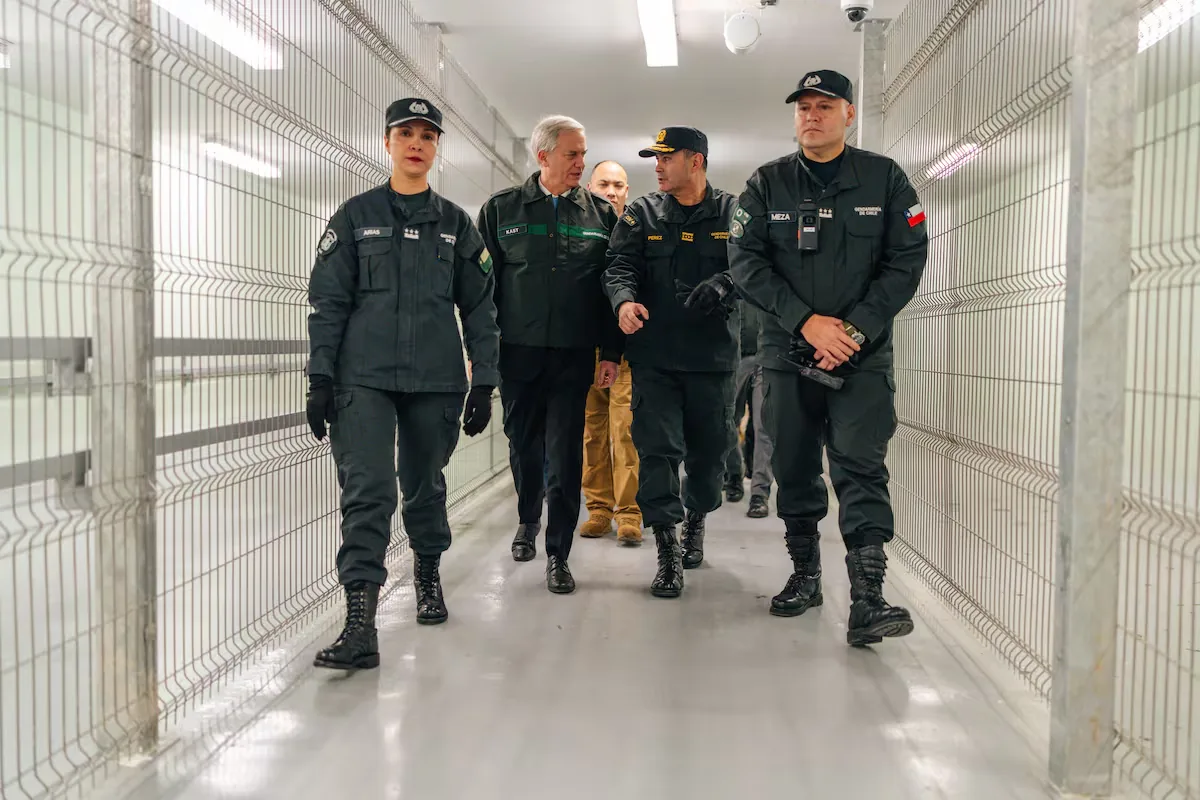
The government of José Antonio Kast began this Thursday, at 6:30 a.m. (local time), a massive transfer of prisoners from Santiago de Chile to the new La Laguna prison, near the city of Talca, in the Maule region. According to a statement from the Ministry of Justice, in the procedure, dubbed by the Executive as Operation Cerberus, 295 inmates have been moved, of which 37 correspond to members of organized crime groups, who will be assigned to maximum security modules under a special regime of surveillance and control. The other inmates, considered especially dangerous, will be located in high-security modules.
The operation, which was carried out by the Gendarmerie and supported by Carabineros, has similarities with those carried out by the president of El Salvador, Nayib Bukele, due to its media staging and the way the inmates have been arranged: seated in rows, very close together, with their hands forward and heads bowed. “Today is a historic day, because from today an important change of hand begins according to the same powers that the Gendarmerie has, but which must be reviewed from a legislative point of view,” said Kast.
This occurs after Kast, in January – three months before assuming the Presidency – visited Bukele in El Salvador, where he asked for advice on prison matters. “We want to ask for your collaboration on issues of improving our penitentiary system, in better understanding your criminal law system, not necessarily doing the same, but, according to our reality, being able to improve,” said Kast, who on that visit took the opportunity to tour the Terrorism Confinement Center (Cecot), the maximum security mega-prison built by the Salvadoran president to keep gang members isolated and where, since 2025, U.S. president Donald Trump sends deportees accused of belonging to criminal groups. The regime of this prison has been denounced by various international organizations, such as Human Rights Watch (HRW), and local ones for torture, abuse, and other human rights violations.
This Thursday, the president of Chile has monitored, in real time, each stage of the operation, something he has highlighted on his social networks, where he is shown in photographs alongside his Interior Minister, Claudio Alvarado; Justice Minister, Fernando Rabat; and Security Minister, Martín Arrau, accompanied by Carabineros and Gendarmerie officials who supervise the transfers through huge screens in a room. “Leaving early to the Maule Region, together with ministers Rabat and Arrau to continue advancing in our agenda against organized crime and terrorism,” wrote the president.
The massive transfer takes place a week after the government presented its Agenda against Organized Crime and Terrorism (ACOT) and after Kast himself and his Security Minister have appeared in police operations. Amid the deployment, the president asked parliamentarians to review how they will implement the agenda against organized crime and terrorism. “We have to see how some situations need to be improved according to the progress of organized crime and terrorism, and that control measures are very strict,” he said.
In that sense, the president thanked some initiatives from legislators aimed at having inmates wear uniforms, not receive packages, and have their visits conducted through visiting booths. “That is something we have been gathering from proposals from various parliamentarians and from the experience transmitted to us by the Gendarmerie and police forces,” he explained.
Read more From Björk to skaters: the viral phenomena after the total solar eclipse
In June, Kast promised, in his first Public Account before Congress, the strengthening of penitentiary regimes to regain effective control of prisons “with cutting-edge technology, rigorous control of access, communications, and the real separation of inmates according to their level of criminal involvement.” After the announcement, that new special maximum security regime began to be applied in at least four prisons in the country, where some of the rules have been that prisoners classified as highly dangerous wear clothing different from the rest of the inmates: orange jacket and blue pants.
The prisoners arriving at La Laguna come from various prisons in the country, such as the Special High Security Penitentiary Facility (REPAS), the main high-security prison in Chile, in Santiago, which faced four unprecedented episodes of disorder and destruction of its facilities by inmates in 2024. They also come from prisons such as Puente Alto, Colina I and II (Metropolitan Region of Santiago), Alto Hospicio (Tarapacá), and Puerto Montt, in Los Lagos. Kast said that about 400 would be transferred in total throughout the day: “It begins with a high-security module so that those inmates have no contact whatsoever with the rest of the prison population.”
The La Laguna prison, located in Panguilemo – about 10 kilometers from Talca – was inaugurated by then-president Gabriel Boric in January 2025. Kast highlighted that this “is a state project, a unit that began to be thought about 15 years ago” and stated that a “radical change must be achieved in how we think about penitentiary policy in Chile, the level of overcrowding exceeds all limits and that requires an effective, rapid way to face it.”
Chilean authorities, concerned about the advance of organized crime, particularly the Tren de Aragua, have considered different formulas to reinforce security in their penitentiary facilities. In 2023, national prosecutor Ángel Valencia said that the creation of a special prison was needed, “like the one that allowed Italy to combat, with full respect for human rights, organized crime.”