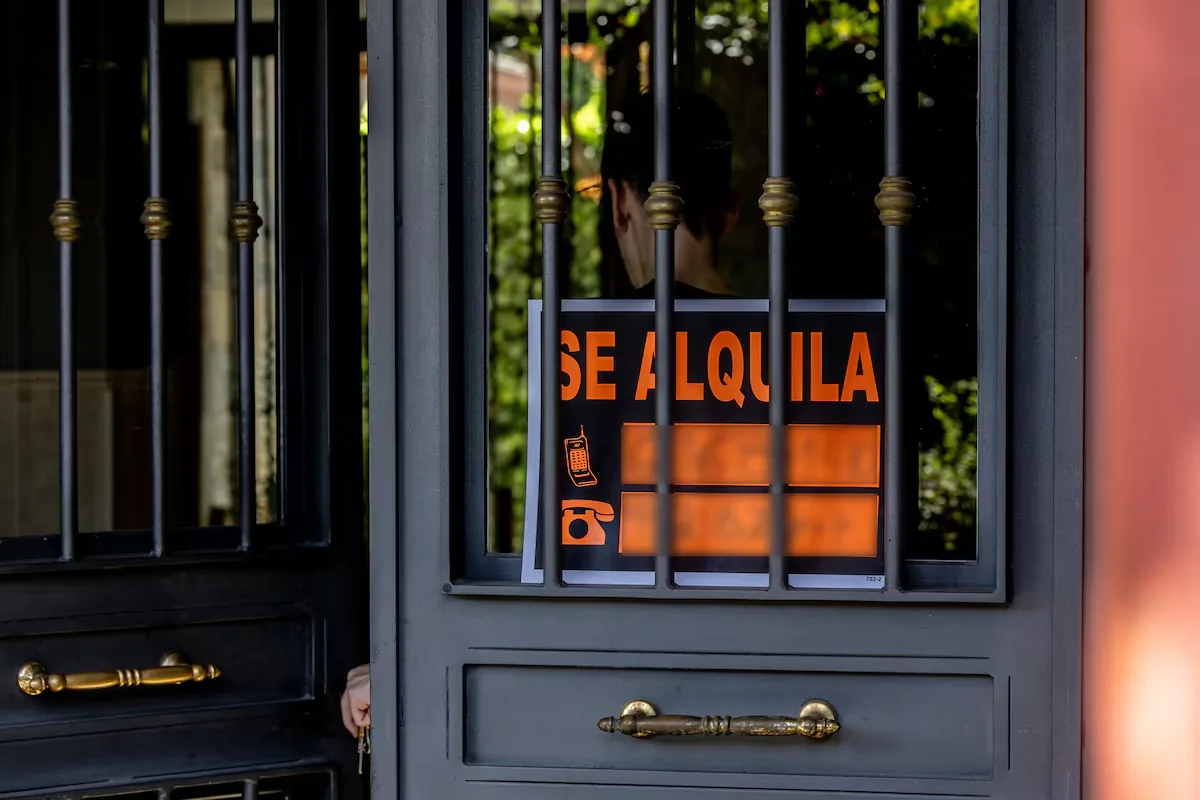
It only takes 20 seconds of searching on a real estate portal to verify that in Madrid even the doorman’s house has become a real estate business. And it is increasingly lucrative. In a building on Doctor Castelo Street, in Retiro, an ad highlights that “the former doorman’s residence has been renovated and currently generates approximately 1,000 euros per month in income for the community.” In another property in Ciudad Jardín, the buyer takes, along with the apartment, “3.32% of the former doorman’s house”: a penthouse that the community is renovating to rent out.
Read more La Aemet warns of an “important” weather change over the weekend: heavy storms after the heat
These are just two examples of an increasingly visible phenomenon in the capital. The spaces that for decades housed those who opened the door, collected packages, cleaned the stairs, and knew the entire life of the building now generate income, reduce community fees, or finance renovations. The doorman retires, an automatic system is installed, and his former house starts producing money. A perfect operation.
“Communities have an asset”
People like Juan Pedro Caro, CEO of Templo Consulting, directly offer the management of the sale of these homes on the internet for 2,950 euros plus VAT. The former employee’s home already even has a marketing fee. For Caro, the growing interest in these properties is explained because communities have stopped seeing them as residual spaces and have begun to view them as assets with their own value. Their sale or rental is already an alternative to improve the building’s finances, although the operation has tax consequences for all owners. “When a disaffection and sale of a property is carried out, a capital gain occurs that each owner must pay,” he recalls.
The impact is distributed according to each neighbor’s participation quota, but Caro insists that this bill must be explained before closing the operation. “Communities are realizing that they have an asset,” he summarizes. From there, the debate arises: keep it and rent it out or put it up for sale.
In the cases managed by his company, the sale is usually related to the need to pay for works in aging buildings. “Building maintenance is usually high because they have to do the Building Evaluation Report (IEE), review all the roofing, facades, sanitation, and also incorporate energy efficiency and accessibility measures,” he explains. The former doorman’s house thus ends up paying for the elevator, the facade, or leaks and often prevents owners from having to face a special assessment.
The disappearance of these homes is causing a massive extinction of the profession. However, the Professional Union of Doormen, Porters, and Urban Property Staff (SPCV) downplays this impression. The organization estimates that between 15,000 and 20,000 urban property employees work in the Community of Madrid — a category that includes doormen, porters, and garage attendants — although it acknowledges that there is no official census.
Read more The ultra-British Farage retains his seat in Parliament after defeating the motley Count Trash Cube
“We do not find a significant reduction in the number of doormen, as colleagues who retire are replaced by new colleagues with the same characteristics,” says a union spokesperson. It also defends that their presence continues to be an added value because “it increases the quality of life of the building’s inhabitants” and enhances the value of the homes. “As seen in real estate portal ads, having a physical doorman is valued, adding a plus of quality and value to the property,” they maintain.
The paradox is served: having a doorman increases the value of the apartments, but selling or renting out his former home does too. The building benefits from his presence and, when the time comes, from the space he leaves free. For Emiliano Bermúdez, deputy general director of Donpiso, the evolution of the residential market has completely changed the role of these properties. “The building that has a doorman’s residence has a small treasure,” he says. The appreciation of the home over recent decades has turned these spaces into a source of income or a store of value. If the community needs liquidity to face a major work, it can sell them. If there are no urgencies, renting them out is usually more attractive: it receives a periodic income without giving up ownership.
According to Bermúdez, in areas like Salamanca, Chamberí, or Retiro, these homes can offer returns between 6% and 8%. Beyond the percentage, he highlights that they constitute “a secure source of income” in a rental market marked by high demand. What was once considered a small attic or a service house is now, in certain districts, an attractive property for which calculations are made with a calculator.
The transformation also reflects the changes experienced by Madrid. Many of these homes occupy attics, lofts, or residual spaces of buildings constructed when the doorman was an indispensable figure for community life. He was not limited to watching the entrance: he knew the neighbors, received technicians, solved breakdowns, and knew who entered, who left, and who had not paid the community fees for months. What for decades was a labor benefit has now become an asset capable of generating income, financing renovations, or reducing the expenses of those living in the building.
The real estate ads themselves tell it without complexes. In one in Arganzuela, it is highlighted that “the community owns an apartment — the former doorman’s residence — currently rented, which reduces community expenses.” In another property in the Salamanca district, it is boasted that “community expenses are only 78 euros a month thanks to the rental of the former doorman’s residence.” In Madrid of impossible prices, even the disappearance of a house can be advertised as a new real estate business.