





Beyond hoarding outstanding decorative objects from around the world, the new branch of the Victoria & Albert Museum in East London, V&A East, is dedicated to creativity as a driver of change. Perhaps that is why it has two locations in Stratford, the former Olympic neighborhood of the British capital. Its director, Tim Reeve, talks about a family of museums. He himself offers a familiar approach to those who sit on the steps of the V&A Storehouse, the museum’s 16,000-square-meter warehouse converted into a gallery by the agency Diller Scofidio + Renfro. Opened last year with more than 250,000 objects on display, from a life-size kitchen by Margarete Shütte-Lihotzky from Frankfurt to Gaudí’s Calvet chair, it may be the most revolutionary in terms of museum architecture built this century. Why? Because it brings the visitor into the warehouse. A few meters away, the other branch of the family is now opening, a civic building that, far from imposing a cultural creed, seems built to listen.
Read more The most enjoyable Griezmann Cup final
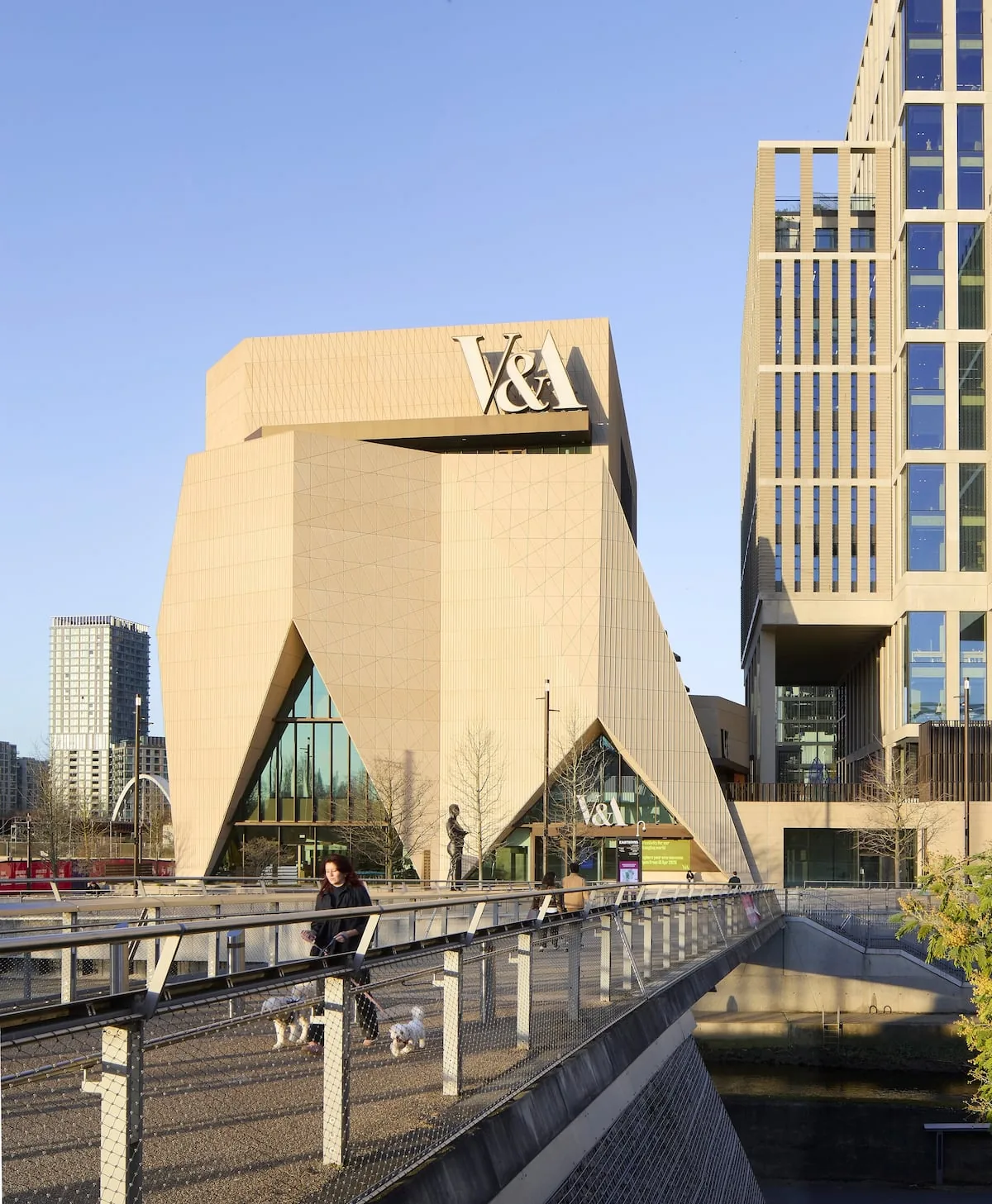
Thus, although its architecture is industrialized, it speaks of craftsmanship. The 479 prefabricated sand-colored concrete panels that make up its facade are all different. However, they are perceived as part of a whole. Echoing the plurality of the multicultural neighborhood it arrives in, the museum is more sponge than pedestal. That is why it speaks of individuality and community from its shell, a skin that changes with rain and sun. “It relates to the neighborhood but maintains its own direction,” explains Irish architect John Tuomey. “The building is, in fact, the most important piece of V&A East,” points out his partner since 1988, Sheila O’Donnell, as we cross the threshold. “The goal is for people who have never entered a museum to feel comfortable here.” How do they seek to achieve this? With a paradoxical combination of mystery and transparency.
The folded and recessed shape of the building is, O’Donnell and Tuomey say, inspired by a Balenciaga dress from the V&A collection. The design by the Getaria couturier wraps the body without barely touching it. That idea of the intermediate space is the key to circulation sculpted into the building’s own skin. Thus, the museum’s dress announces and protects it. The interior is a rational, flexible space because anything — from a plane to a pin — can be exhibited there. In the middle lies the innovation: its circulation.
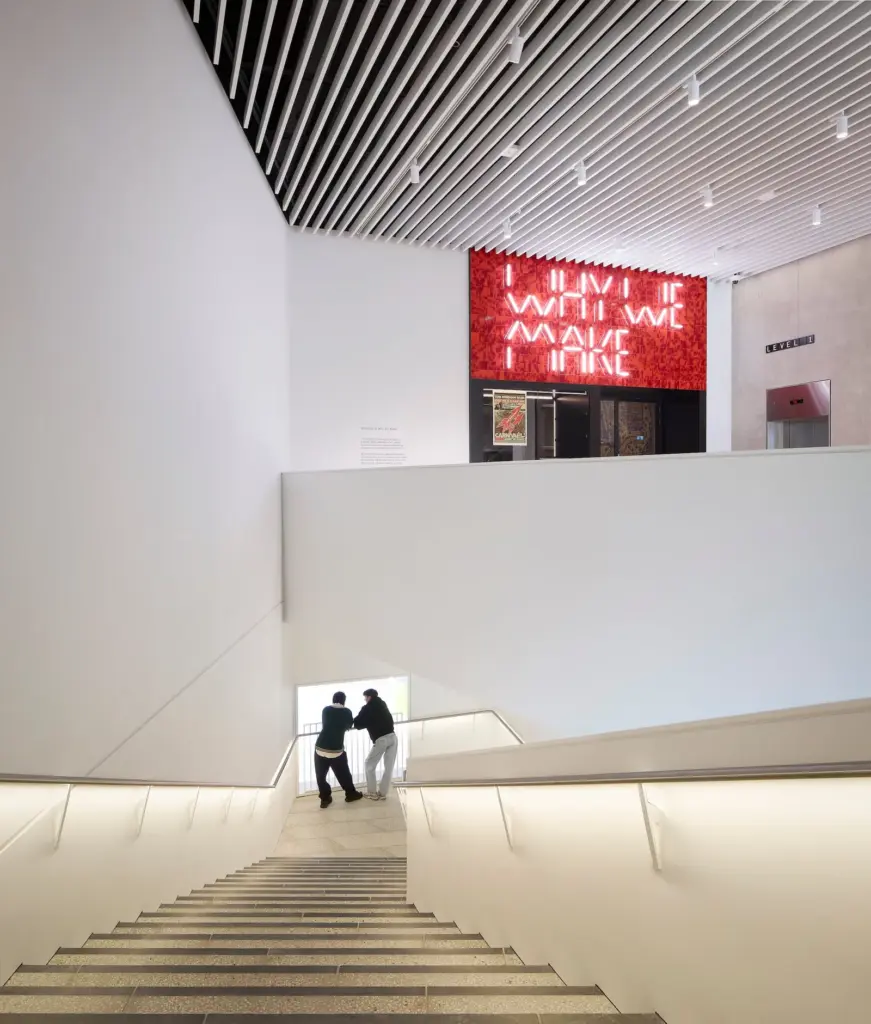
The staircase wraps around the building’s floors, embracing them, following the twists of the facade. In it, two triangular openings, like the V and A of the initials of the monarchs who founded the museum, announce the entrance to the five-story building perceived as a large faceted rock. A large hall displays pieces from the collection, and two others host temporary exhibitions referencing the neighborhood. The café has a cosmopolitan look and prices of a peripheral neighborhood. On the top floor, an auditorium, with access to the terrace, crowns the building. It is up there, facing what is now called Stratford’s waterfront, where one stands and remembers that “the shape of a city changes faster than the heart of a mortal.”
The building will house two permanent galleries and temporary exhibitions. The first is dedicated to black music in the UK
In addition to housing two permanent galleries under the name Why We Make, with more than 500 pieces of art, architecture, design, and fashion with free access, the new building will host temporary exhibitions. The first of these, The Music is Black: A British Story, covers 125 years of black music and explores how that tradition has shaped British culture.
Read more Immigration: the debate that Spain owes to itself
V&A East culminates a transformation, that of the competition called after those grounds hosted the 2012 Olympic Games. O’Donnell & Tuomey won it and devised the master plan for the new cultural neighborhood alongside other architects, such as Allies + Morrison or the Girona-based Arquitecturia. This studio designed the only non-Olympic bridge, and the most notable one, to cross over the tracks that for decades have isolated the neighborhood.
On the other side of the tracks appears the former Olympic Stadium, now the West Ham stronghold. Thus, facing the spectacle of the Olympic footprints — like that football field or London’s aquatic center, designed by Zaha Hadid — the new buildings are approachable, they breathe naturalness. They update the artisan tradition and feel as tactile as visual. Far from acting as a lure, V&A East’s function is to root itself in a new neighborhood without expelling the residents. And, conversely, bringing the world to them. That proposal is admirable. Its realization? More tricky.
To get there from the new metro station, you pass through a shopping center with luxury stores and a casino. On its main artery, people sit with their laptops or a latte as if they were in a staged version of a street with cafés. Although the seats are grouped in spaces named after squares, they are false exteriors: they are covered. They are, in fact, private streets. It is true that there are benches and that you don’t have to buy anything to sit. There are also trees — olive trees, for example — in large planters. What surprises most is that they are real.
Bowler hats stopped being used years ago in a city that, besides being the monarchy’s stronghold par excellence, was the birthplace of punk. However, it is not that plurality that speaks in the new Stratford. Curiously, it was the Victorian era that, with the arrival of the railway and the construction of small industries, turned the place into a Dickensian setting, close to Oliver Twist. On the other side of the tracks, men display printed umbrellas and imitation perfume bottles. Almost all women wear veils. There are many pawn shops and much street vending. That said, the supermarket is Sainsbury’s. Since progress has many faces, artist studios have begun to emerge. If Stratford follows the logic of the whole world, West Ham, on the other side of the tracks, will be perceived closer than ever. And rents will rise. Or… maybe not. Maybe, just maybe, Stratford will not end up gentrified like all urban peripheries that seek improvement.
Read more The day Paul Weller switched sides