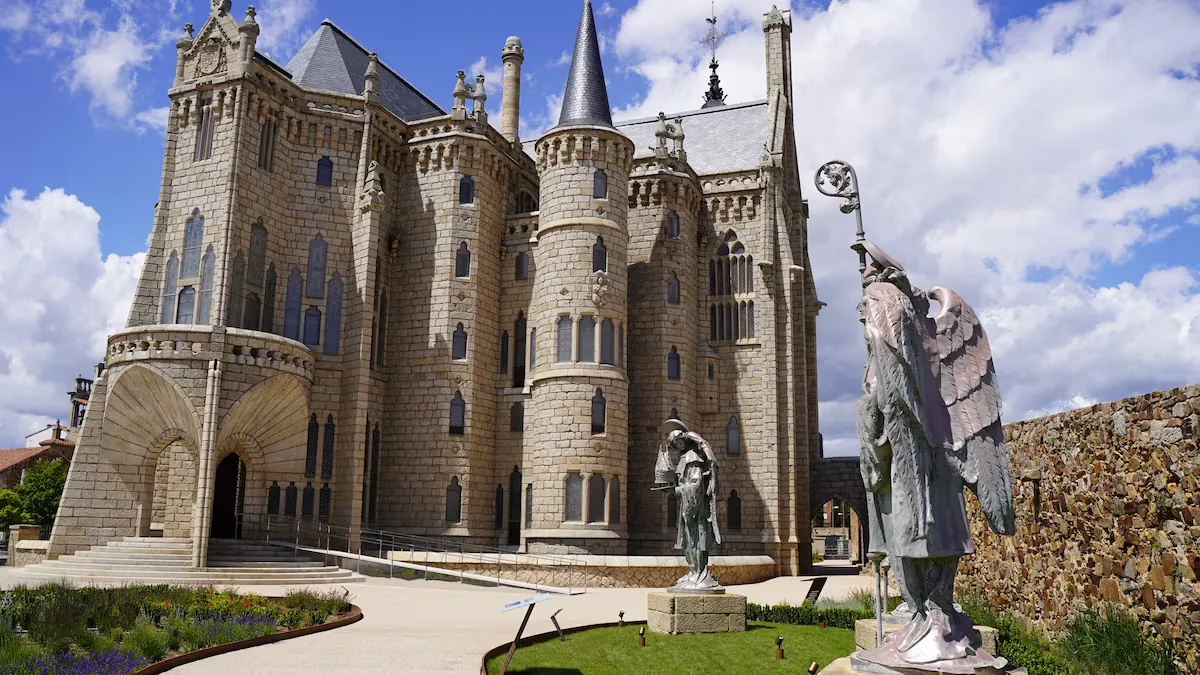
Many pilgrims and tourists are left speechless when they arrive in Astorga. “But this, what is it doing here?” some exclaim, looking up at an unexpected monument. The town in León preserves a rich Roman archaeological heritage and is a symbolic stop on the Camino de Santiago, but it holds a surprise for less informed travelers: a fairytale palace that coexists with the old Gothic cathedral like a fantasy. It is one of the two buildings that the Catalan architect Antoni Gaudí (1852-1926) designed in the province of León, along with the Casa Botines in the capital, also known as the House of the Dragon for its references to the mythological animal. This is an exceptional concentration, as the creator of Barcelona’s Sagrada Familia and modernism genius left only three main works outside Catalonia: the two in León and the villa El Capricho in Comillas (Cantabria).
That is why the Gaudí Year is also celebrated intensely in León. The centenary commemoration of his death, with grand festivities in Catalonia culminating in June with the Pope blessing the new tower of the Sagrada Familia, leaves a trail of activities and interventions aimed at highlighting the two architectural jewels of León, which for many years could not be visited. Casa Botines, inaugurated in 1893, had various private uses until 2017, when it passed into the hands of the Fundos foundation and became a museum. The Astorga palace, completed in 1913, was designed as a residence for the bishop but was never used as such and remained empty until the diocese opened it to the public in 1962. Before that, it had only been used once: during the Civil War, it was requisitioned by the Falangist troops.
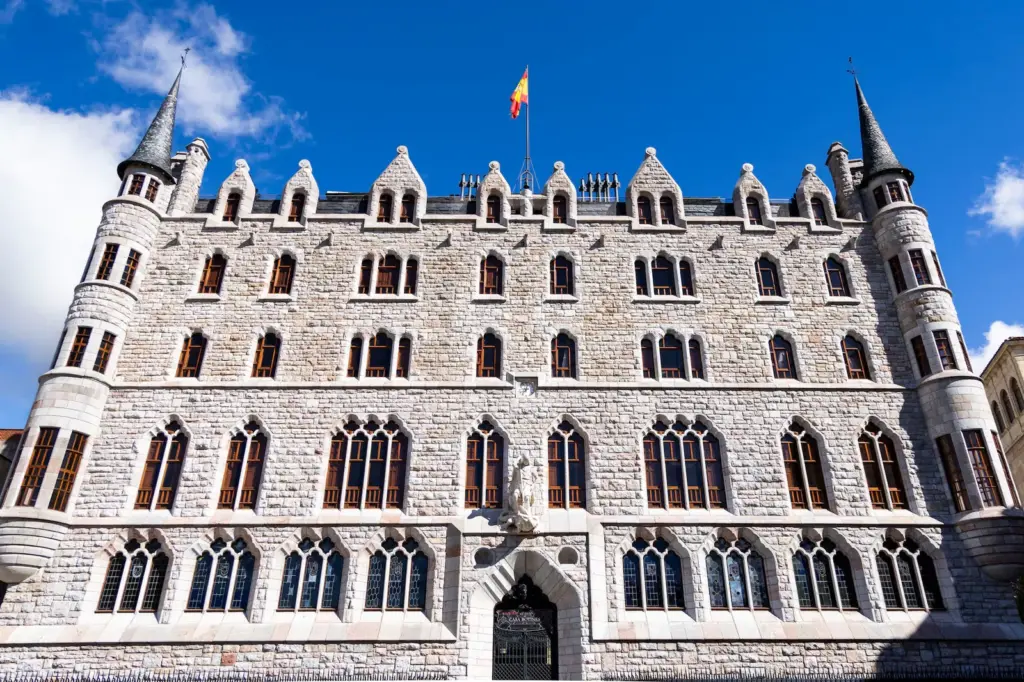
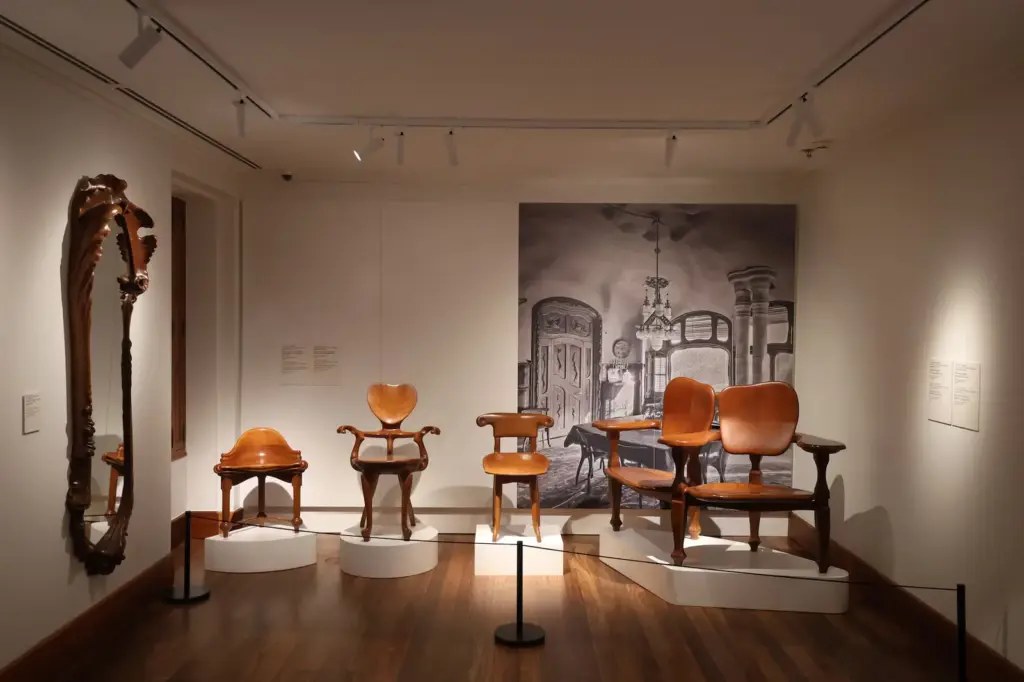
The most important intervention is the comprehensive renovation of Casa Botines and a new permanent exhibition, inaugurated last June, that delves into its history and recovers everyday anecdotes of the building. Built on commission from two merchants from León as a fabric store and residence, the tour through its rooms is an immersion into Gaudí’s universe: stained glass, iron columns, organic shapes, and lots of symbolism. There are pieces of furniture from the first inhabitants, some designed by the architect himself. There are typewriters, office desks, savings booklets, and filing cabinets from the time it was the headquarters of the Caja de Ahorros de León (1929-2017). There are even recreations of the dentist’s office and the tailor’s workshop that rented respective rooms. The third floor houses a selection from the Fundos art collection, with works by Sorolla, Casas, Tàpies, and Chillida.
The secret of the dragon
From the outside, Casa Botines looks like a medieval fortress. “Children often say it looks like a Disney castle,” jokes José María Viejo, general director of Fundos, in an interview at the foundation’s headquarters in León. Stone façade, Gothic windows, turrets, a moat, and a sculpture that recreates the legend of Saint George slaying the dragon and that for many years hid a secret: in the mid-20th century, it was removed for restoration and behind the dragon a lead tube was discovered containing Gaudí’s original plans and a work calendar certifying that the construction lasted ten months, something unprecedented for the time. We can imagine the architect hiding the tube with a mischievous expression, foreseeing the surprise of whoever found it in the future.
But the dragon is not only depicted in that sculpture. Researcher César García Álvarez has developed the theory that the trapezoidal shape of the floor plan corresponds to the arrangement of the firmament on April 23, Saint George’s Day, where the Big Dipper, Little Dipper, and Draco shine. From that perspective, the entire building is a sleeping dragon: the slate roofs imitate the animal’s scales, the main door is an allegory of the mouth, and the iron grilles are interpreted as sharp claws.
The visit also has an added attraction: the rooms are not overcrowded with tourists. There are many, of course, although not as many as those who visit the Sagrada Familia or Park Güell in Barcelona. “Gaudí slow!,” Viejo points out.
Read more Macarena García: “I have spoken very badly to myself, but now I treat myself better”
Since it opened to the public in 2017, the number of visitors has steadily increased. Last year there were 150,000, according to Fundos data. “When we inaugurated the museum, we realized that the people of León were very curious. Many people tell stories of when their grandparents came to the bank, but few had seen it inside. However, there was no awareness of the enormous cultural and tourist potential that having a Gaudí work in the city represents. Our vocation is to consolidate Casa Botines as a reference Gaudí museum,” Viejo explains.
Gaudí’s time in León was very important in his life. The architect, deeply marked by his religious convictions, experienced a kind of mystical catharsis linked to his stays in this province, also marked by his deep friendship with Juan Bautista Grau, a native of Reus, appointed bishop of Astorga in 1886. That same year the episcopal palace burned down and Grau commissioned his friend to design a new one. The works extended until 1913 because construction became complicated after Grau’s death in 1893. The new diocesan team did not know what to do with the building.
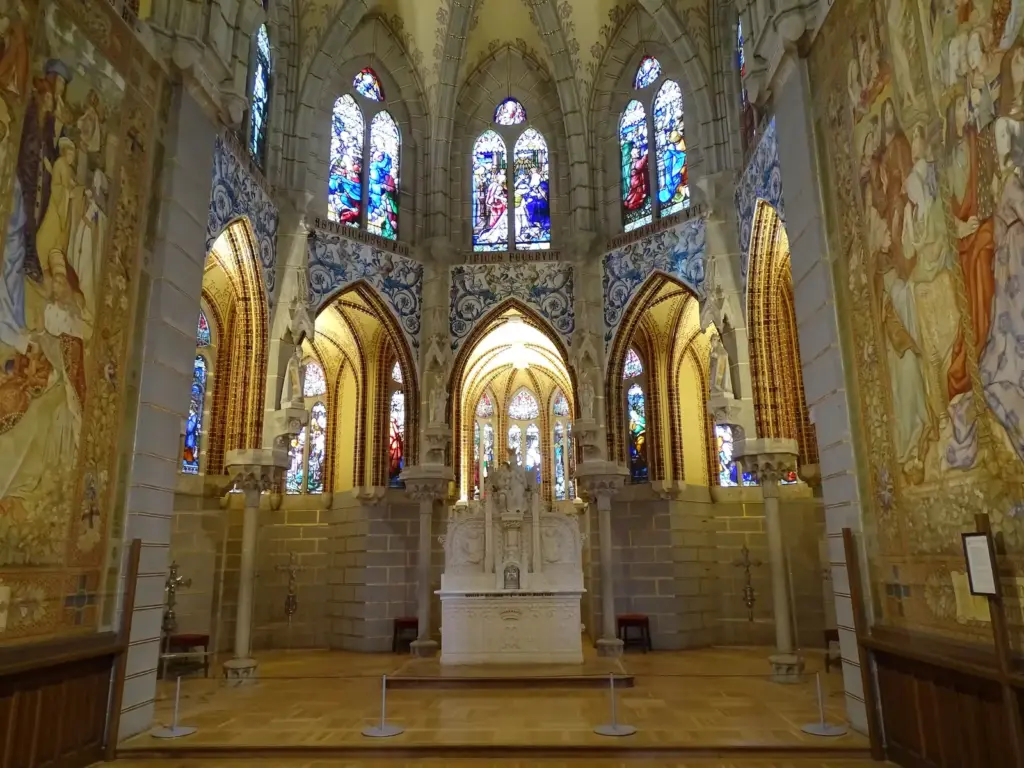
After years of languishing unused, Bishop Marcelo González decided to open it to the public, turning it into the Museum of the Ways, inaugurated in 1964. Dedicated to the Camino de Santiago, it exhibits an important collection of sacred art and offers a unique tour, called The Hidden Palace, to discover the secrets of Gaudí’s architecture: towers, arches, wrought iron, and a forest of stone trees in the chapel that function as columns, an idea that years later reached its fullest expression in the Sagrada Familia.
The palace, which completely transformed the profile of Astorga, is one of the most visited buildings in Castilla y León, with an average of 130,000 visitors per year, according to its director, Víctor Manuel Murias. An important figure for a town of 10,000 inhabitants. “In general, it is not a problem because the city is prepared to accommodate them and because it is mainly seasonal tourism, with strong peaks at Easter and August,” Murias assures.
One of the most outstanding projects of the Gaudí Year celebration in the palace is the installation of three sculptures linked to its history: Antonio Gaudí, Bishop Grau, and Pío Gullón, the economic promoter of the building. So far, the sculptures of the prelate and the architect have already been inaugurated.