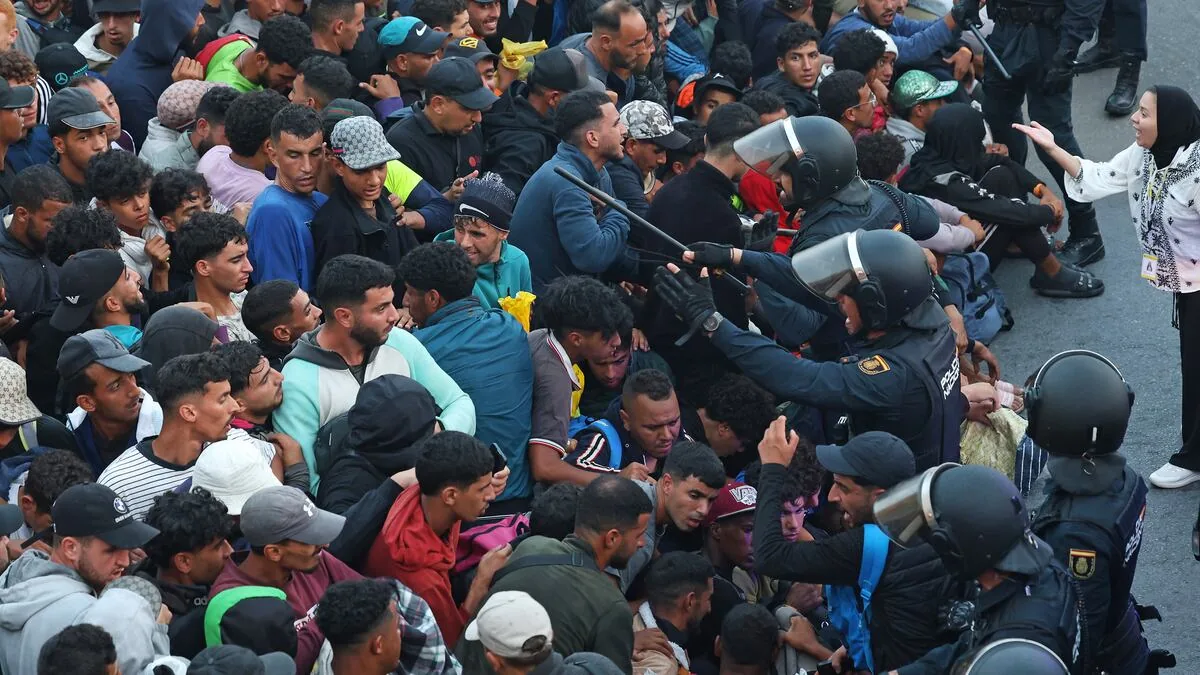
The PP has hit a dead end in its attempt to set the schedule and the appropriate place to hear the Government’s first explanations in parliament about the Ceuta crisis and its consequences. Since the massive crossing of immigrants on July 30, we have witnessed a constant standoff between the Executive and the opposition, in the absence of any initiative for dialogue between socialists and the Popular Party. The political pressure from the PP is logical, while waiting to channel the city’s health situation, but in parallel, some attempt at rapprochement and collaboration would have been advisable given the need to manage the aftermath of the aggression suffered by Ceuta and the situation of the migrants who remain on its streets.
To expect the Supreme Court to resolve a substantial part of the differences that have arisen — such as those related to the Government’s accountability before Parliament — and for its Vacation Chamber to seat the Executive on the Senate “bench,” exceeds any reasonable approach by being excessive. The court itself has ruled this way by rejecting the urgent precautionary measures — without prior hearing of the Executive — requested by the Popular Party, emphasizing that it had not been “sufficiently justified” that for parliamentary control to be “effective,” it must “necessarily” take place in the chamber and on the dates chosen by the claimants.
It is obvious that, as the Supreme Court reasons, “it is not apparent” that the public interest in the “serious migratory crisis” produced in Ceuta will disappear. Hearing the Government does not imply, however, infringing on the parliamentary rights of the Popular Party, specifically its senators. Hence the ten days granted to the Executive to respond to the PP’s demands, considering that in this case there is no “special urgency” that justifies “sacrificing the right” of the Government to defend its decisions. However, other possible Supreme Court rulings remain pending on important aspects regarding “jurisdiction, competence, and admissibility of the procedure” initiated by the PP.
Read more The alternative left to the PSOE stakes out its own ground with a harsh message against Morocco
The order in question is correct, in short, in applying prudence criteria to resolve the conflict raised. Politics often has urgencies that justice must analyze and resolve with temperance and without haste. Initiatives that border on abuse of rights are frequently raised, not only before the courts. The PP, which has not managed to articulate a parliamentary alternative that would allow it to present a motion of no confidence — for which it has so often called on other groups — has often acted anxiously in the Senate, trying to use its majority in this chamber in hardly defensible terms, to the detriment of other political forces. This has happened with initiatives to reform the regulations, in the context of a continued conflict with the Congress in this legislature.
With this dynamic, the tension between parties has extended to acquire other profiles, those of an institutional crisis affecting very sensitive areas of the system. This situation should be stopped. Regarding Ceuta, it makes no sense to open a controversy about the powers of the King and the Government in foreign policy. The PP, which was so opposed at the time to the possible intervention of Juan Carlos I in the crisis of the Perejil Island, now fuels the controversy over possible initiatives by Felipe VI regarding the conflict with Morocco over the “attack on the territorial integrity” of Spain, as Pedro Sánchez defined the events of last July. The important thing about a visit by the King to Ceuta is that it is useful for its citizens, and it is obvious that for this, the Royal Household and the Government must act hand in hand.