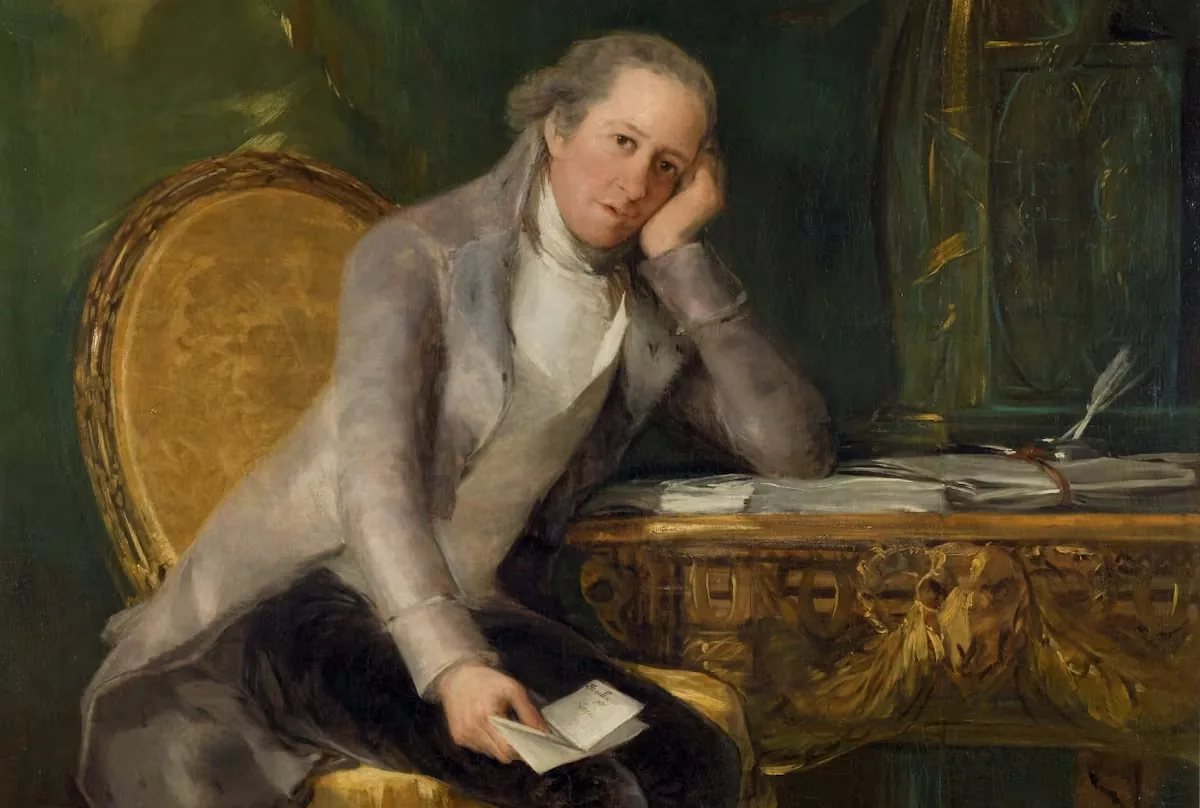
It is undoubtedly a posthumous justice that posterity has shown Gaspar Melchor de Jovellanos (Gijón, 1744-Puerto de Vega, 1811) a sweetness far superior to that shown to him by life. Not in vain, Jovellanos’ centrality in Spanish Modernity cannot be explained by the material legacy of his political positions: barely nine unhappy months as Minister of Grace and Justice (1797) and another fifteen, not much easier, in that embryonic Supreme Central Junta (1808) of the Cádiz Cortes. The accounting of his misfortunes, in fact, was to be much more substantial than these worldly successes: if he first suffered seven years of postponement in his native Asturias, he would later endure seven years of unjust imprisonment in Mallorca. His death in 1811, in the depths of the war and fleeing the French, has only added a noble pathos to his figure.
Read more Moda agosteña de Flavita Banana: el tanga
Frustrated in his life projects, political hopes, and enlightened ideals, on the threshold of a Spain that was going to burn in crossed intolerances, Jovellanos has been able to rise as an effigy of a certain Spanish tragedy. And, disliked by the radicals of his time, even as a proto-martyr —as posited, with grateful caution, by Benigno Pendás— of any notion of Third Spain. The Goyaesque iconography, which shows us the gravity of a man overwhelmed by political melancholy, is one of the sweetnesses that posterity reserved for Jovellanos, but also one of the images that encapsulate our History: what would have become of Spain without the two men, Jovellanos and Goya, the most beneficial of their time? What void would we have when it comes to knowing the last eighteenth-century splendor, the enlightened ambitions, the disasters of (and resistance to) the war?
It is hardly strange, then, and also just, that Jovellanos has survived among us, above all, as a myth. As we have seen, in his worm-eaten politics, he had very little power. And in Jovellanos. Ilustración para españoles, Pendás is realistic about his bookish reach: the Report on the Agrarian Law or his various Memoirs may astonish for their enlightened spirit more than captivate as literature. The Asturian dignitary has also been harmed by the reputation of a century that has never satisfied our progressives and always caused the ridicule of our traditionalism. And if, in general terms, he is affected by the very improvable fame of eighteenth-century letters, in particular he has been affected by a solid tradition of poor editions. This flaw has not only been happily resolved in recent decades, but —with his magnificent Diaries— for the first time it can be said that Jovellanos is a read author. Nevertheless, for pedagogical purposes, and if we want to emulate Jovellanos’ own enlightened aspirations, perhaps we should anchor him in the subject of History rather than Literature.
Post mortem, Jovellanos embodies the rarity of a consensus, if not unanimity, by which the most diverse Spanish ideological affiliations would have been orphaned without the Asturian
One of the many merits of Pendás’ biography consists precisely in mapping the projection of his myth in History. For Moreno Alonso, “the absolutists saw in Jovellanos the shadow of a Jacobin,” and “the most radical liberals considered him outdated.” Post mortem, however, Jovellanos embodies the rarity of a consensus, if not unanimity, by which it seems that the most diverse Spanish ideological affiliations would have been orphaned without the Asturian. Menéndez Pelayo, not given to dispensations, considers him a staunch traditionalist. Díez del Corral, a doctrinaire liberal. Fernández de la Cigoña, a counter-revolutionary. Fraga turns him into a star of his El pensamiento conservador español. Juan Cueto slides him into Asturian nationalism. And others have highlighted his feminism, brought him closer to Azaña, or made him a prophet of republican values. Jovellanos’ very complexity fosters so many and such different interpretations: after all, he was, according to Sánchez-Agesta, a man “religious and touched by Jansenism, lord and detractor of lords, landowner (..) and disentailer, old-fashioned and wary of encyclopedism, universal and provincial.” In short, not to go further, Jovellanos can make a moderate scholar like Pendás dedicate a biography to him, a poet from Izquierda Unida like Luis García Montero dedicate a poem to him, and those verses appear in the book.
Read more Lymphatic drainage: all about the star massage of the summer
Jovellanos’ moral garments in adversity, as well as his very pragmatic enlightened resolution —“to open a path and found a school”— have always had much to do with the plural admiration that fame has granted him. That does not imply that he did not have a bundle of contradictions, as has been said, which —that much— he managed to harmonize successfully. The man who notes “reading Gibbon. Fireplace. Conversation” in his diary is the same who will not leave Kempis in moments of distress. And the sophisticated and modern intellectual who reads Bentham, Beccaria, Adam Smith —four times— is also an enlightened man who, like Burke, positions himself against the revolution. Enlightened, yes; illuminated, never. At the supreme hour, Jovellanos is offered to collaborate with the French at a moment, as the poet Quintana wrote, when “we all thought in the French way.” Jovellanos then refuses “the flattering suggestions and offers of friendship and power” and, without any protection, will defend “the cause of my country, (…) which may be reckless but is at least honorable.” He had already had the lucidity to see Napoleon as the “tyrant of Europe,” but it will always be astonishing to think of the anguish that a “modern, European, enlightened and liberal” Jovellanos would have felt seeing the admired French behave “like a barbarian invader and a plunderer.”
“There was Enlightenment because there were enlightened people,” Pendás concludes, in a statement difficult to refute
The fifty pages of commented bibliography —a Benedictine work, worthy of the enlightened Feijóo— endorse the stature of a biography that does not want to be academic and perhaps for that reason is written in magnificent Spanish. The Jovellanos bibliography is large and abundant. The distinctive and commendable aspect of this work by Pendás lies in tracing a Jovellanos as much his own as convincing: saint founder of our moderantism, “germ of the Spanish doctrinaire liberalism that culminates in the institutional politics of Cánovas,” historicist liberal in the manner of Burke and bridge between “enlightened reformism and bourgeois liberalism.” This point is important insofar as, as Fusi states, “enlightened reformism articulated the Spanish nation” or, as Pendás nuances, “creates a State for a nation that does not reach political dimension (…) until the nineteenth century.” Jovellanos thus represents an invitation to review clichés about a Spanish Enlightenment that, according to Pendás, was, as in other countries, “an active minority (…) strictly in line with Modernity,” with no other exceptionality than “a deep-rooted Catholicism” and the limited international diffusion due to the loss of political hegemony. There will undoubtedly be dissenters of this thesis: there already were, like Ortega. But the debate is important, because “if there was Enlightenment in Spain, we are a country like the others (…); if there was not, not only do the defenders of eternal Spain win, but also (…) those who revel in the historical failure of an impossible nation.” “There was Enlightenment because there were enlightened people,” Pendás concludes, in a statement difficult to refute. And perhaps for that enlightened purpose, Jovellanos, long after, remains greater as hope than as tragedy.
Read more Successes and risks of tourism
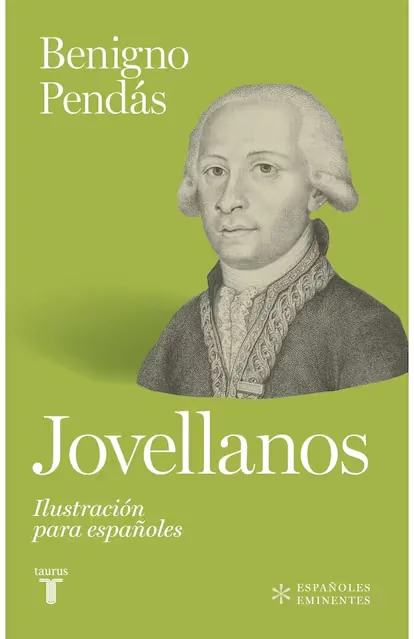
Jovellanos. Ilustración para españoles
Taurus / Fundación Juan March, 2026
568 pages. 23.65 euros