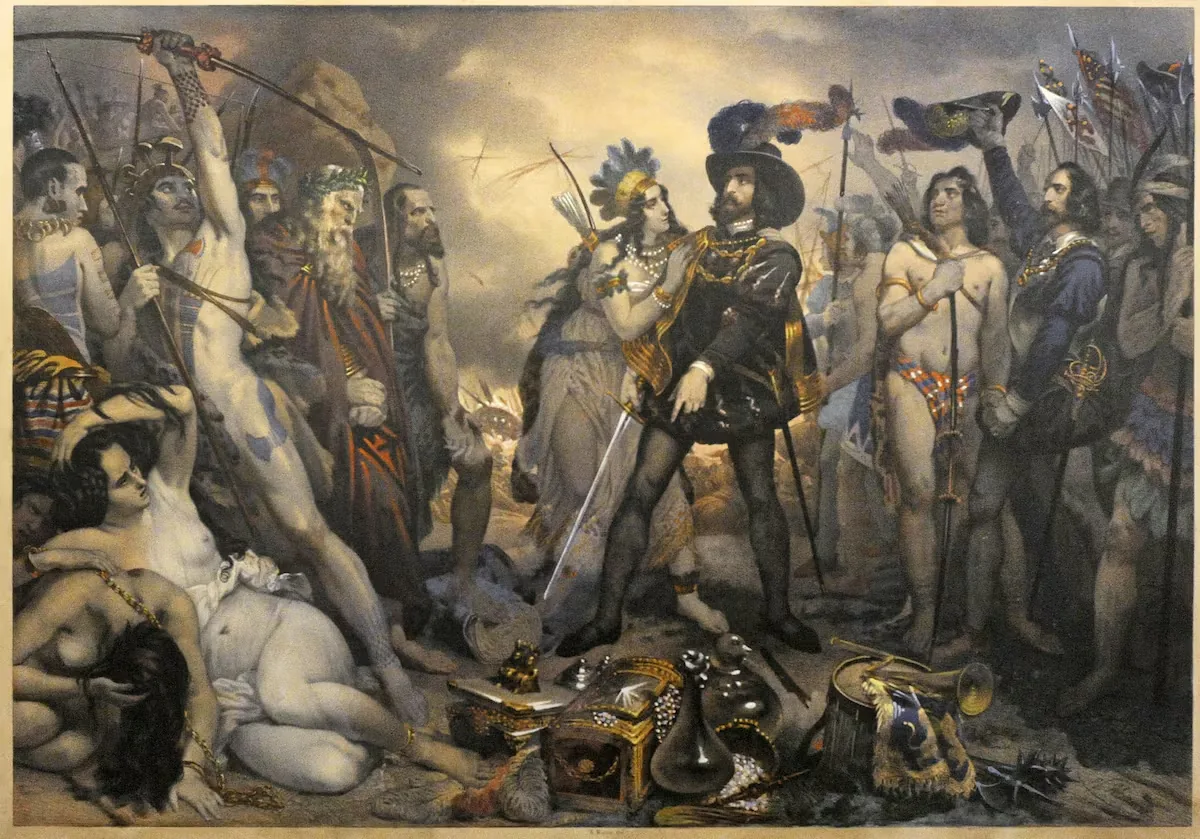
Alejo Carpentier, a profound connoisseur of the origins, essences, and behaviors of the identity of the New World, author of the identity concept he called “the marvelous American real” — which he also stylized in his novels — stated that the “discovery” of America, which materialized in 1492, was the most transcendent event in history, since from this encounter man finally had full knowledge of the world in which he lived. And what happened from that moment changed everything. For everyone.
Read more Rude children and parents who don’t know how to raise them: a statement that deserves to be reviewed
Many were the disruptive events and phenomena that followed since then. As is known, after the Columbian discovery, the conquering effort drastically and fiercely transformed the lives of the original inhabitants of the American continent, where not only was another worldview implanted, but violence was used to do so and, as collateral damage, diseases were introduced, processes that reached levels of genocide, such as that suffered by the indigenous Cuban populations, among others. But, of course, the American adventure also altered the physiognomy of European societies, from those directly related to the conquering action to those populations that could begin to satisfy their famines with the various benefits coming from the other side of the Atlantic. Remember the life-saving potato.
Undoubtedly, two of the most dramatic conquest processes executed, considering the enormous amount of sociohistorical transformations they generated, were those that occurred in the lands of Mesoamerica, inhabited by cultures grouped under the names of Mayas and Aztecs, and the one that occurred in the southern part of the continent, in the gigantic Inca empire, the Tahuantinsuyo.
The irruption caused a historical tsunami that altered the course of the original cultures, transformed by blood and fire, since along with the evangelizing cross came the seekers of riches
In all cases, the irruption of a civilization that was at a technologically superior level of material and cultural development, undoubtedly, and theologically in the monotheistic religious stage, caused a historical tsunami that altered the course of the original cultures, transformed by blood and fire, since along with the evangelizing cross came with the invading hordes the material violence of the search for riches generously found throughout the territory of what would soon be called The Americas.
Such conquest campaigns and the disruptive convulsions they generated revealed their historical importance — tinged with the amazement of the barely conceivable, but many times supported by the ideological justification of evangelization which, as was repeated again and again, would promote the salvation of so many infidels alien to the true religion — provoked the writing of a varied and abundant literature. In this literary corpus, known as the chronicles of the conquest, there was everything: from more or less official letters and documents — inaugurated with Columbus’s letters to the Catholic Monarchs and crowned with those of Hernán Cortés about the conquest of what would be the Viceroyalty of New Spain — to documents as indispensable for understanding the dimensions of what happened as the two volumes of the Comentarios reales, by the very gifted writer Inca Garcilaso de la Vega, about the Andean empire and the events related to its fall, followed (as almost always happened) by disputes among the newcomers, and the work of the very memorable soldier Bernal Díaz del Castillo, emphatically titled True History of the Conquest of New Spain, which was published in 1632, almost 50 years after the author’s death.
When in recent times several of those events and processes, which occurred half a millennium ago — in another world, in another system of epochal ideas and concepts — have once again become political controversy with score-settling included, the publisher Libros del Asteroide has put into circulation the substantial work of Bernal Díaz del Castillo. Preceded by a well-documented prologue signed by Jordi Gracia and crowned with an enlightening epilogue written by Andrea Martínez Baracs, this 2026 edition of the True History… is presented with a daring adaptation. It is an edition to which, with the help of the specialist in medieval and Renaissance Hispanic literature Lorenzo Martín de Burgo, the 16th-century lexicon has been modernized (“rendered into current Spanish”) and chapters considered repetitive or tedious have been eliminated or condensed. The explicit purpose of the managers has been, therefore, to make a classic piece more accessible to contemporary readers.
The bold bet to modernize the 16th-century lexicon may bring closer readers who would hardly be attracted by the magnetic yet thorny immersion in this document
Debatable, of course, may be the exercise of the editors and specialists. And although many times the end does not justify the means, I, personally (after reading, with the original text in my affective memory), welcome such a bold bet that will surely bring closer readers who would hardly be attracted by the magnetic yet thorny immersion in this indispensable document within the historical panorama of Hispanic letters and the history of a germinal relationship of Europeans with the world completed with the Columbian expedition.
From its very title, this work expresses intentions: to narrate what the author considers the truth of a history that has already begun to be manipulated by certain interests, either due to lack of information or, at times, even more murky issues, such as certain relations of power and material and historical benefit. It is no coincidence, then, the barrage of darts thrown at the General History of the Indies, by Francisco López de Gómara, published in 1552, a few years before Bernal Díaz began writing his chronicle.
Such intention is appropriate to attempt a synthetic assessment of the qualities of all historical writing. And although this discipline is considered a “social science,” the truth is that its scientific nature is often questioned. Because, to begin with, it carries a very real stigma: history is written by the victors (and this is the case), a condition to which its classist writing character must necessarily be added, influenced by economic, epochal, and above all ideological judgments and prejudices from which the historian can never detach, not even if he proclaims that he reveals the truth and even documents it.
In this case, it is necessary to note that Díaz del Castillo works with the advantage of physical proximity he had to the narrated events since he was the only European who participated in the three expeditions that completed the discovery and subsequent conquest of the territory, already led by Hernán Cortés, which would end up concretizing the fall of the power of the Mexicas of Tenochtitlán. However, it is also necessary to warn of the disadvantage of his partiality, for having been, precisely, an actor in the events, and although he writes his account with the purpose of establishing a truth, this will always be contaminated with the original sin of his historical and cultural condition (his ideology) that impregnates him with a worldview, adorned with intellectual traits as visceral as religion.
The capital of the Mexicas, the lacustrine city of Mexico-Tenochtitlán, housed about 300,000 inhabitants when Paris reached 200,000
One of the most notable literary values of Díaz del Castillo’s work lies in his narrative ability to create dramatic tension despite dealing with a known story. And, on the conceptual level, his mediated yet perceptible understanding of what that conquering campaign meant. Let us remember that the capital of the Mexicas, the lacustrine city of Mexico-Tenochtitlán, housed about 300,000 inhabitants when Paris reached 200,000. It was a highly stratified society, with strict controls over its inhabitants and despotic with its overwhelmed neighbors, but economically prosperous and advanced in very diverse human activities. Hence the chronicler’s admiration for so much beauty, opulence, and social organization that runs throughout the work, allowing him to affirm that they could “see things never heard of, nor seen, nor even dreamed of, as we saw,” since “they seemed like enchanted things told in the book of Amadis,” but without ceasing to justify, again and again, the civilizing character of a process he assumes as a great historical and spiritual necessity.
At the same time, the soldier-writer does not hide the plundering that animated the much-mentioned civilizing action. It would be worth counting the times words like gold, silver, riches appear in his chronicle and noting the complaints about the unfair distributions made of them. Nor does he hide many misdeeds of the Europeans, atrocities such as, among many, the enslavement of the indigenous, branded with a hot iron like beasts, and much less the internal disputes among the invaders… and, of course, the fate of expeditionaries like him, burdened with the countless scars he took from the battles in which he intervened and who, in the end, barely receives the leftovers of the great loot obtained.
It is no coincidence that in the final stretch of the chronicle, after the capital of the Mexicans was taken, Moctezuma long dead, even his successor Cuauhtémoc assassinated, while Bernal Díaz continues noting the many “benefits” brought by the arrival of the Spaniards to lands of idolaters, he also recounts how the shameful feast of scams into which the conquering campaign degenerated begins among the Europeans. And so Bernal Díaz notes when he reflects: “Here you will see how much distance there is from the old conquerors to the recently arrived from Castile, who do not know what the Indian war and their tricks are. This is how that conquest ended.”
Well, it seems so: as always, in history some win more than others and some get rich. But the great losers were not those who failed to obtain more riches or more Indians entrusted to them. They were civilizations that, due to ambitions and fanaticisms typical of an era, suffered a historical catastrophe. And I repeat: as always, since ambitions and fanaticisms are also present in our 21st century, while for today’s readers a history announced as true is reissued, modernized.
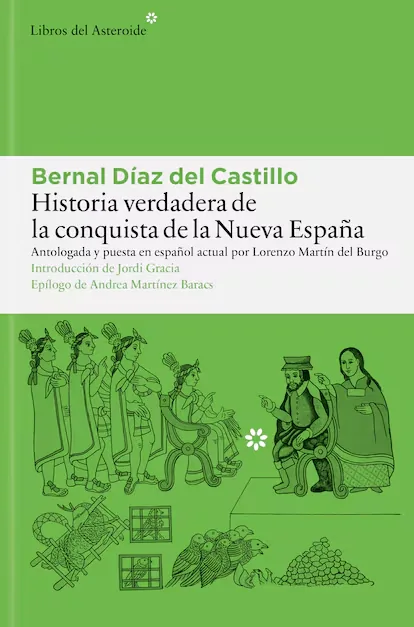
True History of the Conquest of New Spain
Anthologized and rendered into current Spanish by Lorenzo Martín del Burgo
Introduction by Jordi Gracia
Epilogue by Andrea Martínez Baracs
Libros del Asteroide, 2026
552 pages. 24.95 euros