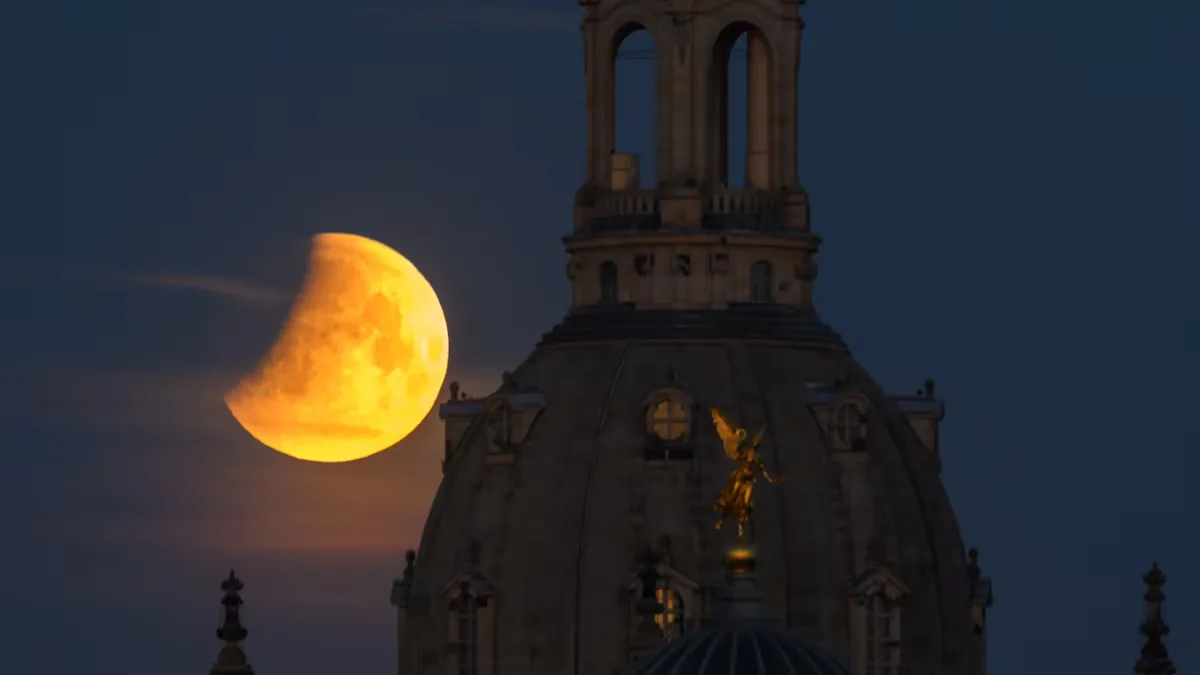
In the early hours of August 28, the Moon’s transit through the Earth’s shadow will cause a partial eclipse. A lunar eclipse has not been seen in Spain since September 7, 2025, although on that occasion it was total in a large part of the territory. Our planet’s natural satellite was tinged with an ocher tone that time, as will also happen in the early hours of this Friday. A color, according to experts, similar to Earth’s sunsets.
Read more The endless war between Marlaska and Robles
What time will it be?
The partial phase will begin around 4:34 AM on the 28th (Spanish peninsular time), when the Earth’s shadow will gradually begin to engulf it, reaching its maximum at 6:12 AM. At this maximum, the Moon will take on a reddish hue, becoming a ‘Blood Moon’ as it moves westward.
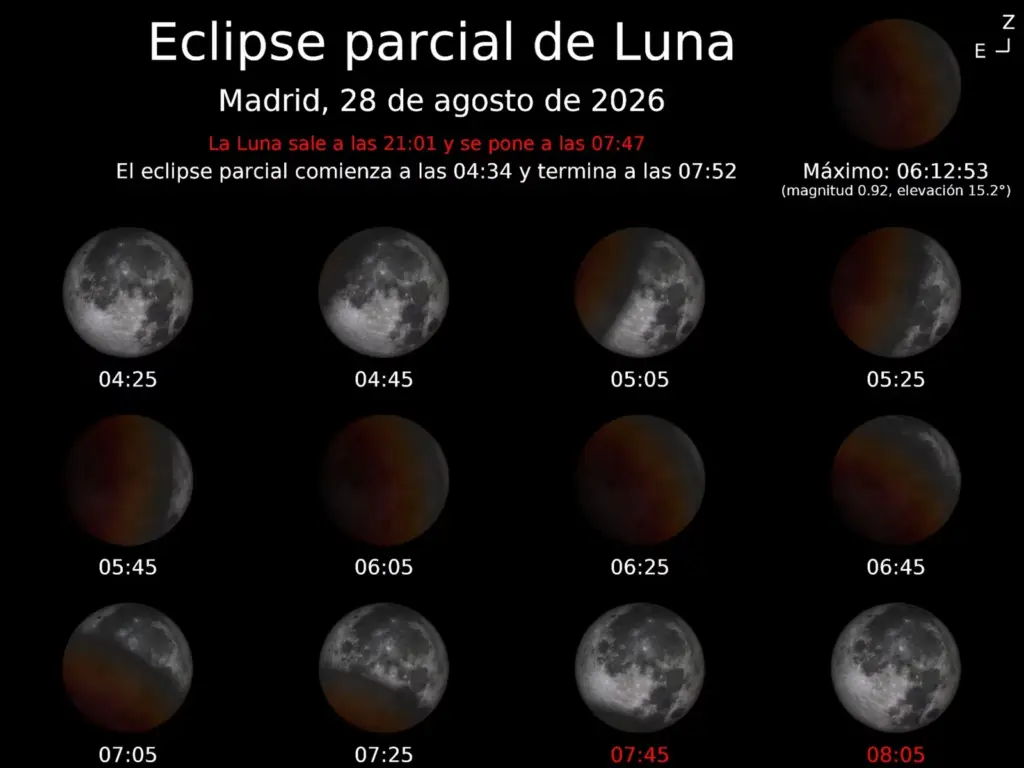
Astrophysicist Javier Armentia details that, from the afternoon of Thursday the 27th, the full Moon will occupy the great black canvas, but, as the hours pass, its shape will mutate. “From approximately 4:25 AM (peninsular time), you will start to see that the full Moon is missing a bit on the left side and from above, with a curve that is not typical of lunar crescents,” he explains. The Earth’s shadow will cover the lunar disk until it reaches its maximum occultation. “The most beautiful moment is the maximum, which is when we barely see a full Moon. We only see that red Moon,” he points out.
Where can it be seen?
According to the National Geographic Institute (IGN), the phenomenon will be visible from Europe, Africa, Western Asia, and America. In some places, it will be total, while in others, partial, as in Spain. Armentia explains that, although it can be seen from all over the country, the experience will vary depending on the observation location, so some areas will be able to enjoy more phases than others.
“More or less from Asturias to Malaga, the Moon will set below the horizon before the eclipse ends,” the popularizer details. In places like Pamplona or Madrid, the end will not be seen. Neither in the Balearic Islands nor Melilla. By that time, the Moon will have already set below the horizon, and on the other side, the Sun will have risen.
However, in the peninsular west, a more complete view will be had. “In the westernmost part, in the provinces of Huelva, Seville or Cadiz, in Extremadura, Salamanca, Zamora, Galicia, and part of Leon,” Armentia states. In the Canary Islands and Ceuta, the lunar sunset will also arrive after it has finished.
Read more The battle for spaces to house migrants prolongs the Ceuta crisis
🌘 August sky gives us a last phenomenon!
— Agencia Espacial Española (AEE) (@aee_gob) August 25, 2026
On August 28 we will witness a Partial Lunar Eclipse: it will graze totality with 93% obscuration.
👁️ 100% safe with the naked eye.
📍 Visible from all over Spain before dawn.
🔭#EclipseDeLuna #AEE pic.twitter.com/V6bLAFtKYm
The eclipse will be partially visible in a wide strip extending from the Middle East across Europe and Africa, while on the other side of the Atlantic, conditions are different. “From South America and Central America, they will see it completely,” Armentia emphasizes. The time difference will mean that, while in Spain the eclipse coincides with the last hours of the night and dawn, in a large part of America it can be observed during the night of August 27-28. “When it starts, there it will be before midnight, as for example in Argentina,” adds the popularizer.
How to watch it?
A lunar eclipse can be observed with the naked eye, just like looking at the satellite on any given night. It is not necessary to use glasses as in a solar eclipse. However, using a telescope helps to observe in greater detail the contrast between the illuminated part and the area that remains under the Earth’s shadow.
During the maximum, when the sky begins to lighten, the reddish hue of the Moon will still be visible. “It is sunlight, but filtered by the Earth’s atmosphere,” explains Armentia. Part of that light passes through the atmosphere and reaches the satellite, in the same way that sunsets acquire reddish tones.