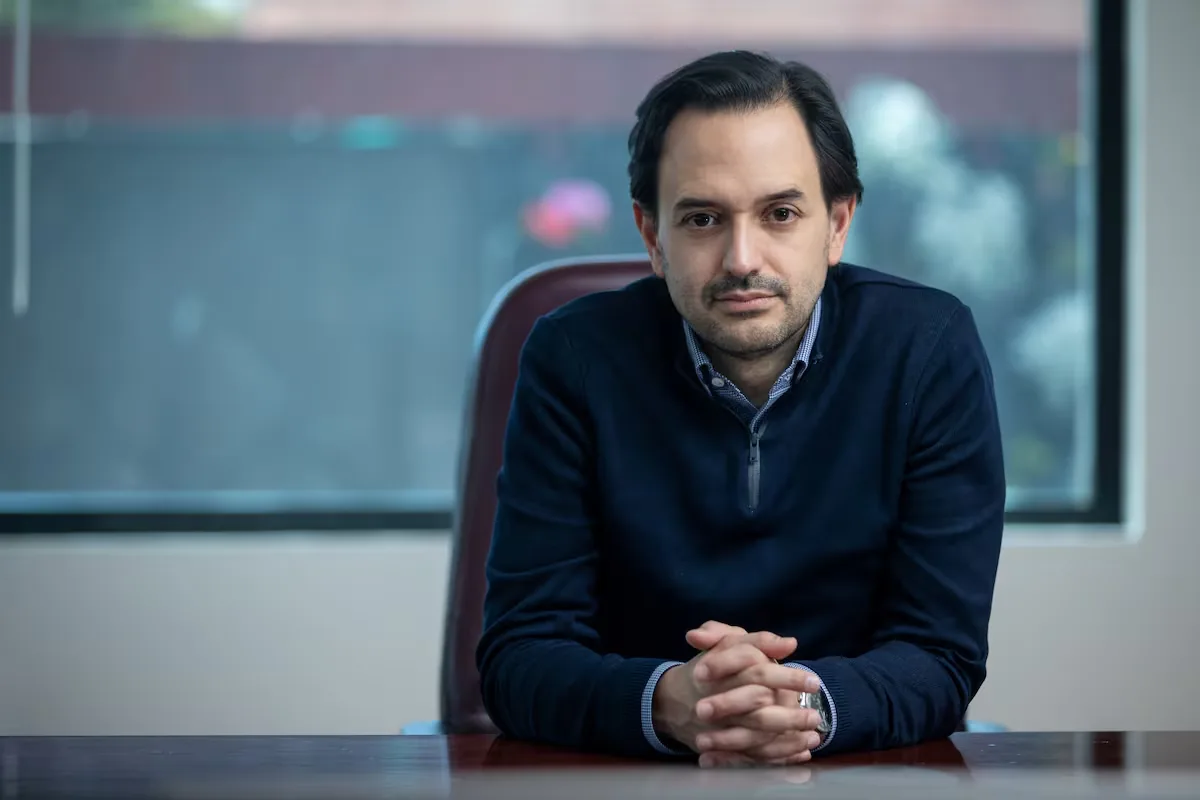
When Diego Mesa Puyo (Medellín, 44 years old) received the call confirming his appointment as Executive Director of the Global Environment Facility (GEF), he was at home working. His wife, Margarita Penagos, was by his side. “We celebrated right there,” he recalls.
Read more Jimena Cangrejo, the leader who pacified the Siloé neighborhood in Cali
To reach that moment, he went through a six-month process competing with 270 candidates, took a series of written tests and an interview in Paris. He also had the support of the Governments of Colombia — with a letter of recommendation from José Manuel Restrepo, his teammate in the Duque government and then vice president-elect — and Canada, the country of which he became a citizen after completing his postgraduate studies. Finally, on July 31, the GEF board elected him by consensus, and he will assume the position on October 1.
Mesa is an economist and, despite being away from the country for more than 20 years, he still defines himself as Paisa and a fan of Atlético Nacional, and his unmistakable accent explains it. That identity, he insists, he does not abandon for anything. It was in Medellín, with his family, where he found his vocation for public service: his mother, Silvia, was a prosecutor, attorney, and judge. His bridge to the private sector has roots in his father, Jaime, a dedicated merchant. “It was something I grew up with and that showed me economics as a path to serve in public matters impacting the community,” he says.
One fund, 186 countries
“The GEF is globally important because it is the official financing mechanism for the major multilateral environmental conventions,” Mesa explains. These include the Paris Agreement and the Convention on Biological Diversity.
The Antioquian takes on a titanic task that includes leading the Global Biodiversity Framework Fund, the Fund for Least Developed Countries, and the Special Climate Change Fund. Its resources — about 3.9 billion dollars financed by 14 advanced economies that contribute every four years — reach more than 160 low- and middle-income countries through non-reimbursable loans, meaning they do not generate debt. Colombia, which currently has projects underway worth nearly 220 million dollars through the fund, will have one of its own at the head of the institution for the first time.
The path that brought him here
Mesa Puyo’s route to the GEF included stops in Medellín, where he began studying Economics; Montreal, where he transferred in his third semester to finish and do postgraduate studies; Washington, for his first stage at the International Monetary Fund, where he worked on fiscal management of natural resources; Bogotá, at the Ministry of Mines and Energy; and since then, back in the U.S. capital and the IMF, this time as Deputy Director of Climate Policy. From this position, he advised the governments of more than 40 countries.
Read more Julia Salvi, the woman from Cali who put Colombia on the international classical music scene
During his time in the Iván Duque Administration, he left a measurable mark: he promoted measures in favor of the energy transition that helped mobilize more than 3 billion dollars in private investment, such as renewable energy auctions, the first comprehensive climate change management plan for the mining-energy sector, and the 2021 Energy Transition Law. As a result, in 2022 the international NGO Driving Change included him in its report “20 People Helping Cool The Planet By 2050,” among those who most help fight global warming.
Like a mantra, he repeats over and over the key to his work: “produce conserving and conserve producing.” For him, caring for the environment does not mean divorcing from development. “To protect forests, species, you have to meet the basic needs of communities.”
Transparency as a proposal
Mesa Puyo brought to the GEF selection process a proposal that has transparency as one of its pillars. He proposed building a real-time control platform that allows Council members to see projects in execution, their status, and their level of efficiency. “With current technologies, using artificial intelligence and data management, it can be set up with a moderate investment,” he states.
The moment is demanding: only four years remain until the 2030 horizon set by the Paris Agreements to reduce carbon emissions by half. “It’s the last push,” he says bluntly. “We come to give it our all, as we did in government in Colombia,” he adds.
For him, leading is inspiring and generating trust “by example, so that people are committed.” As in football, for that he considers it essential to always surround himself with an ideal eleven. Those who “know more than you.”
Read more Manuela Álvarez and the ‘MAZ Effect’ with which she conquered the world