









Maica García joined Club Natació Sabadell at the age of four, in 1994, and trained there as a water polo player for three decades. During that time, she built one of the most complete careers in Spanish sport: seven Champions Leagues, seventeen Leagues, fifteen Queen’s Cups, five European Super Cups, and thirteen Spanish Super Cups. To that club record, she adds the Olympic gold from Paris 2024, the world title from Barcelona 2013, three European crowns, Budapest 2014, Budapest 2020, and Split 2022, and the recognition as the best player in Europe in 2014.
On September 25, 2025, García became the mother of her daughter Olivia. She had informed the club of her pregnancy in January of that year and resumed training in November, after the first weeks of postpartum recovery, convinced that her contract was automatically extended until 2027. That certainty was based on article 6 bis of Royal Decree 1006/1985, introduced by Organic Law 2/2024, of August 1, 2024, which obliges clubs to extend by one year the contract of athletes who have become mothers during their last contract term.
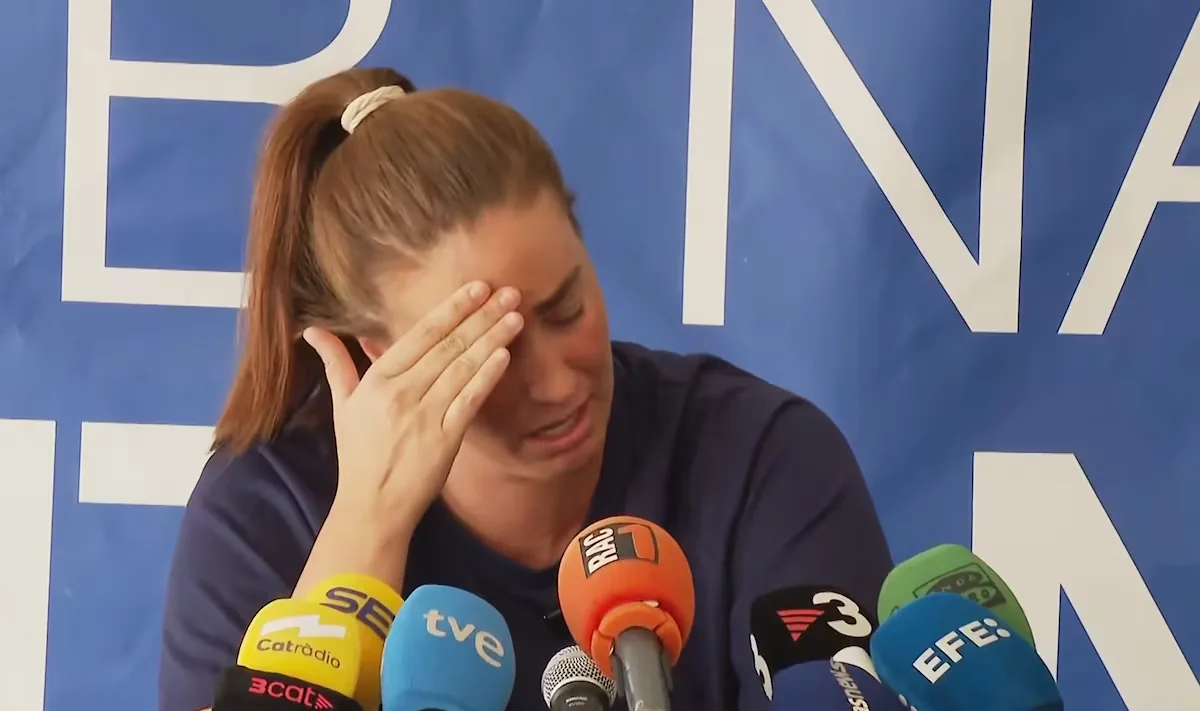
This Thursday, García appeared before a large press conference as a new player of Club Natació Sant Andreu, the entity with which she has signed until 2028. Visibly affected, the water polo player explained that Sabadell had conveyed to her in various conversations that the sports project no longer included her, without any formal communication until September 3, when Human Resources confirmed the decision, almost at the same time she received the notice of deregistration from Social Security. The club from Vallès justified her departure due to “the sports project and technical decisions,” an explanation the player considers insufficient given her more than thirty years of career.
García acknowledged that this months-long process took a toll on her. “I had very strong anxiety attacks,” she recounted tearfully, and admitted that it was hard for her to accept that the breakup was final: “I didn’t want to believe it was going to happen, I thought they would reconsider at some point.” Despite this, she avoided blaming the club as a whole and separated the badge from those who manage it today: “Sabadell is my life and it will continue to be. One thing is the club and another, the people. I don’t deserve this, neither I nor anyone else.”
‼️🗣️Maica Garcia assures she will sue CN Sabadell for not renewing her after becoming a mother: “I don’t deserve this”
All the details👇https://t.co/BcF4e0L8ZW pic.twitter.com/EB1ooQp8Ht
— Esport3 (@esport3) September 10, 2026
The player insisted that her departure is not due to a loss of sporting level, but to a management decision she considers disproportionate given her career. “I have led many sports projects at this club,” she recalled, and emphasized that her goal remains to compete at the Los Angeles 2028 Games, this time with her daughter in the audience. At Sant Andreu, a team almost completely renewed after more than a dozen departures, García also takes on a leadership role for a mostly young locker room.
Beyond her case, García wanted to give the situation a collective reading. She claimed her return to competition as a precedent for other athletes who consider becoming mothers during their professional stage and demanded conditions that facilitate this balance in elite sport, a field in which, she stressed, there were hardly any role models before hers. “I want to fight for the next girls or women who want to be mothers so that they have an easier path,” she explained.
The judicial route is, however, the chapter yet to be written. García confirmed that she is considering taking legal action against Sabadell for understanding that the club breached the contractual extension provided by the regulation. “Yes, I am considering suing Sabadell. I am talking with my legal team to decide and they are processing it,” she stated, without specifying deadlines. The player stressed that, in her opinion, the entity was not aware at the time of the existence of that law: “They were not aware, or have not been, that this law existed. I was calmly assuming I would reach Los Angeles playing for Sabadell.”
If successful, the lawsuit would test in court a law that, on paper, already protected her continuity: article 6 bis of Royal Decree 1006/1985 establishes the automatic contract extension for athletes who become mothers during their last year of contract. García’s case will, in practice, be the first to determine if that protection is also enforced when a club decides otherwise.
Read more The ECB raises rates for the second time this year due to rising energy costs