








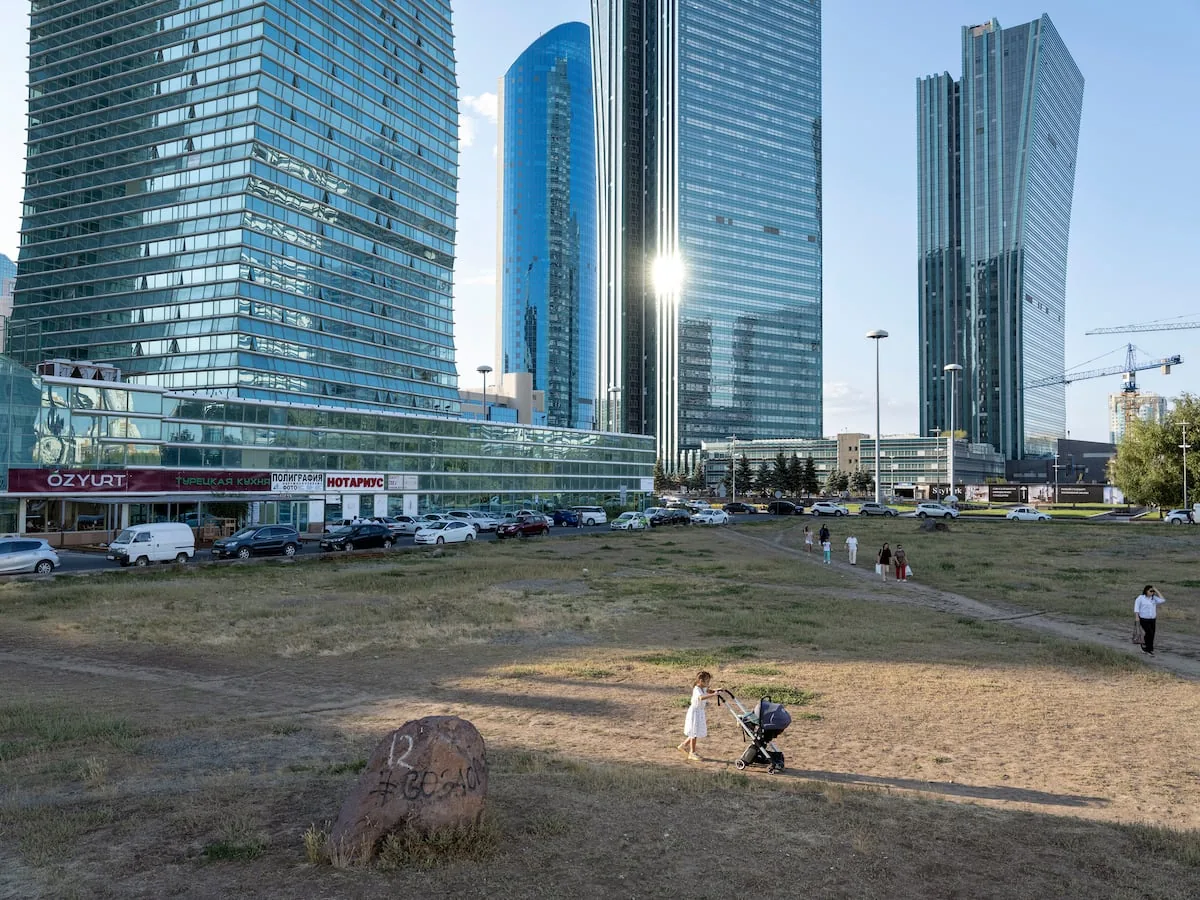
In Ekibastuz, an industrial city in northern Kazakhstan known for its coal, the Government is betting $30 billion on an underexploited idea: that the future of artificial intelligence depends as much on geology as on software. There, on an energy node inherited from the Soviet era, the current Executive wants to build a complex capable of scaling up to a gigawatt of computational power —a figure that would place the Data Center Valley project in the league of major global data hubs—. Its ultimate goal is to attract everyone from cryptocurrency miners to artificial intelligence giants.
The timing is no coincidence. While the war between the United States and Iran further fragments the international system —affecting energy routes, trade and capital flows, or the supply of inputs— and technological infrastructures begin to be exposed to geopolitical risks, countries outside the major powers like Kazakhstan (which shares a border with China and Russia, making it a logistical hub) are trying to capitalize on this disorder.
The thesis of its president, Kassym-Jomart Tokayev, is simple: in a world divided into technological and financial blocs, there will be a growing premium for “neutral” countries that offer cheap energy, connectivity, and legal security. Its ambition for this digital transformation has been confirmed by EL PAÍS, during a recent international press trip to which it was invited, coinciding with the celebration of the Freedom Inside 2026 technology forum in the Kazakh capital.
The pillar on which this ex-Soviet country, independent since 1991, relies is abundant and cheap electricity. While data centers in Europe face prices of up to 40 euro cents per kilowatt-hour, Kazakhstan has set a reduced rate of just 2.5 US cents for high-performance computing projects, which by their nature require massive electricity consumption. This price, which competes even with the most efficient data centers in Virginia in the United States, is possible thanks to the country’s immense mineral wealth, which holds the title of the world’s largest uranium producer.
Authorities are confident that the current conflict in the Middle East will quell the nuclear debate and allow them to benefit from the headaches suffered by the West due to its dependence on fossil fuels, something in which they are also competitive by having large deposits such as Tengiz and Kashagan. This, added to the very nature of the steppe —with temperatures dropping to 40 degrees below zero—, allows them to be competitive in a process where the thermometer must be kept very low. Thanks to this, the country has become a world leader in crypto mining, an activity that requires devices with high computational power, a lot of energy, and continuous cooling to prevent equipment overheating.
However, cheap energy is useless for business attraction without a legal framework to protect it. This is where Kazakhstan has played its second card with the creation of the Astana International Financial Centre (AIFC). Operating under the principles of English common law, with independent British judges and its own arbitration system, the AIFC aims to be an oasis against the risk of international sanctions isolating the country. The design has achieved its objective, as it has led to international capital that was previously managed from Russia being massively relocated to Astana after the invasion of Ukraine and Moscow’s subsequent disconnection from global markets, turning the city into the new gateway for investment in Central Asia.
This environment has served as a breeding ground for the region’s first institutionalized crypto-asset market. The launch of the BETF fund, the first spot bitcoin ETF (exchange-traded fund) in Central Asia in August 2025, traded on the Astana International Exchange (AIX) and custodied by the US firm BitGo, marks a milestone for the country. Zhaslan Madiyev, Deputy Prime Minister of Kazakhstan and Minister of Artificial Intelligence and Digital Development, insists that the country has moved from an uncontrolled mining boom to a strict licensing regime for global operators such as Binance (the largest crypto exchange in the market, with some 300 million users) and Bybit. This transition responds to what the minister describes as a strategic dilemma: “Do you first allow the sector to grow enormously and then put in regulation to control it, or do you put in regulation first and try to grow afterwards?” According to Madiyev, “Kazakhstan has chosen the more difficult but safer path.” His future vision involves facilitating banking entities to offer the possibility of exchanging fiat currency for cryptocurrencies, and vice versa.
The country’s ambition to be a digital mecca has allowed private actors to use it as an experimentation platform. This is the case of Freedom Holding Corp, led by Timur Turlov, of Russian origin but naturalized Kazakh. Its banking subsidiary, Freedom Bank, has developed highly digitized financial services that reduce traditional processes —such as granting mortgages or loans— to unusually short times. This model relies on integration with 120 state databases and the extensive use of machine learning to assess risks and verify identities almost in real-time. Turlov insists that if this has been possible, it is because “here the competition is lower, and it is easier to have direct access to the Government.” Furthermore, having fewer bureaucratic hurdles, “it is much cheaper to launch new products and use it as an experimentation field to then deploy it in other markets.”
But, despite governmental optimism, many details still need to be ironed out for the country to consolidate itself as a major player in the digital world. First, it must complete connectivity projects, such as the Trans-Caspian fiber optic cable, which would connect Asia with Europe without crossing Russian territory. Added to this is the image of a country under a centralized, authoritarian system with a complex history of civil rights. Internally, the challenge is equally complex. The Government itself recognizes that a data-driven economy requires, in addition to energy, human capital, cybersecurity, and network resilience. The creation of a specific ministry for artificial intelligence and the commitment to training local talent reflect this governmental urgency. In any case, Minister Madiev hopes that he will be able to convince Big Tech that the security of the steppe is preferable to the uncertainty of the Gulf.
Read more Unrewarded disposition for the novice bullfighters