








The European Commission has finally taken the step that several States, including Spain, have been demanding for months, and has presented the Kids Act, or Children’s Law, which seeks to protect minors in the EU from the most harmful effects of the digital world, from cyberbullying to exposure to illegal content. As the title of the proposed regulation itself says, it is about “ensuring that digital internet spaces are responsible and reliable.” These spaces include social networks and platforms where videos are shared, but also online video games or conversational chatbots, such as ChatGPT, Claude, or Gemini.
The specific mention in the text of generative artificial intelligence (AI) tools underlines Brussels’ concern about limiting the effects of these tools on minors. In the US, the phenomenon of digital friends, AI chatbots designed to hold conversations and simulate companionship relationships, is beginning to cause concern. One fifth of Americans aged 18 to 22 already admit to turning to them for emotional support, according to a report by Rand Corporation and Harvard University. Their impact on children can be fatal, as evidenced by the case of Sewell Setzer, 14, who committed suicide after interpreting that a synthetic character created with Character.ai, with whom he was madly in love, was inviting him to do so.
The regulation proposes a gradual access to social networks, generative AI tools, or online video games — starting with a total ban for the youngest — which must also be supervised by parents or guardians of minors and must have “appropriate and proportionate” safeguards by the platforms to ensure a “high level of privacy, security, and protection of minors when using their services or systems.” It also establishes a maximum screen exposure time for minors: a maximum of one hour per day for teenagers between 13 and 15 years old.
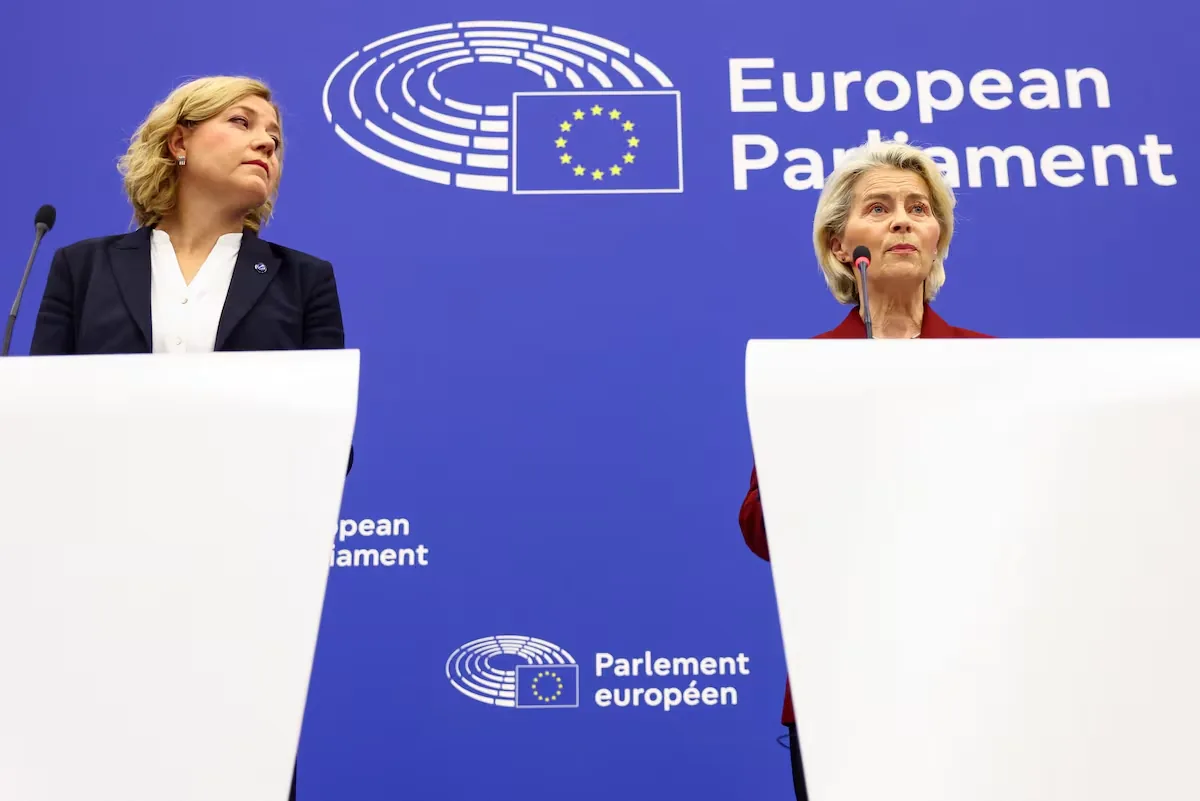
“Young people in Europe spend, on average, between four and six hours a day in front of a screen, and those who started using social networks before the age of ten spend even more, around seven or eight hours online each day, almost a full working day for an adult,” highlighted the President of the European Commission, Ursula von der Leyen, when presenting the initiative from the European Parliament in Strasbourg. And that must be stopped, she emphasized: “There are too many children who are exposed too early to a digital world for which they are not yet prepared: an environment where bullying can follow you home, where every mistake can be recorded forever, and where childhood and puberty consist precisely in making mistakes, learning from them, and improving.”
The law now proposed, which Brussels urges to be approved as soon as possible due to the “urgency” of the situation, seeks precisely that minors “can enjoy their rights online, learn, be connected, and explore” in a safe way, stressed the Vice-President for Technological Sovereignty, Henna Virkkunen. Therefore, in addition to providing parents with the necessary tools to “accompany their children in navigating a safe digital world,” the Kids Act “keeps the pressure high on platforms, because they are the ones who have to prove that their services do not cause harm,” she added.
This regulation, Virkkunen assured, complements what is already established by others, such as the Digital Services Act (DSA), which subjects large tech companies to stricter controls than the rest.
These are the key points of the new regulation.
Which platforms or services will be affected?
The law will apply to social networks such as TikTok or Instagram and to video-sharing platform services like YouTube, but also to software app stores, online games, and operating systems. Also included within the scope of the law are the so-called digital friends or AI — software programs designed to simulate companionship relationships and converse with people as if they were real friends — as well as general conversation chatbots, such as ChatGPT or Claude.
Which are exempt?
The European regulation will not apply to educational or scientific dissemination platforms, such as non-profit digital encyclopedias, non-profit educational and scientific repositories, or services and systems designed for educational purposes and operated by organizations or educational institutions.
Similarly, services and systems developed and managed specifically for the sole purpose of scientific research and development, as well as those managed by and for public authorities, are exempt. The exception also includes open-source software development and sharing platforms, unless that platform constitutes an AI system covered by the scope of the Kids Act.
What are the restrictions according to age?
The European Commission has finally advocated a gradual restrictive approach, ranging from a total ban for the youngest to restricted and supervised use once entering adolescence. Von der Leyen herself summarized it in her annual State of the Union speech in Strasbourg on Wednesday: “No social networks for children under 13. No personal accounts for those under 15,” she explained. Between 13 and 15, only “mini-accounts” will be allowed, created and supervised by parents and with “limited functions,” just like the usage time, which will also be restricted, she emphasized. From 15 to 18 years old, teenagers will be able to access networks without supervision, but platforms will be required to comply with a “safe design” that protects them. Because, as the preamble of the proposed regulation highlights, “only half of children between nine and 16 years old across Europe say they feel safe on the Internet.” A network, it recalls, “that was not designed with minors in mind.”
“We do not have to accept features that create addiction. We do not have to accept that children are drawn to increasingly extreme content. We do not have to accept that girls’ photos are used to create sexualized AI-generated images,” emphasized the former German Family Minister in her speech, in which she recalled the case of Oléa, a 14-year-old Belgian teenager who committed suicide just a month ago after suffering cyberbullying. “Platforms will have to prove that they are safe,” she concluded.
What are safe environments like?
The big novelty of the Kids Act, according to Von der Leyen, is that the EU wants changes in app design to make them safer. The Commission demands the removal of addictive elements, such as infinite scroll, reward mechanisms, or untimely notifications; regulation of content recommendation systems, so that they respect the accounts the child follows; and an account configuration that guarantees the privacy of minors’ content. Emphasis is also placed on ensuring that unknown accounts cannot interact with them and that there are simple mechanisms to report inappropriate content.
What will be the role of parents?
Parents or guardians of minors are the “guardians,” as the law calls them, that is, those responsible for ensuring the safety of children and adolescents when they enter the digital space. Hence, they will be responsible for creating limited accounts for teenagers between 13 and 15 years old, which will be in the adult’s name. In the case of video-sharing platforms, when providers of these services can demonstrate that the content is suitable for minors, they may allow, “exceptionally,” guardians to enable access for children under 13 to accounts “created and supervised by the guardians themselves” and that have “parental control” tools. Under no circumstances may these be accounts created specifically for those minors, and parents or guardians must be able to set content, access, and exposure time limits. To this end, providers must create “effective, accessible, and easy-to-use tools for guardians.”
Will there be fines?
The punitive section is barely developed in the regulation. However, it is noted that fines will not exceed 6% of the annual turnover of the responsible companies.