









January 2006. Nobel Prize in Literature José Saramago and theologian Juan José Tamayo leave the Los Seises Hotel together. At nine o’clock sharp, they pass in front of the Giralda and the bells begin to ring.
–The bells are ringing because a theologian is passing by –murmured Saramago.
–No –replied Tamayo–, the bells are ringing because a confessed and convicted atheist is about to convert to Christianity.
–Ah, none of that. I was born an atheist, I have lived as an atheist, and I will die an atheist, and you can verify it because you are much younger than me.
Tamayo responded with a definition of God: “God is the great silence of the universe, and the human being the cry that gives meaning to that universe.” Saramago jumped like a spring: “That definition is mine!”.
–That’s why I quoted it. And that definition is closer to a mystic than to an atheist. Or perhaps mystics and atheists have more in common than it seems. Do not forget that the great mystic Master Eckhart defines God as “the Nothing” and John of the Cross says that God is found in emptiness and nakedness.
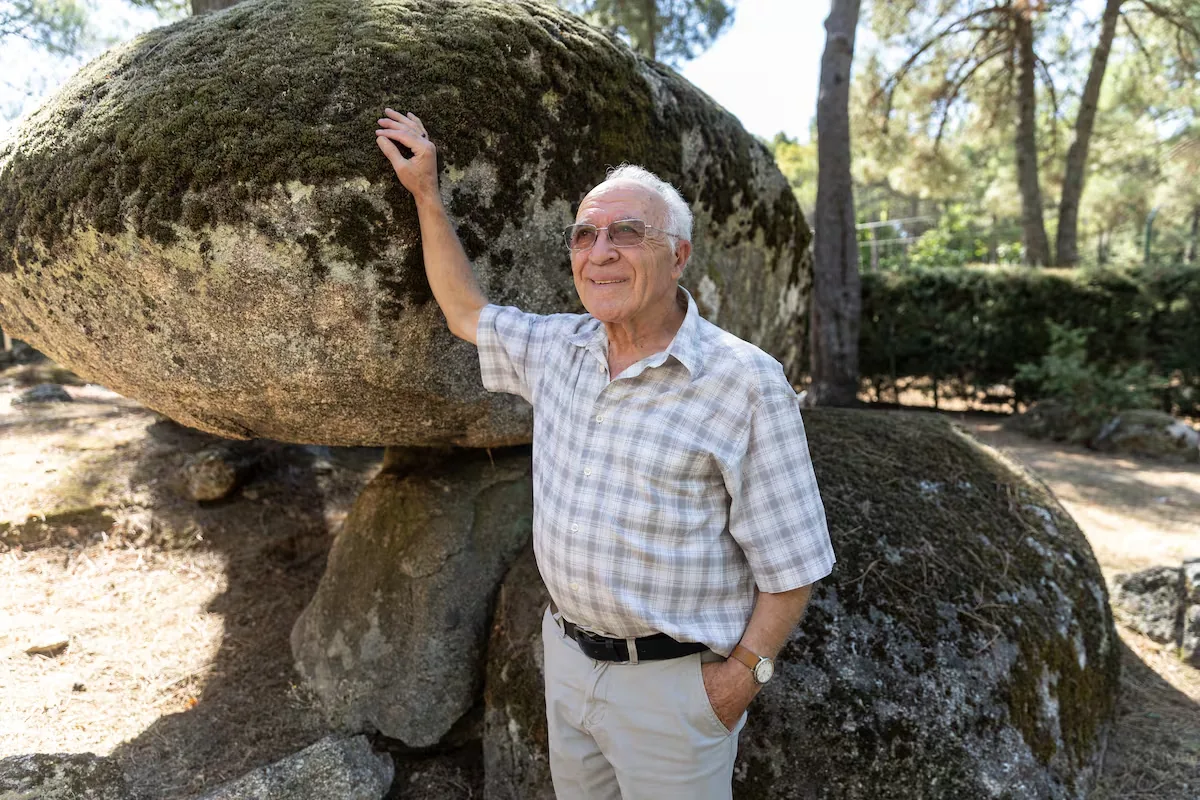
“The conversation lasted barely two minutes. Witnesses are Pilar del Río and the painter Sofía Gandarías,” concludes Juan José Tamayo (Amusco, Palencia, 79 years old), one of the most relevant figures of contemporary theology in the Spanish language, author of more than 50 books – also a columnist for media such as EL PAÍS – and with an overwhelming academic record, as overwhelming as have been his disputes with the Vatican and the Spanish Church. “It is not possible to be a theologian without being heterodox,” he writes to this journalist after the interview. “The German philosopher of hope Ernst Bloch said: ‘The best thing about religions is that they create heretics’ and before him Paul of Tarsus: ‘It is necessary that there be dissensions so that the truth may shine’.
The professor has lived in Cadalso de los Vidrios (Madrid) since the pandemic, where he became seriously ill. In the last two years he has published two essays, Radical Christianity (Trotta) and Politics and Religion (Tirant).
Question. Bad name “cadalso” for a theologian on the blacklist.
Answer. It would have been worse in the 16th century. As a heterodox, my life would have been in danger and possibly my body would have served for the flames.
Q. They threw you into the metaphorical flames in 2003.
A. I have always had censorship in front of me: in 1976 the Public Order Court condemned and seized my book For a Church of the People. And in 2003 the Congregation for the Doctrine of the Faith, led by Ratzinger before becoming Pope, took a harsh stance against my book God and Jesus. It is one of the most spiritual and religious books I have written, but the sentence had already been previously dictated by some articles I published in EL PAÍS on the occasion of the canonization of Escrivá de Balaguer. They immediately took my latest book to Rome and there it was subject to condemnation and severe censorship. I presented the image of Jesus of Nazareth in a different way: as a free man who carried out liberation practices. That is why they killed him, and the resurrection is the triumph of justice. That is basically the synthesis of the book.
Q. Jesus was much more uncomfortable than the Christianity that was later built around him.
A. Without a doubt, because the Christianity of Jesus is an egalitarian movement of men and women, a discipleship in which women had a very important role. The ethics of Jesus of Nazareth is radical ethics. He is a vulnerable, fragile person, not a hero at all; rather a failure. And the failure is shown at the end of his life. He was not tried, he was politically condemned and executed as a subversive. This image of Jesus of Nazareth, which is the starting point or origin of Christianity, has very little to do with later Christianity. One of the fundamental keys of Jesus’ ethics is the option for the most vulnerable people, for oppressed groups.
Q. But the Vatican…
A. During the pontificates of John Paul II and Benedict XVI there were numerous condemnations against theologians who made this option for the poor and I have not known in those 33 years a single condemnation against theologians who opted for the rich. Also, Jesus’ lifestyle has nothing to do with the lifestyle of our hierarchs: a itinerant life, shared austerity, no possessions, no security, no home. We could say he belonged to the group of what today we call homelessness. And there is something key that the Catholic hierarchy does not practice at this moment: the incompatibility that Jesus establishes between serving God and money.
Q. You turn 80 on October 7. Your academic, theological, and outreach biography is overwhelming. Why theology?
A. My mother’s great effort was always that her children got an education and approached the world of culture to which she could not access. In 1957 she sent me to the seminary for that reason. I studied humanities, philosophy, and theology. The theology I studied there was rather scholastic. I asked the Theology professor the first year: “What is a theologian?” And he told me: “A theologian is a very sensible and serious person who spends a whole life locked among books trying to give precise and very exact answers to questions that no one asks.”
Q. What did you answer?
A. Nothing. I was 18 years old and my first impulse was to take the train, go to my village, 20 kilometers from Palencia, and get on my father’s tractor to work the land. But very soon I approached Liberation Theology, where I am now located. There I found another definition of theology that I liked more, that of Gustavo Gutiérrez: “Critical reflection on historical praxis through faith.”
Q. And that changes your life.
A. I discovered that at the beginning of Christianity there were no dogmas, but the message of Jesus of Nazareth, the liberation of the poor. That is the key to my orientation to theology, which became a critical theory of religion and a force of struggle against injustice.
A Theology professor told me that if 4,000 paparazzi had shown up at the moment of the resurrection, the photo would have come out completely blurry
Q. Look back, very far back: what is the greatest historical betrayal of Christianity to Jesus?
A. The alliance between the throne and the altar from the 4th century: there the identification between political power and religious power occurs.
Q. What happened?
A. That alliance constitutes a distortion of the conflict that Jesus of Nazareth and the first followers had with power. From liberation we move to dogma; from the presence and protagonism of women in Jesus’ movement and in the first centuries of the Church we move to the discrimination of women and their exclusion from spaces of responsibility; and from the Church as a community of equals we move to clericalism, a phenomenon in which the hierarchs, all men, exercise all powers and dispossess the Christian community of any active task and any responsibility in the running of the Church.
Q. You do not doubt the existence of Jesus. Nor the resurrection?
A. There is no doubt about his existence due to the contributions and testimonies of Roman historians and, of course, the Gospels, which are testimonies of the relationship with him. The resurrection, however, is not an empirically verifiable fact. A Theology professor from my early seminary years said: “If 4,000 paparazzi had shown up at the moment of the resurrection, the photo that would have appeared would be completely blurry.” Because it is not the reanimation of a corpse. It is not the return to life of the figure of Jesus of Nazareth when he existed in Galilee, in Israel, but the experience lived by some of the groups that accompanied him: that life has triumphed over death and that the executioners have not triumphed over their victim.
Q. When you claim the feminist or egalitarian character of Jesus’ movement, there is a fact: he had twelve apostles and all twelve were men. Do we sometimes run the risk of turning Jesus into a feminist because we need him to be?
A. No, not at all. Jesus was not a feminist because feminism and women’s liberation movements are much later, starting three centuries ago. But Jesus’ life and his relationship with women correspond to the liberation proposal that feminism makes. Right now there is a very powerful reflection within the Catholic Church which is feminist theology. And feminist Christianity is based on Jesus of Nazareth’s incorporation of women into his movement on equal terms with men. A great biblical scholar and feminist theologian from Germany rooted in the United States, Elisabeth Fiorenza, says that women in Jesus’ movement had a protagonism in solidarity from below. In many gospel accounts, the disciples led by Peter, James, and John are mentioned and, at the same time, women who accompanied him in the announcement of the Kingdom of God, followed him, and supported him.
Q. This clashes with what the Catholic Church is today.
A. It is a patriarchy where absolute power is held by men with women subjected. They are excluded from priestly ministries, from spaces where major decisions are made, and from direct access to the sacred: to access the sacred and God they need the mediation of men. In original Christianity it was not like that. The communities created by Paul of Tarsus in the Mediterranean basin are communities that in many cases had female leadership.
Q. If Christianity must fight capitalism, patriarchy, racism, or inequality, when does it stop being a religion and become a political program?
A. What worries me most is that a new religion has emerged with more and more followers: christoneofascism. It is the alliance and complicity between the far right and part of the political, social, and cultural right, and fundamentalist Christian movements within the Protestant evangelical Church and integrist movements within the Catholic Church.
The physical figure of the devil does not exist, but his representations do. For example, in Netanyahu and Trump, who make a bellicose, anti-immigrant, and antisolidarity interpretation of the texts of the Hebrew Bible and the Christian Bible
Q. Have you ever been outraged with God?
A. Yes. But the outrage with God does not originate in my attitude, but in Jesus of Nazareth. The relationship that Jesus has with God is that of father and mother. The word he uses to relate to God is Abba, an Aramaic word that means father and mother. It is a relationship of trust, familiarity, and affection. He experiences God as a person he could fully trust. He was the center, the horizon of his liberating project and the one who gave meaning to life. He was not the distant God but the God of hope, the God advocate of the poor, the compassionate God, and nothing separated him from him. What happens in the crucial moments at the end of Jesus’ life? That, at the moment of trial and persecution in Gethsemane, he feels true fear, anguish, and deep sadness. And then he addresses God with the same trust but in an attitude of supplication and outrage: “My God, my God, why have you abandoned me?”, taking the words from a psalm of the Hebrew Bible. Jesus asks God for an account for having abandoned him.
Q. Harsh.
A. There is a crisis of faith and hope in Jesus. A moment when he hits rock bottom and in which, as the great German theologian Jürgen Moltmann says, he felt despair. That is the great paradox that Jesus of Nazareth lives in the final moments: after such a close and direct relationship with God, who gave him the strength to propose a new religion freed from Jewish orthodoxy, God leaves him in total solitude.
Q. And he gets angry.
A. With everyone. With religious, economic, and political authorities; even with his disciples, who do not fully understand what his liberation project is and what his image of the Kingdom of God is, which is not that of a triumphant leader, but that of a totally failed person. The question is: where is God amid so many catastrophes in which those who suffer are the peoples, the most marginalized and impoverished sectors? Where is God? Hence the criticism we make of God’s omnipotence. How can God be all-powerful, omnipotent, omniscient, omnipresent, and not act in situations of destruction of nature and the life of the poorest sectors and the popular majorities?
Q. And where is he?
A. Elie Wiesel was in the Auschwitz concentration camps and also wondered where God was. He recounts a scene in which three people are being crucified and someone in the crowd asks: “Where is God?”. And the answer is: “God is with the victims who are being crucified.” That is my idea of the crucified people, crucified Jesus, crucified God, who frees us from our comfortable state, from a selfish attitude that prevents us from seeing the suffering of other human beings.
Q. Tell me about the devil.
A. His physical figure does not exist, but he does have his representations. Today he is represented in oligarchs, plutocrats, and the new theologians of neofascism. There is the devilry represented, for example, in Netanyahu and Trump. I define Netanyahu and Trump as the theologians of neofascism, who make a bellicose, anti-immigrant, and antisolidarity interpretation of the texts of the Hebrew Bible and the Christian Bible. There I find the devil incarnate.
Read more Von der Leyen announces a security plan for Europe without the United States