









The Campos Cebrián-González Ruano family was not in the room. The neighbors at number 22 General Lacy Street eagerly awaited the Campos Cebrián-González Ruano family because, although they have been their landlords for more than 80 years, they still do not know what they look like. Neither Blanca Castro, nor Santiago Sanz, nor Jacqueline Leca, nor María Gutiérrez know the tone of voice of their landlords. If they crossed paths on the street, they would not recognize each other. None of them know if they are tall or short, blond or brunette, if they are the type who win in close quarters or if they seem as cold as the formal notices that arrived, one by one, to the 32 neighbors of the building to notify them — with four months’ notice — that their lives “end for all intents and purposes” once their lease contracts expire. That is why there was some whispering in the hallways of the Madrid Court of First Instance number 82 on Wednesday morning among the neighbors who accompanied Blanca, the first of the lawsuits by the Campos Cebrián-González Ruano family for “contract expiration.” “Is it them?” they wondered, glancing sideways at those present. No. It was not them. They had sent their lawyers. None of them wanted to speak to this newspaper.
General Lacy 22 is a building constructed in 1920, located in the Arganzuela district and situated 550 meters from Atocha station. The block belongs to the Campos Cebrián-González Ruano family, who from the beginning practiced a rental model similar to that used by another great Madrid family, the Dukes of Alba, in several historic buildings near the Liria Palace, where tenants were loyal, solvent people who would be there for many years. Over time, friends of friends, their relatives, or people of “utmost trust” joined General Lacy 22, always with the approval of the former administrator, a man named José Ramón, who conducted the interviews and was dismissed when the landlord family’s policy began to change.
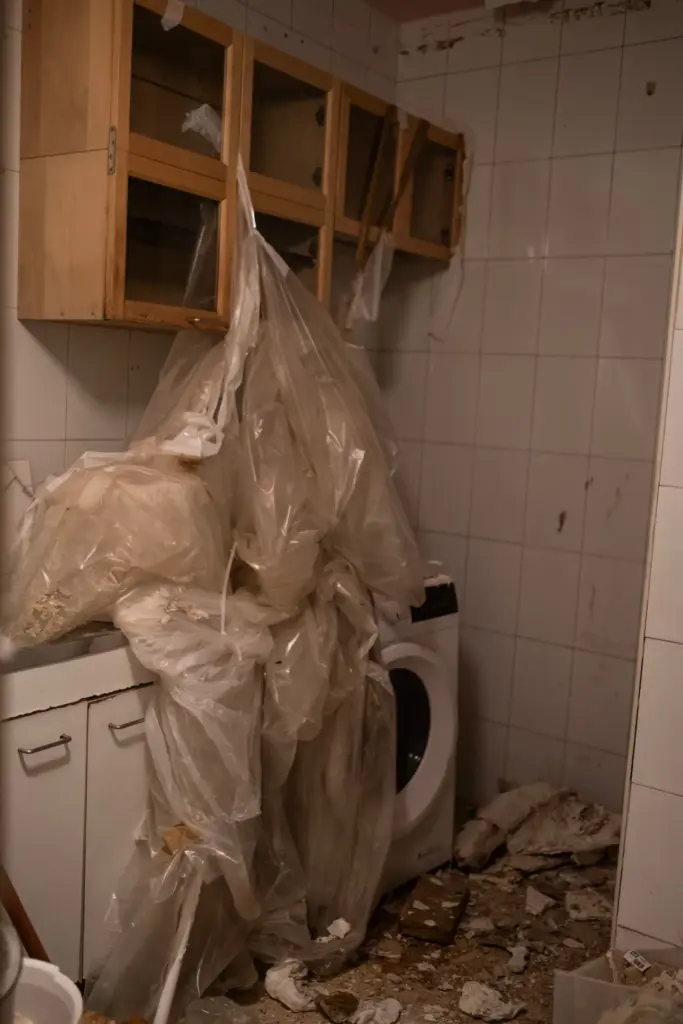
From then on, tenants had to address a generic email, since after the death of one of the co-owners of the property, the owning family reorganized and channeled ownership through two companies: FURUD 2024 S.L. and GOMEISA 2024 S.L. For the management of the block, the ownership has operated through the real estate managers Savills and WeRent. With the rental contracts still in effect, the building began to suffer neglect. Repairs were not fixed, leaks were poorly resolved, cockroaches or dirt in the common areas gradually eroded and corroded the building’s interior until it achieved the ruinous appearance it currently shows. “It was about letting it die with us inside,” says Blanca Castro, 53, a neighbor on the fourth floor.
Blanca, a painter and artisan by profession, moved into the block in 1999 when she was 23 years old. Part of the property is also her workplace. In 2025, her last contract ended, which had been for five years at 800 euros per month. After not accepting the order to leave, she received another formal notice with the so-called MASC (Appropriate Means of Dispute Resolution), a legal tool to resolve conflicts amicably without going to court. To avoid suing her, they asked that, in addition to leaving the apartment, she pay 6,000 euros. This same procedure has been repeated one by one with all the neighbors. “We needed advice,” Blanca points out. The Madrid Tenants’ Union managed to gather and organize all the tenants to follow the same strategy. The first step was to resist inside the building. The second, to continue paying their rent fees (between 800 and 1,200 euros). The third, to wait to be sued and go to trial. “Chronologically, I am the first, but after me come all the others,” the woman says. The Campos Cebrián-González Ruano family plans to summon each and every one of them to the Court of First Instance number 82 in Madrid.
The evening before Blanca’s trial, which will serve as a benchmark and precedent for all that follow, the woman goes down to the street somewhat sorrowful and tired. She crosses paths with Santiago, Mariola, and other neighbors who are finalizing preparations for the rally in support of Blanca called in front of the court. “I can’t go because of work, ma’am. But my wife will go,” a man tells her. “Despite being the defendant, I am calm because I will be in the right place. They have hurt me so much that now I am the one looking forward to the trial,” she declares.
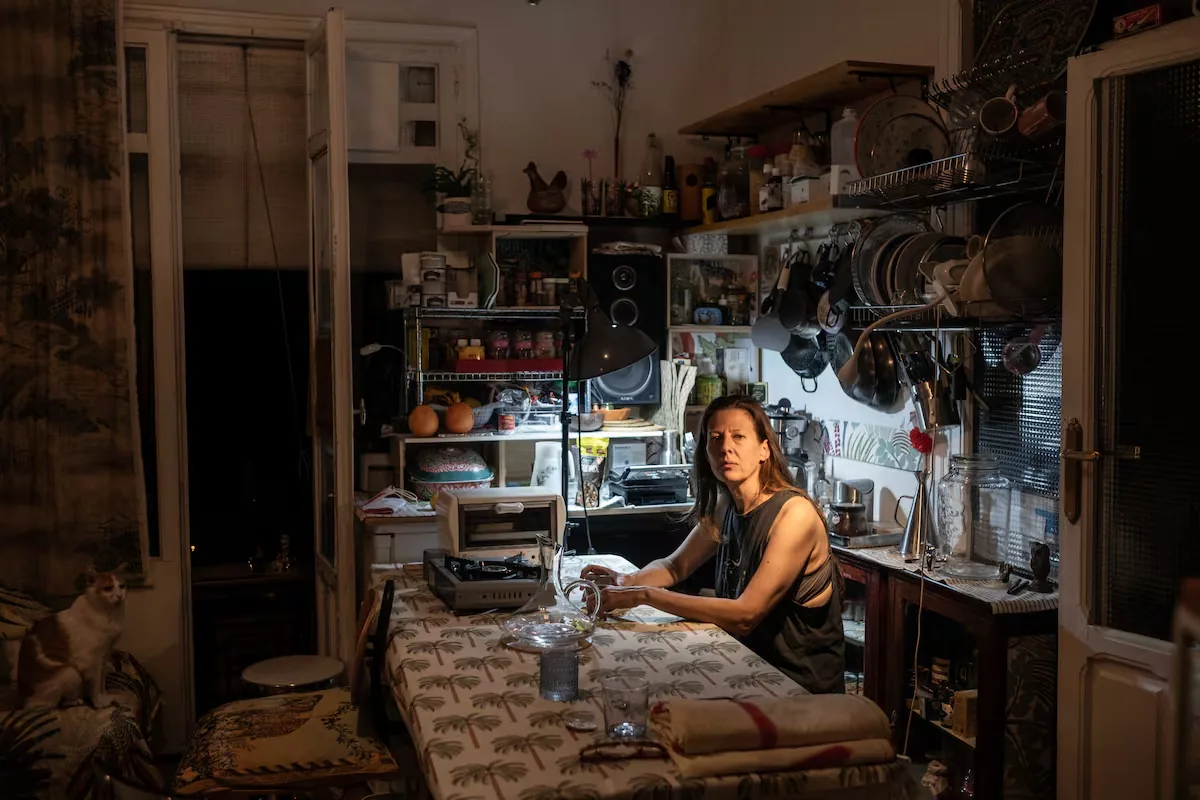
Blanca’s home has been more like a ruin than a home for over a year. Still under contract, a leak appeared that was not resolved. Then a false ceiling collapsed. For weeks she cooked with water dripping onto the appliances while having to clean debris every now and then. According to her, the situation “got the better of her.” None of the managers solved the issue and, on her psychologist’s recommendation, she closed the kitchen and set it up as best she could in the living room. Now Blanca lives in a kitchen. She cooks in survival mode: without a sink, on a folding table with a camping stove and a sandwich maker. She stores spices and dishes in wine boxes hanging on the wall. “This has upset me; I think it is the perfect metaphor for how they ruin our lives, how they coerce us until our homes become unlivable and hostile places. They have even changed my diet because I can’t shop like I used to since now I have a small refrigerator,” she admits.
“This is the sign of the times. What we were told is that the family’s policy regarding the building shifted due to a ‘generational change.’ That is, the younger ones have taken the reins and are seeking speculation that maximizes their profits,” Blanca reflects. “Can’t they think of another way to live other than destroying the lives of dozens of families to make a quick profit?” questions Santiago, the neighbor on the third floor, who will probably be the next to go to court.
Read more Von der Leyen announces a security plan for Europe without the United States
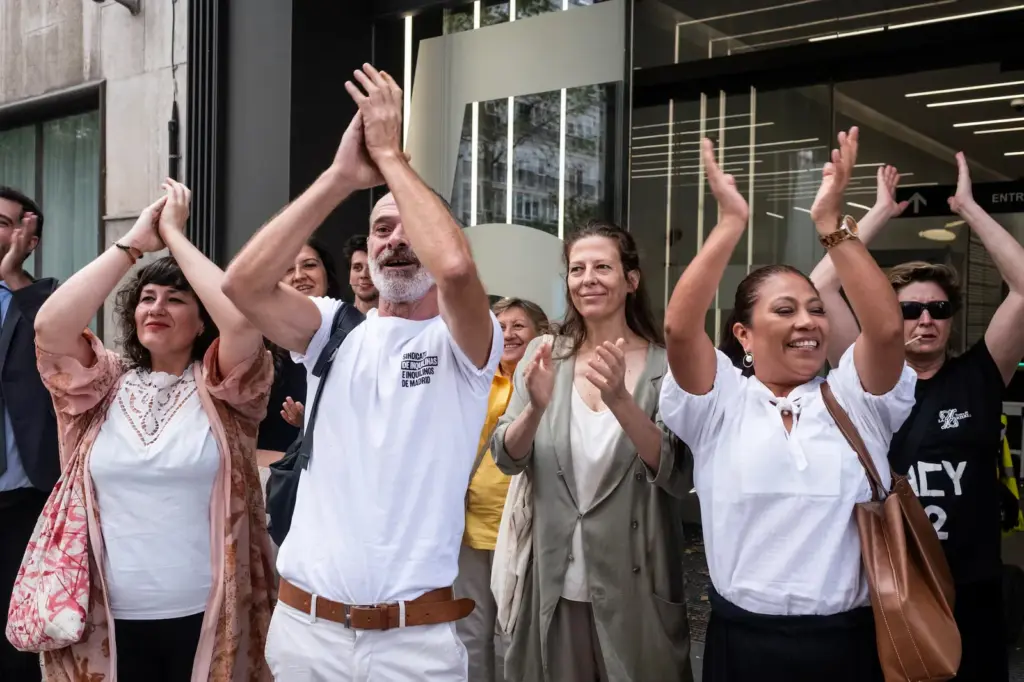
Throughout Wednesday morning, when the trial takes place, Blanca Castro does not spend a single second alone. A group of about 20 neighbors and activists from the Madrid Tenants’ Union accompany her at all times. Some go up with her to the oral hearing, while others gather at the courthouse door shouting: “No one leaves De Lacy 22.” They feel, says Blanca, like “little ants” fighting against a giant.
Alicia del Río, spokesperson for the Tenants’ Union, calls to “disobey when a landlord tells you to leave to speculate.” Their strategy is to “face the trials” and pressure for “laws to change in favor of tenants” because “the Government can legislate in favor of family stability.”
After 30 minutes of trial, the neighbors of General Lacy 22 leave satisfied but frustrated by the very technical language used by the lawyers of both parties.

The defense’s argument states that the ownership acts as an S.L., with more than 100 properties and not as a community of goods, and therefore their contracts should last seven years and not five, so Blanca’s contract would not have expired yet. Víctor Palomo, Blanca Castro’s lawyer, is optimistic. He trusts that the ownership will opt for collective negotiation, which he considers “the only solution” to the conflict. Otherwise, they will “fight” in every trial, with all that entails: rallies at the courthouse door, media pressure, and a cumbersome process that would inconvenience the ownership.
At the end of the day, Jacqueline Leca, 49, a neighbor on the first floor, recalls that some “are no longer part of this fight.” From some of the balconies of General Lacy, 22, hang sheets with the message “72 years paying.” They refer to the case of María Luisa, a nonagenarian who spent her whole life there and died of cancer a few months ago with an eviction order.
Read more Trump threatens to “cut trade” if the EU partners with Canada