






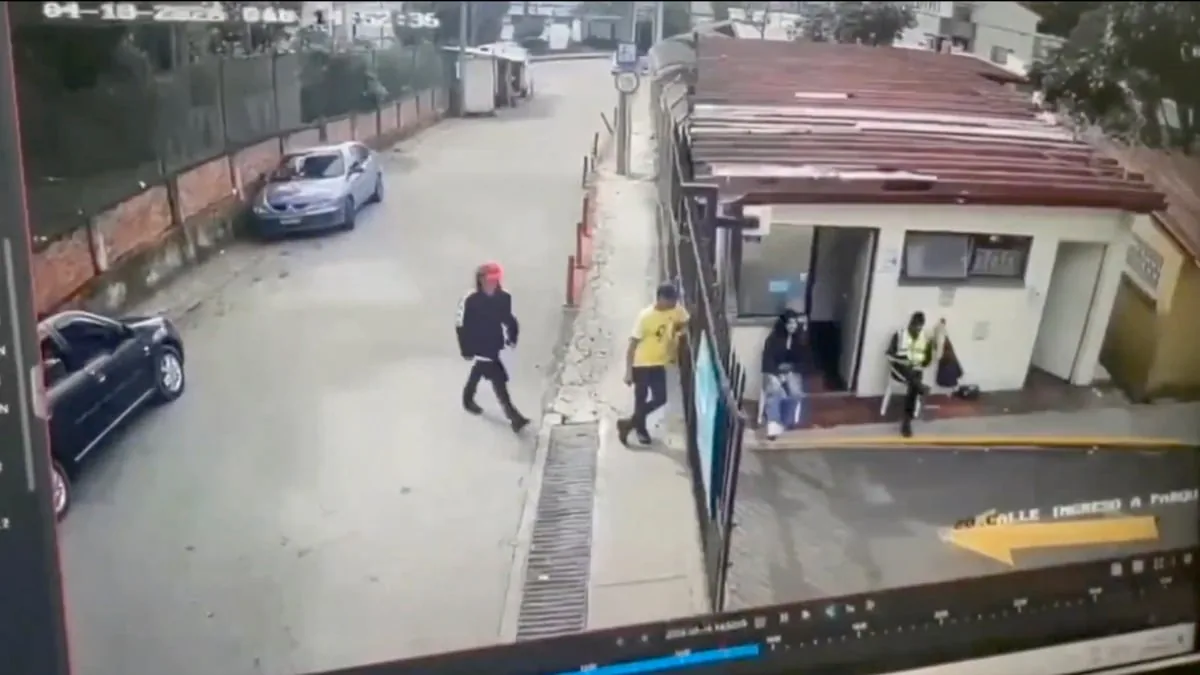
Confusion reigned in downtown Bogotá on Saturday afternoon after a brutal crime on the set of the telenovela Sin senos sí hay paraíso. A security camera captured how, at the entrance of a hospital serving as a filming set, a passerby approached a television production worker and slit his throat. Afterwards, he confronted several of the victim’s colleagues. Another production worker and the aggressor died. The images were clear, but nothing made sense: there was no attempt at robbery, nor any interest from the passerby in entering the hospital where the filming was taking place, the Roosevelt Institute. Authorities stated this Monday that investigations have ruled out hypotheses of theft or contract killing. They emphasized that the aggressor suffered from psychosis and schizophrenia.
Read more Apple names John Ternus as CEO and Tim Cook as Executive Chairman
The commander of the Bogotá Police, Giovanni Cristancho, provided several details about the aggressor in radio statements this Monday morning. According to him, he was 24 years old and lived in the Tunjuelito locality, in the south of the city. His medical history indicates that he had been diagnosed with “a psychotic disorder associated with the consumption of narcotic substances, with episodes of thought disorganization and with a differential diagnosis of schizophrenia,” referring to a condition that blurs the discernment between what is real and what is not. He had been hospitalized in different institutes in the city and had been reported on several occasions for threatening his neighbors with death.
Cristancho also explained that the main clues lie in the visit the aggressor made the day before to the Roosevelt, which will appear in the fourth season of Sin senos sí hay paraíso. He went, according to the commander, to request his medical history and presented three different ID cards, none of which allowed administrators to find his file. “He was aggressive and the guards had to remove him. At that moment, he showed a bladed weapon and it was confiscated. They issued him a summons and he left,” he recounted on Caracol Radio.
The next day, he attacked the production worker who was resting on a fence at the entrance. “We think he believed [the victim] was a security person from the institute. That’s the only conclusion we can draw,” the Police commander stressed. “It’s the only antecedent we can associate. [The production workers] had been working in this place for one day. There are no other circumstances, no other element that can give us another hypothesis,” Cristancho said in another interview, on Blu Radio. “The family has not wanted to give us much information about him, and we have to understand them,” he added.
Four of the victims’ colleagues were arrested after the murders. “The production team ended up lynching [the aggressor]. Last night, in a guarantee control hearing, they were charged with homicides,” the police officer continued. The four have been released after their defense argued that they acted in self-defense. “They will surely have to prove it in the judicial process (…). But, if they had not acted, I don’t know how many more deaths this person would have caused,” Cristancho commented.
Read more Javi Navarro once again plays the hero and gifts Real Madrid their second Youth League
On Sunday, Bogotá Mayor Carlos Fernando Galán stated on social media that initial investigations indicated it had been “an act of senseless intolerance.” He expressed his solidarity with the victims’ families and the audiovisual content production industry. “This impacted the entire city, which is a destination for this type of creation,” he said, while announcing the convening of an extraordinary security council. On Monday, he clarified the hypothesis in a press conference: “This is an aggression by a person with a medical and mental health condition.”
Before the aggressor’s medical history was known, the National Alliance of Audiovisual Workers issued a statement denouncing the precarious security conditions in the sector. “This event demonstrates a worrying loss of humanity in contemporary audiovisual creation, where, in many cases, productivity has been prioritized over labor care, protection, workplace safety, and people’s well-being,” it declared on Sunday. The union assured that authorities had ignored “repeated warnings” about security protocols.
TIS Studios, the telenovela’s production company, emphasized that the events occurred “in an area external to the filming location and were caused by a person unrelated to the production.” “They have received the utmost attention from the company from the very first moment,” it said in a statement. The Ministry of Cultures expressed solidarity with the victims’ families and the artistic community. “Culture is built on life, care, and peace,” it stressed.
Several figures from this television world of drug trafficking and prostitution, which began 20 years ago with Sin tetas no hay paraíso and now continues with Sin senos sí hay paraíso, have also spoken out. Former senator Gustavo Bolívar, author of the original novels and screenwriter of the television adaptations, offered his condolences on X. “I embrace their loved ones with all my soul and my solidarity with the company I have worked for for 27 years. Art and life cannot end like this,” he commented. Actress Carmen Villalobos expressed her sadness on Saturday, upon winning the India Catalina award for La huésped, for her colleagues from Sin senos sí hay paraíso: “I dedicate it to them, from here to heaven.”
Read more Alcaraz, Sabalenka and Lamine Yamal, crowned at the Laureus Awards in Madrid