









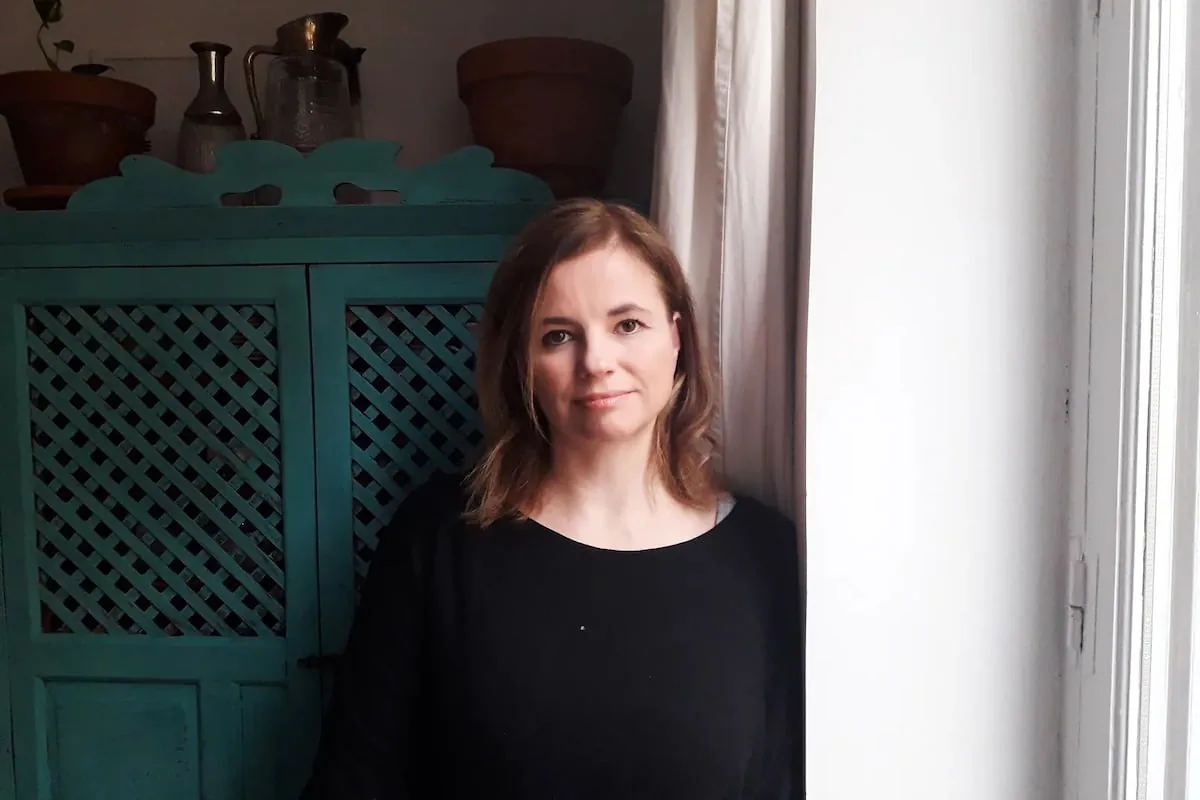
It is 2026 and it seems incredible that at this point we are still talking about outdated myths such as good mother or bad mother, “when these are terms that do a lot of harm, because most women try to do the best they can or the best they know,” explains to EL PAÍS Iria Marañón (Madrid, 49 years old), journalist, philologist, and author of four books on motherhood and feminism. The latest is We are revolution, we are feminism (La esfera de los libros, 2025), in which she invites the reader to discover what feminism is, to identify the gender inequalities that still exist, and to enjoy learning from the history of women and “how both girls and boys have the power to change it.”
Read more Power struggles, greed, war, and ‘technofascism’: AI takes off its mask
“If we stick to something more specific, the most important myth is that of sacrifice, because it is assumed that to be the best mother you have to sacrifice yourself and give up part of your interests,” emphasizes the editor and communicator. Marañón acknowledges that when you have a child, it is normal to have sacrifices, because motherhood requires a considerable investment of time and effort, often incompatible with other things: “But there are many women who give up too many fundamental issues, such as economic independence or their own life.”
QUESTION. This Sunday, May 3rd, is Mother’s Day in Spain. A day to celebrate?
ANSWER. No, because the lack of shared responsibility between fathers and mothers still weighs heavily. When the burden of raising children falls mainly on the mother, which is what happens in most cases, not only does the physical work and mental load weigh, but also the guilt of not wanting to be the only one responsible for that upbringing.
Q. When does guilt usually appear and why is it so hard to shake it off?
A. Guilt almost always appears. Mothers deal with it because we see how we are pointed to as responsible for everything. An example: imagine an extreme case where we look at the file of a serial killer; there are always abusive, absent, or neglectful mothers, in other words, mothers who are blamed for the upbringing they have done. Fathers are never pointed out, who may have been worse role models and who, in fact, often are. Applied to everyday life, every failure of our child is perceived by many women with a feeling of guilt: that they could have done more, that they could have intervened more here or there. So, there is a very strong feeling of guilt in mothers at every step their children take.
Q. Who blames the mothers?
A. Obviously, more can always be done. What happens is that women, mothers, reach as far as they can. And it is the whole society that points to the woman as responsible for that education and raising of boys and girls. It is true that there is a part of self-demand from mothers, but this self-demand is built on a social idea that we are responsible for our children. We have guilt, but it is a guilt built on a social idea that exists and is widespread throughout society.
Q. Why are mothers still measured by a standard so different from that of fathers?
A. Because we still live in a patriarchal society where machismo permeates absolutely everything. So, when you are a mother, a series of things are assumed about you and the standard is much higher than that of the father. The father is considered a great dad just for occasionally pushing the stroller in the park or changing a diaper, while mothers have to do absolutely everything perfectly to be recognized in some way. That is why the bar is so different, because there is still a huge inequality in how a mother is socially perceived compared to how a father is perceived.
Q. Can motherhood be discussed without talking about feminism?
A. It can, but we would leave out the only thing that can save society from a self-sacrificing and exclusive motherhood, which is the way most women are embarking on motherhood right now. Feminism has taught us that we need shared responsibility, that is, that fathers in families where there is a father have to take responsibility in the same way. And another thing feminism has taught us is that there must be economic independence to be free women, to be mothers. The more social and economic capital there is, the more help there is for raising children. Because if there is money, you can pay for daycare, caregivers, people who clean the house… And this frees women a lot. So economic independence and freedom, feminism, are decisive when it comes to raising children.
Q. What signs indicate that a mother needs help even if everything seems to be going well?
A. The fact that a woman is the one taking care of the upbringing alone and has no support, even if everything seems fine, is already a symptom that she needs help, because motherhood has to be something shared. So, if her child has a father or another mother, whatever, they need to also take care of the upbringing. There are mothers who are raising children alone, and if they are alone, they are not well even if it seems so. For me, it is a warning sign.
View this post on Instagram
Q. What would you demand today from public policies regarding motherhood and care?
A. Public daycare for all children and financial aid for families, so that those who cannot afford it have that support and can cover everything related to what is outside the home. I believe public policies should be more coordinated with life. Because this is not only about motherhood, it is about life. Work-life balance means balancing with life. Companies should have incentives for their labor flexibility, for having schedules that align with daycare centers, schools, etc. And parental leave should also be extended to be equal and remain non-transferable. I think this would be the main thing.
Q. A message for this Mother’s Day?
A. The mother you have beside you does not need flowers or gifts; what she needs is shared responsibility. So if you are someone who is going to give a gift, don’t give one. Cook, organize, clean up, take responsibility for the daughters and sons. And not only on Mother’s Day, but absolutely every day. The people around that mother must take responsibility. The work of cleaning and care must be given the space and weight it deserves. Because thanks to women who care, men can be outside the home earning money and social prestige. This is what has to change. Both spaces must be shared fairly and equitably. Men have to get involved in raising and caring, and women have to be able to go out into public spaces without feeling guilty.
Q. And if you could only say one thing to mothers, what would it be?
A. You are doing well. Because generally mothers are doing well. The problem here is with the fathers. I think mothers should not be told what to do unless they ask, and always understanding that, as a rule, they do what they can with what they know and what they have. So, they do quite a lot.