




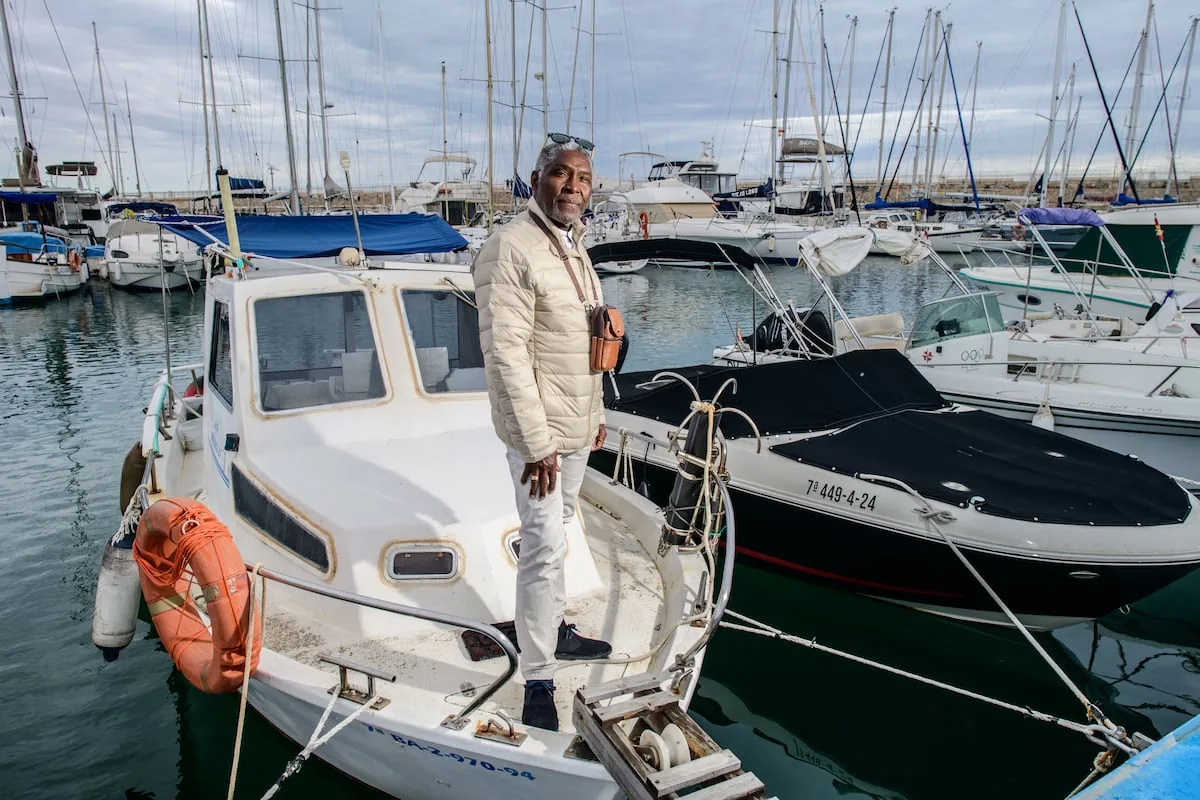
His sailboat, the Almirante, was a grain of rice in the middle of the Mediterranean. While eating the last piece of dry chicken, he smiled at an idea: surely no one but him knew he was still alive. He couldn’t believe it either. Eleven days had passed and for four of those no one was looking for him anymore. “I knew I was a dead man, but I wasn’t yet.”
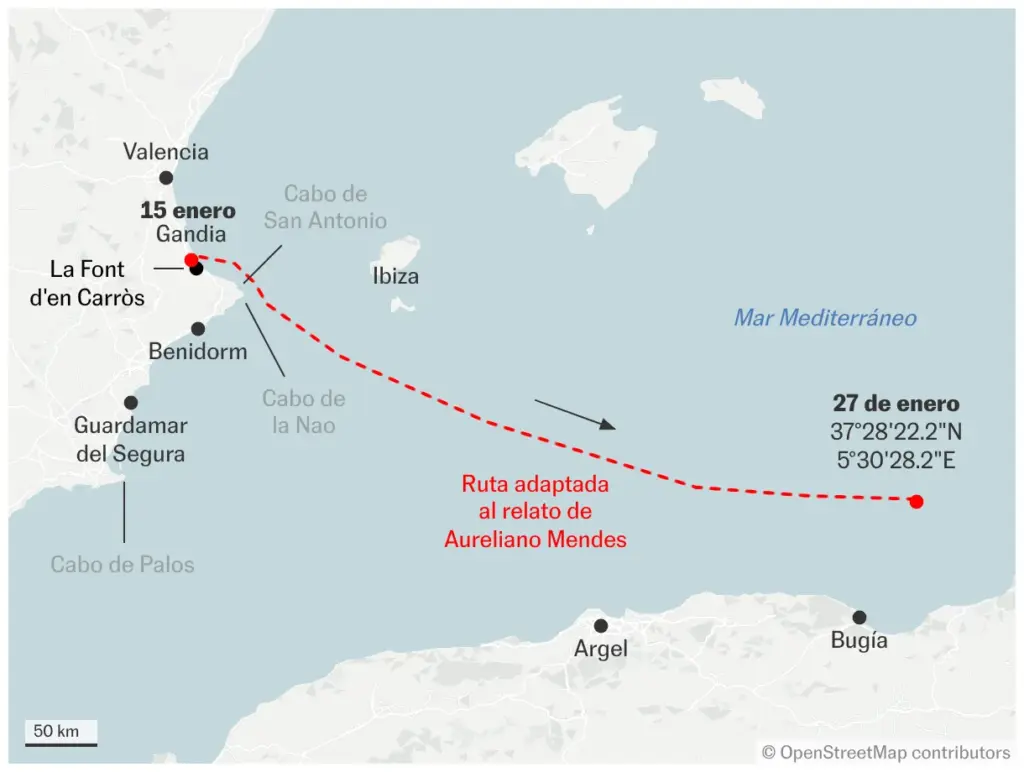
On January 15, Aureliano Mendes Furtado, 69 years old, married with three children, made the first bad decision: to move his sailboat of about 10 meters in length, from the marina of Gandia (Valencia) to that of Guardamar del Segura (south of Alicante), where he had arranged a much cheaper mooring, about 2,000 euros per year. He had to do it immediately or the forecasted storm would arrive and he would have to pay two rents. He got up at six in the morning, at his house in La Font d’en Carròs, 20 minutes by car from Gandia, had breakfast, picked up some bowls of rice and chicken his wife had prepared for him, and said goodbye to her. He planned to return two days later. But then Harry broke loose, the worst storm in 15 years, with waves of five to six meters and winds of 130 kilometers per hour. Then came Ingrid and Joseph. And Aureliano barely saw the sun.
On January 28, newspapers announced a “miraculous rescue.” After 12 days, the drifting sailboat Almirante had been located about 53 miles northeast of the Algerian city of Bejaia. A plane from the European Border and Coast Guard Agency (Frontex) had seen a man with his arms raised in a distress signal and a merchant ship, the Thor Confidence, flying the Singapore flag, had hoisted him aboard. A few days later, that huge 200-meter-long ship headed to Algeciras to return the castaway to Spain.
Since then, very few knew his story. Not even in the bars of La Font d’en Carròs, where the last big news was whether they could participate in the Grand Prix, had he become a little famous.
Three months later, on a Thursday in mid-April, at 10:30 p.m. at a gas station that should have already been closed, a man got out incredulously from a rundown red Renault Clio dressed in a suit and tie.
—Who are you? What do you want?
Aureliano hadn’t wanted to tell anything. But he had just changed his mind.
Chapter I. Objective: not to lose sight of the land
On January 15, Aureliano had a plan. Maybe it wasn’t the perfect navigation plan: it was based on not losing sight of the coast. It didn’t seem easy. He knew, before leaving, even when he bought the sailboat a year and a half ago, that the engine was failing. But he planned to rely on the sail. His trip, which he reviewed in the days before, had apparently simple guidelines: go south, turn a little “to the left” at Cape San Antonio, “but not too much, or I’d be heading to Ibiza [Balearic Islands],” and resume the course to Guardamar. He saw no problem with it. But there were plenty.
Besides the engine, the Polish sailboat’s radio also didn’t work well. He had planned to change it and buy a good device to geolocate the boat. But “I was going to do it later,” he now laments. He had the mobile phone, he convinced himself. But the cable to charge the phone was not the right one. “I lacked more experience, I admit it.”
Aureliano Mendes Furtado was born in the Tarrafal area, north of the main island of Cape Verde, Santiago. Despite being born by the sea, his life mostly took place inland. He hadn’t even gone fishing with his uncle, the only sailor in the family.
Despite the poor equipment and weather forecasts, Aureliano continued on his route. Until he had to necessarily move away from land, and there, in the loneliness of the sea, the storm began: westerly winds of 40 knots. Maritime traffic was suspended in that area surrounding the Balearic Islands. And Aureliano could only make one call to his wife. From that night he knew the journey would not be as he had imagined.
When night fell and he no longer knew where he was, his objective changed: he had to avoid approaching the coast. His greatest fear was now crashing into the rocks; he didn’t know what the Mediterranean had in store for him.
Chapter II. Adrift
On land, his wife filed a report at the Civil Guard station in Oliva the next day. She had had no news from her husband and feared the worst. Meanwhile, Aureliano had not been able to sleep, spending the night trying to keep afloat a sailboat that the Mediterranean was trying to capsize. On January 16, as it began to get dark, he accepted that he was lost.
He had 1% battery left on his mobile. And he had already realized he wouldn’t be able to resume the course. According to his calculations, he should have been heading to Ibiza, but he really had no idea. He had navigation maps he didn’t know how to read, a GPS he didn’t know how to reconfigure, a broken radio, and he hadn’t managed to start the engine. He tried to hold the rudder with a rudimentary mechanism consisting of a board.
In those conditions, he thought to look at the phone and realized he could still make an emergency call. It was 9:43 p.m. on January 16. The Valencian Generalitat Emergency Service registered the call: “Situation stated: adrift, no engine. No radio. Using sea anchor. Plotter misconfigured. Sees coastal lights, location unidentified. Position provided (incomplete).”
Aureliano was trying to read to the 112 operator the damned numbers appearing on a screen (plotter) he didn’t understand. He urgently needed to give coordinates; it was his last chance. Latitude: 38º22.35’ North. Longitude… The call was cut off. The battery had died. He could be anywhere on the planet located on that horizontal line. Aureliano was officially nowhere.
According to information provided to this newspaper by Maritime Rescue, a later antenna triangulation indicated a possible location “between Benidorm and Cape Nao” that night. And towards that area, an operation continued that had begun with the deployment of the first helicopter that day around 4 p.m. Others would depart, including a Maritime Rescue plane, four rescue boats, Frontex planes, Maritime Civil Guard. They had combed a triangle from Benidorm (Alicante), to Ibiza (Balearic Islands), and Cape Palos (Murcia). But Aureliano did not appear. And on January 23, seven days later, he was declared dead.
Chapter III. Waves like trucks
Aureliano didn’t even know how he could still be alive. “The waves hit the boat as if a trailer crashed into a car. I had to hold on as best I could to withstand the blows. The palms of my hands got burned from holding on,” he recalls. The sailboat faced the wave’s mouth and tilted almost parallel to the water. For hours it was impossible to go out on deck and furl the sail, which would have allowed the wind not to push him so forcefully against the sea.
He stayed as best he could inside the cabin, until he managed to go out to bail water, secure the sail to the mast, see how it was peeling off. “Not even if someone else had come with me would it have been safe to change it. Maintaining balance at that point of the sailboat was impossible with that wind and those waves.”
The Harry storm was experienced at sea as one of the most powerful meteorological episodes in the last 15 years in the Mediterranean, according to AEMET reports. It lasted about four days, from January 17, although two more storms followed. This storm forced the almost total suspension of navigation in critical points, especially in the Strait and routes to the Balearic Islands — where Aureliano had been lost. The Italian coast guard acknowledged at least 380 deaths due to Harry, although migrant protection NGOs reported more than 1,000 deaths on routes from Tunisia to Italy.
By then, he had decided that no matter what happened, he had to sleep. “Or I was going to go crazy,” he says. “So I tied myself with a rope to the bed and closed my eyes. And the truth is I managed it. The physical effort was too much.” When he didn’t use that rope, he got into a “rabbit hole,” a kind of wooden box that prevented him from capsizing from the blows the sea gave against the boat, and “from opening my head on something.”
Aureliano was used to a hard life. His parents were farmers and that would have been his fate if he hadn’t boarded a plane at 17 sometime in 1973 heading to Lisbon. Cape Verde was still a Portuguese colony. After working three years as a bricklayer, he decided to move to a village in León, where he ended up in a traveling circus called Las Vegas, setting up and taking down tents. And months later, he settled in Fabero, in the Bierzo region, in Ponferrada, in a coal mine. In this town of about 4,000 inhabitants, his cousin and he were the only black people 50 years ago.
One day — Aureliano doesn’t distinguish days, but episodes that also come to him when he sleeps — after bailing all the water that came in with each wave procession, he thought the water tank of more than 100 liters he had on the boat had broken. “I saw there were a few inches of water and thought the storm might have opened it. So I emptied it through the sink into the sea.” Those liters could have saved his life.
Aureliano had no engine, no GPS, no radio, no mobile phone, and hardly any food. And after emptying the tank, he was about to run out of water. He only had four bottles of one and a half liters. He was still adrift for two days without eating and one without drinking. The problem was he didn’t know how long he would be without doing so.
Chapter IV: The last dilemma
The only way he thought of for any passing merchant ships to notice him was to crash into them. They would never hear him call for help and he had tried for days to throw flares and almost ended up setting the sailboat on fire. “I didn’t manage to do it right and one fell lit on the wooden seats. I got so scared I didn’t throw any more,” he admits. So he tried, collided with some. But there was no way. He was invisible.
Aureliano had no food left. There was nothing left of the dry chicken he had started rationing from the first night. He also had no water left. In those moments, he had thought about some things, like how he would prefer to die. He was clear that as long as he breathed he had to keep fighting. “I was dead, but I was breathing,” he repeats several times during the conversation. But his mantra had a limit and it was the exact moment when water filled the cabin, before the boat sank: “If that happened, there was nothing to do, and then I thought I would throw myself into the water against the wind. So at least the boat wouldn’t hit me and smash me to pieces.”
There was only one dilemma he hadn’t solved. Not even today: “I didn’t know whether to jump with the life jacket or without it. What would you have done?”
Chapter V: Thais speak English
On January 27, Aureliano was, unknowingly, somewhere close to Algeria. That day a Frontex plane, monitoring the migrant route after days of strong waves, found a boat with the sail tattered into a thousand fringes, with a man raising his arms. The plane had to get closer to discover it wasn’t a canoe, just a man lost who knows how long.
“The plane flew so low I thought it was going to crash into the mast and we’d all die,” Aureliano recalls. It was the first time he began to believe he might return home. Although it wasn’t all done yet. He had to board the Thor Confidence, which had been alerted to go get him. Aureliano remembers it as climbing to a fourth floor by a rope with wooden steps, at a moment when his strength was just enough to hold on to life and little else. “On top of that, they gave me instructions I didn’t hear and, moreover, they were in English,” he now recalls laughing. The rescue lasted hours.
The ship, which was heading to the United States, broke in two the mast of about 10 meters that had withstood all the storms. They tried to tow it, but according to Aureliano, his sailboat was left stranded somewhere in the Mediterranean, on the same route he would have followed if no one had seen him that Tuesday morning at the end of January. “I haven’t even been able to use the insurance, because I don’t know why they released it, I didn’t give the order…,” he laments. It still hurts him to have left Almirante behind. It was 3:00 p.m. UTC, four in the afternoon in Valencia, exactly at these coordinates: 37º28.37’N / 005º30.47’E, according to Maritime Rescue records.
Chapter VI: I have an idea
Aureliano got married in ’79 and lived in Ponferrada many years, even after retiring early from the mine at 42. He had three children. He separated and in 2010 married in Colombia his current wife, the one who filed the report at the station because she thought she wouldn’t see him again, to whom he still doesn’t know how to explain why he can’t get the idea of buying another sailboat out of his head. To sail again. “I have an idea, you know?” he says smiling, knowing everyone will think he’s crazy.
—I want to cross the Atlantic, I want to reach Cape Verde with my sailboat. Although I wouldn’t go alone.
Aurelio’s sarcasm causes suspicion. Maybe that’s why when this newspaper asked about him at the Nautical Club of Gandía, it was commented with some anger that one can’t have things go so badly and still be alive. Aureliano’s feat might not be taught in sailing courses, one of the instructors pointed out, but there is something unbeatable: if he had followed the manual to the letter, if the boat had been prepared and he had been the most skilled sailor, he would be as alive as he is now.