


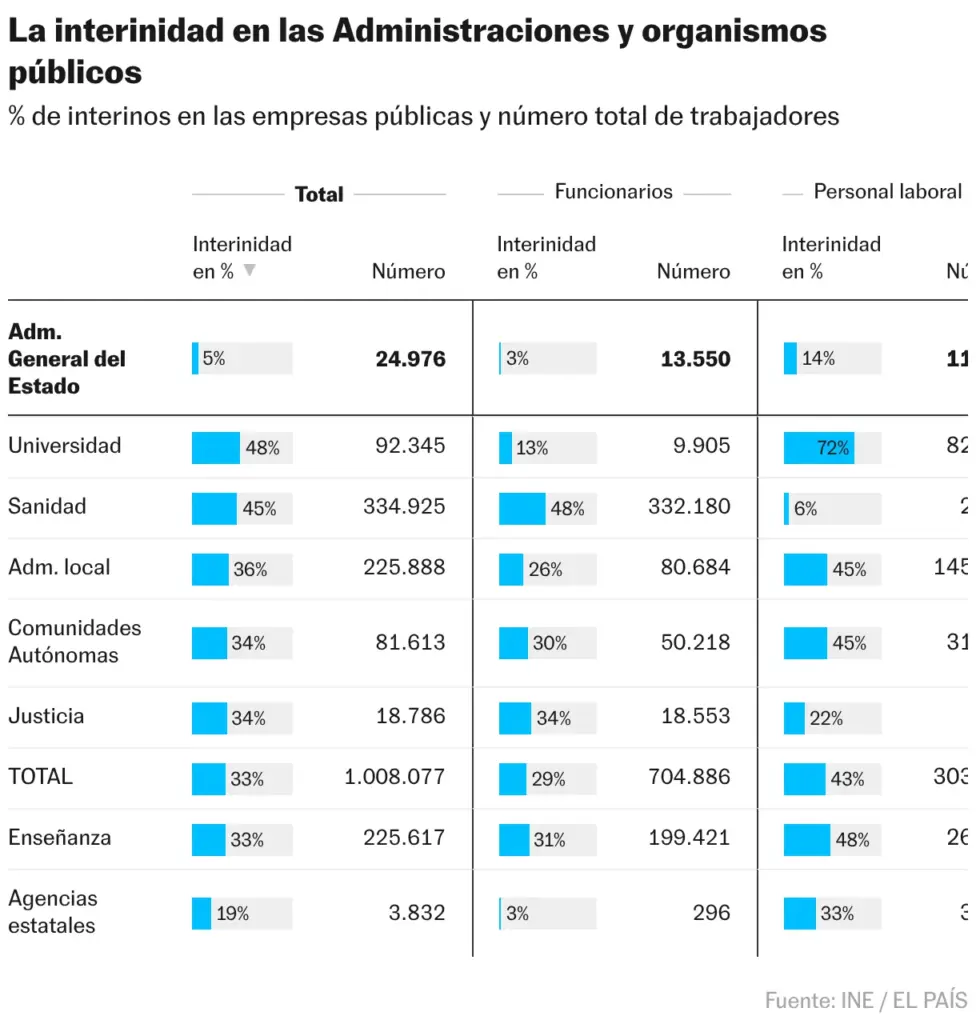
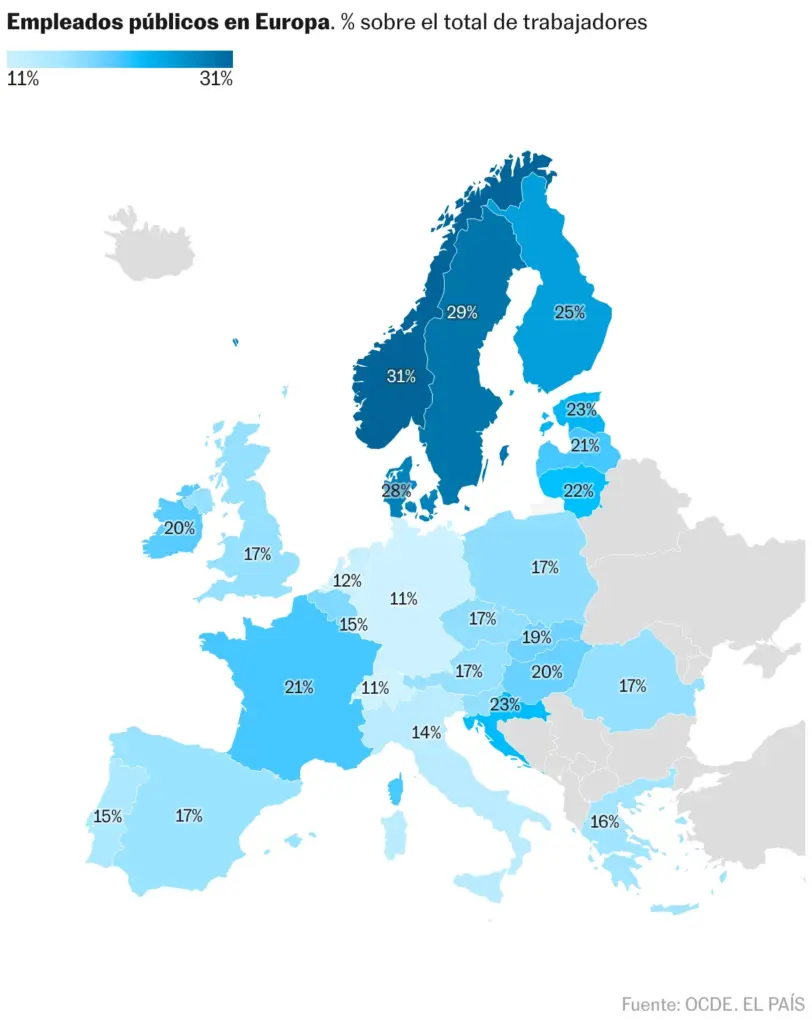
Nieves Lao Giménez is 42 years old and started working for the Andalusian Health Service (SAS) 18 years ago. During all this time, she has accumulated a work history of 17 pages. This official document provided by Social Security records all the job entries and exits that a worker registers in the system, and for someone with a work history of about 20 years, it usually occupies two or three pages. This nurse, who now works in the mental health area of the Torrecárdenas hospital in Almería, has developed almost all her work experience by linking substitutions of a few days, weeks, or months at best. “And without even generating the right to vacation,” she complains. Her case is one of the hundreds of thousands of examples that flood the staff of the Spanish public administrations. These employ more than three million workers. Currently, one in three are temporary.
Far from having a lifelong job — as work in the public sector was conceived until a few years ago — these salaried workers chain contracts, even for decades. In most cases, this constitutes fraud of law. The rule and case law limit the duration of interim positions covering a vacancy, the most common case, to three years. And they establish other limits, in some cases even shorter, for other types of temporary public jobs. This is an issue that has prompted several reprimands from the judiciary and European authorities. The latest, this very week, when the European Commission sent two reasoned opinions to the Government. If Spain does not respond or presents a reform within two months, the European Executive will take it to court.
Lao’s example places her at the lowest rung of public employment precariousness because for almost all the time she has not even been an interim civil servant, but temporary statutory staff, whose contracts have an even shorter duration. When she was finally given an interim position, which she hoped would be longer than the substitutions she had been doing, she was dismissed after a month for administrative, not labor, reasons. And later, she was recognized another interim position for a vacancy, but of a particular type called “non-supervised,” which meant it had to be confirmed every two months.
“For years and years I was not included in the service’s vacation schedules, so I took days off when my shift boss told me, whenever it suited him,” recounts Lao, who has just secured a permanent position after passing a selective process in 2025. Now she has to fight to have points recognized that have not been counted, because the position she is given will depend on it.
J. L., another interim civil servant who obtained a position through a vacancy 15 years after entering as temporary labor staff and who asks not to be identified for fear of reprisals, has worse prospects. This healthcare sector employee from La Rioja sums up the job insecurity that has accompanied him in the Administration with a single fact: “In 19 years I have accumulated 205 employment contracts,” he states. He started as an orderly in a primary care center working weekends. “During the week I was on unemployment benefits,” he emphasizes. “Soon they started giving me administrative or customer service tasks during those weekends, since as an orderly I didn’t have much work and it was cheaper to have me.”
Over all these years, J. L. alternated several positions, always from the substitution pool. He never even became an interim because working only weekends, he never accumulated enough points. Not even for a permanent position. His situation reflects a disadvantage that equally affects temporary workers in the private sector and is one of the greatest harms of the lack of stability: they have many more gaps in their social security contributions. This employee from La Rioja says that despite having worked for 19 years, he has only contributed 11 years to Social Security.

One third temporary
The precariousness reflected in these testimonies extends to hundreds of thousands of public employees. In Spain, there are just over three million, of which around one million maintain a temporary employment relationship (32%), according to the Statistical Bulletin of Public Administration Personnel, whose latest data is from July 2025. The Active Population Survey places temporariness in the public sector at 27%, compared to 12.4% in the private sector.
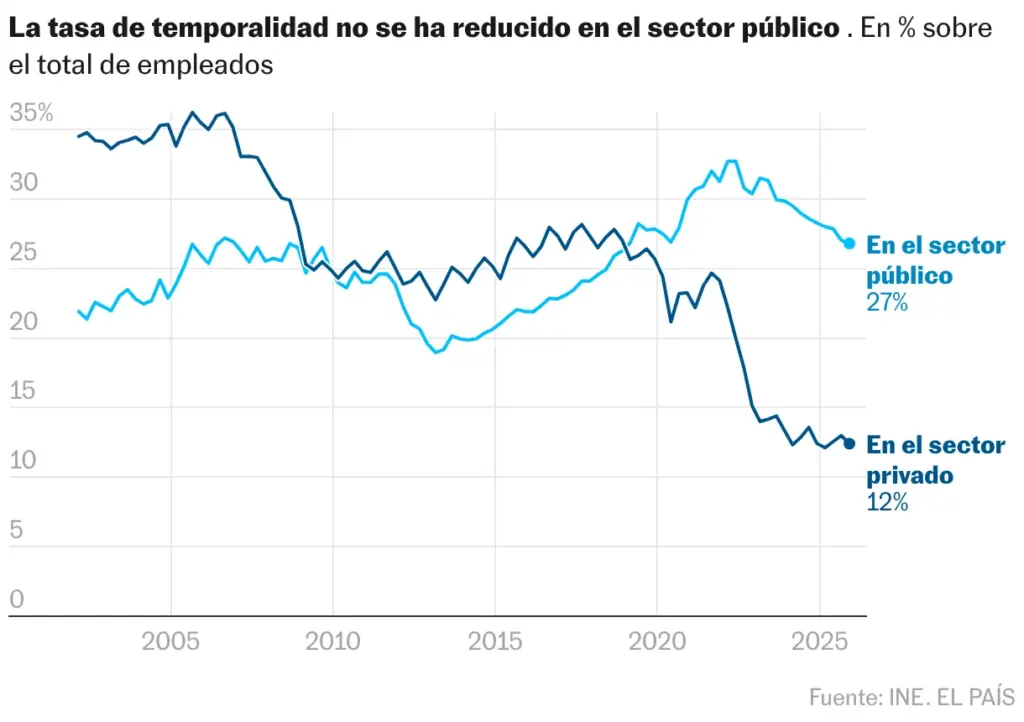
The abuse of temporariness has been one of the major structural problems of the Spanish labor market, with rates approaching 35% before the 2008 crisis. The labor reform implemented since 2022 drastically reduced temporary hiring in the private sector, generalizing permanent contracts. But that progress has not been transferred to public employment.
In this area, thousands of temporary workers — both labor staff and interim civil servants — have been litigating for decades to have the abusive nature of chaining temporary contracts recognized and for the courts to convert them into permanent staff by judgment. Or, at least, to distinguish them as indefinite non-permanent, a figure created by the Supreme Court to provide stability without granting the status of career civil servant. The latter is constitutionally reserved for those who pass a selective process.
Judicial battles over the abuse of temporariness in the public sector have intensified since 2014, when the European Commission opened an infringement procedure against Spain. Since then, the Court of Justice of the EU (CJEU) has repeatedly ruled in favor of the workers. Meanwhile, the Supreme Court has rejected permanence for considering it contrary to the Constitution, an interpretation assumed by the Government, which rules out granting stability without a competitive exam. The opinions sent this week by Brussels represent a reactivation of the procedure.
Insistence of the European justice
The latest ruling of the CJEU, dated April 14, responded to a query from the Supreme Court and reiterated that the solutions in force in Spain — capped compensations, stabilization processes, and the figure of the indefinite non-permanent, which the EU ruling considers a temporary category that perpetuates precariousness — are not sufficient to sanction abuse or repair the damage. Now the Supreme Court must decide in an imminent ruling whether Spanish legislation is adequate.
But the European court has already concluded that it is not: the ruling dismantles one by one the measures taken by Spain to solve the situation. In the case of stabilization processes, which have granted permanence to 419,000 workers in the last five years, the CJEU considers them insufficient to repair the damage because “although the previous experience of the affected worker and the time of service dedicated by him to the development of his tasks are valued, this valuation is not limited to those candidates who have been victims of such abuse.”
Belén, 54 years old and with two children in her care after having divorced, is an interim civil servant for a vacancy in the Justice Administration since August 2004. This means she occupies a structural position that has not been held by a career civil servant for more than two decades. She works as a procedural processor in Madrid and says she has “only” chained eight contracts since entering the public sector. Now she complains that she could find herself “on the street from one day to the next,” because the Administration she works for has designed a new job pool to access vacancies. To apply for the positions, she explains, “the least weighted factor is experience, compared to having a law degree without any experience and, secondly, having passed some isolated test of a competitive exam.”
“I have been dedicated to Justice for more than 20 years, I control all jurisdictions, criminal, civil, social, the registry… now I will have to teach those who arrive and maybe I will be fired,” laments the civil servant from Madrid. During all this time she has tried to get a permanent position but has not succeeded. “I have applied to all the processes that have arisen, but they set a very high cutoff score and only those who do nothing but study can apply. I don’t have eight hours a day to study,” she narrates. She is afraid of losing her interim position and, like many divorced women, of losing her home when her children leave. “During all these years, I have not been able to apply for a loan to buy a house, first out of responsibility, because I had no guarantees of keeping my job, and later because they don’t give me a mortgage even though I am a civil servant, because I have a temporary job,” she recounts.
The lack of adequate compensation for the abuse of temporariness is reflected in the case of Juanjo Manzano, 66 years old and interim civil servant since 1985. Although he has barely changed positions — “I was 25 years in one position and in the current one, in the Madrid deanery, I have been for 13 years” — he has always lived with the uncertainty that his position would be put up for competition. After unsuccessfully applying to several competitive exams, he now expects to be dismissed to retire and has claimed compensation from the Community of Madrid, which has been denied, so he has expressed his disagreement. In response, he warns: “If three months pass and they do not answer, administrative silence will operate and I will go to court to claim damages.”
If it reaches the courts, Manzano’s case will not be isolated by any means. According to lawyer Javier Araúz, who handled the lawsuits that opened the infringement procedure against Spain in 2014, there could be about 40,000 active cases in the courts related to the abuse of temporariness in the public sector. Some courts already apply the latest CJEU ruling without waiting for the Supreme Court, such as the Social Court of Vigo, which recently granted more than 52,000 euros to a CSIC researcher for chained temporary contracts since 2008, even though she was declared indefinite non-permanent in 2010 and later accessed a stable position. Similarly, a court in Madrid has just annulled the dismissal in 2024 of an interim after almost 20 years in a structural position and recognized her as “indefinite by judgment,” without converting her into a career civil servant.
Both rulings comply with the mandate to raise the currently foreseen compensations, in theory, without contravening the Constitution. The Supreme Court and the Government rely on this to justify their refusal to initiate or change the law. But Gerardo Pérez Sánchez, PhD in Constitutional Law from the University of La Laguna (Tenerife), highlights that “it is textbook that national law is below community law.” In this regard, Javier Ramón, former magistrate and managing partner of the law firm BDO, interprets that after the European rulings of February 2024 and April 2026, “all doors to not making affected workers permanent have been very closed.”