




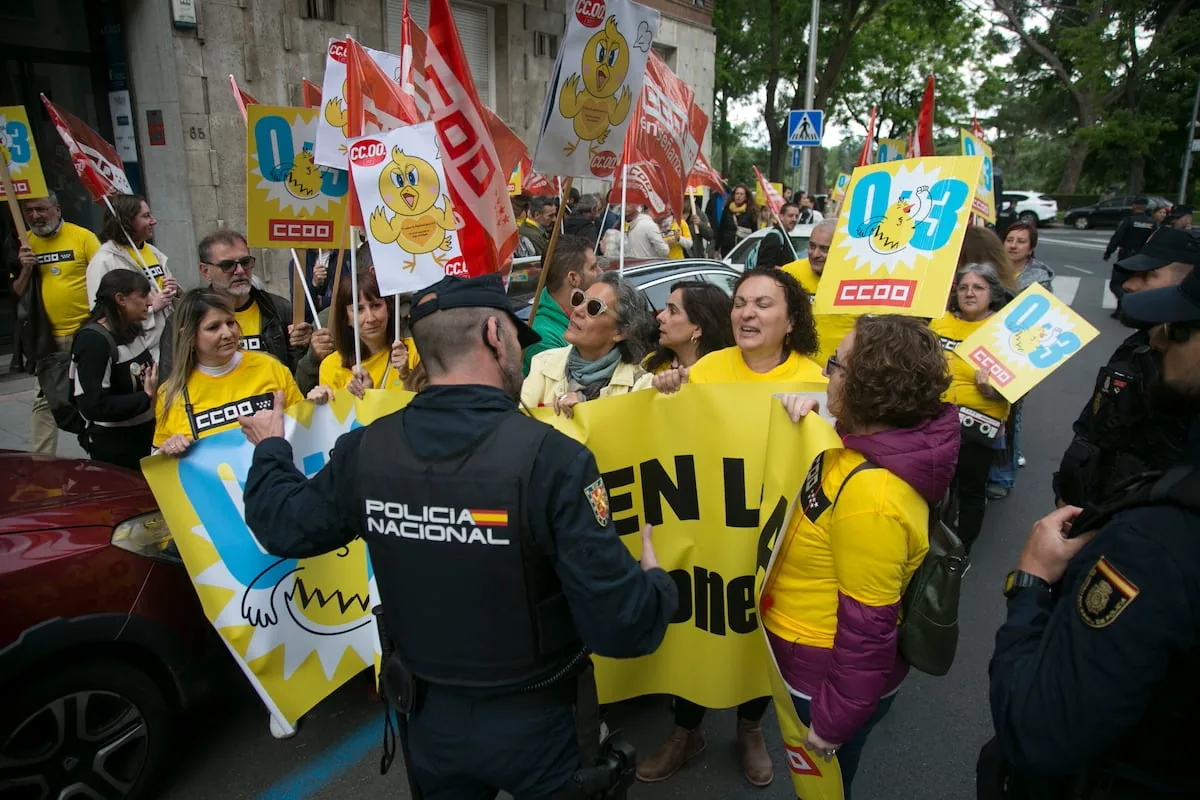
The first cycle of Early Childhood Education experiences this Thursday its first nationwide strike day covering both public and private education. A mobilization that, according to the CC OO union, the majority in the stage and the organizer of the strike, has had a turnout of over 75%. The private nursery school employers’ association has not provided data. And in a very fragmented public network, administrations have reported disparate participation, including 23% in those of Barcelona, 25% in those owned by the Junta of Castilla-La Mancha, and 0.04% in those of the Generalitat Valenciana. The 61,000 educators and teachers of 0-3 (97% of the staff are women) represent the proletariat of the education system: their salaries, schedules, and workload in the classroom are much worse than in other levels, especially those who work for private companies, which account for around 50% of the total.
Read more ‘The cell’: Aristotle and the universe
“Until two months ago, we were 11 euros below the Minimum Interprofessional Wage, and they had to regularize us,” says Cristina, 52, who has worked for 30 years as an educator in a private nursery school in Madrid; “with our salaries, either you have a partner who supports you, so you depend on that person for absolutely everything, or you look for another job in the afternoons, at night, or on weekends.” Carmen, 36, employed in a municipally managed private school in Castilla-La Mancha, adds: “I have colleagues who have separated and had to move back in with their parents because living alone was unsustainable. With just over 1,000 euros net per month, and rents starting at 700 euros for the cheapest, how do you live, pay for transport and heating, how do you eat?” Carmen holds an educator position, which requires a higher vocational training degree, although she has a diploma in Early Childhood Education and a degree in Pedagogy. Both women ask that their full names not be published for fear of labor reprisals. In their school, the strike was 100% this Thursday.
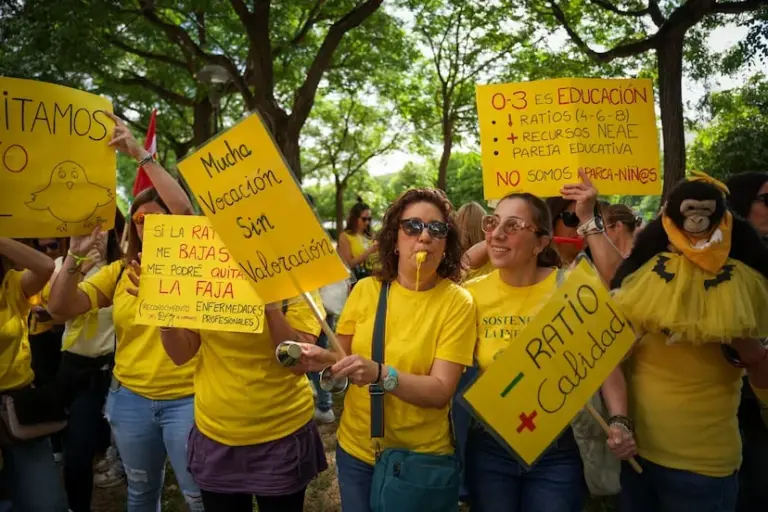
“We work in a context of precariousness and with very high ratios. Alone in classes with eight babies from 0 to 1 year old. And that does not guarantee the well-being of the children, nor does it allow us to adequately attend to those with specific needs,” continues Raquel Vizcaíno, 39, educator in another municipally managed school by a company in Seville, where only the minimum service staff went to work (four educators, the director, and the cook).
The maximum allowed number of children in Early Childhood Education reaches 13 students in the 1 to 2 years class, and 20 in the 2 to 3 years class, more than double the recommendations of the European Union. They are also the only ratios that have not improved since 1991. The Ministry of Education, which was about to approve a decree in 2022 that lowered these figures but ended up withdrawing it, has committed to approving it now by summer.
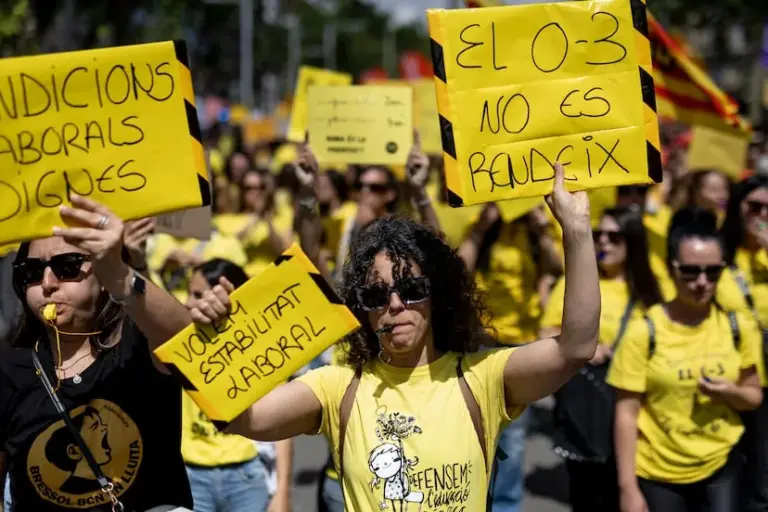
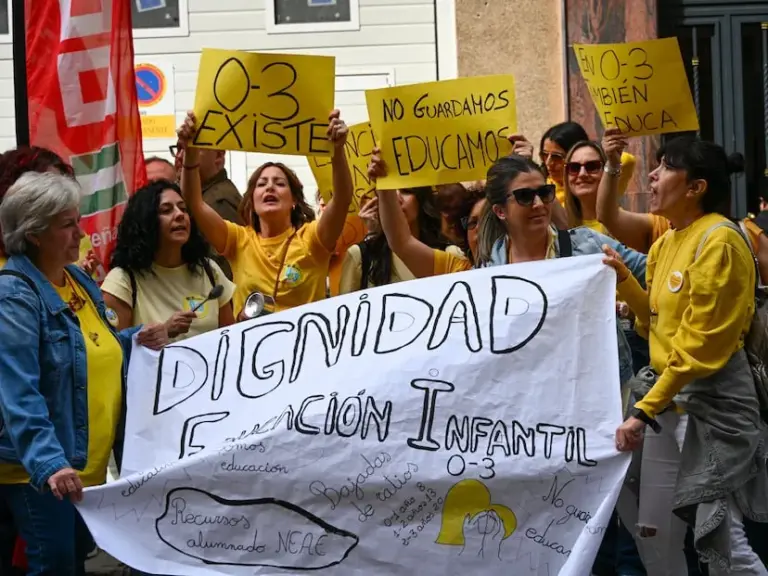
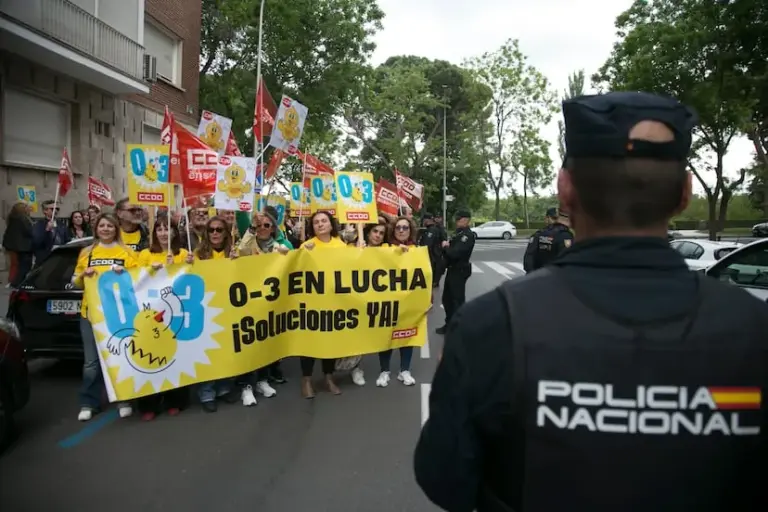
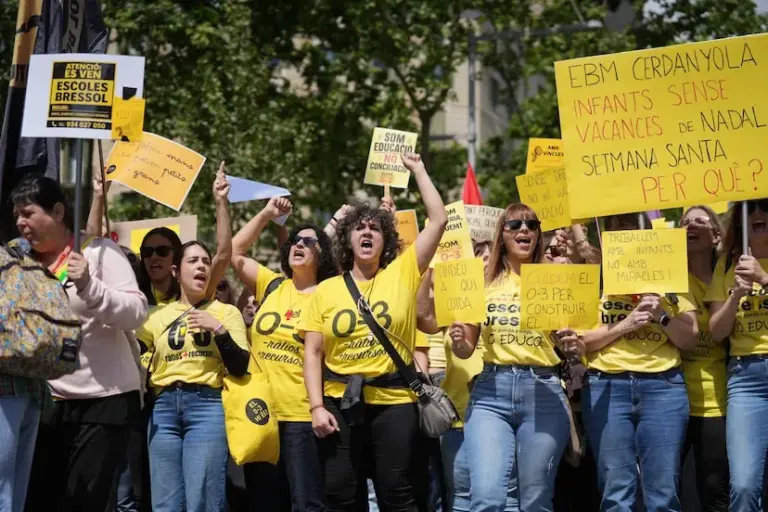
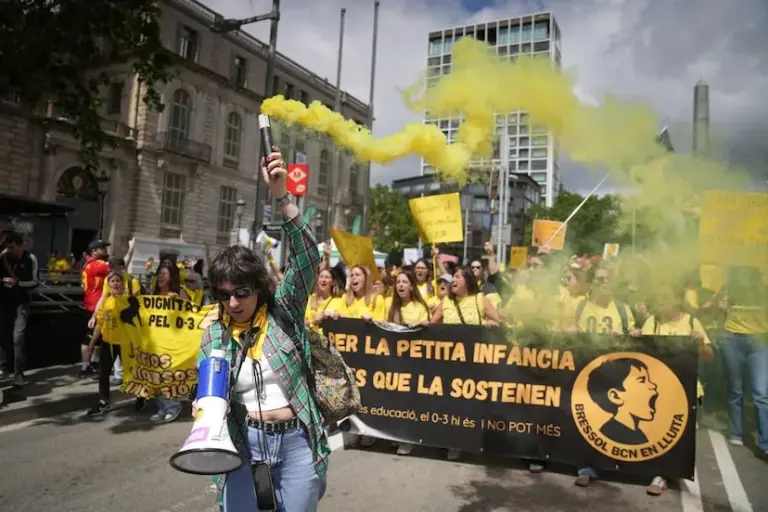
0-3 educators carry out 38 teaching hours (that is, work inside the classroom) per week, while in the second cycle of Early Childhood Education (3-6) and Primary it is 23 hours, and in secondary, 18. “That means we do not have scheduled time to prepare classes and meet, which forces us to do it in the afternoons, outside our working hours. The training courses, which they require to value our seniority, even if with a very low supplement, we have to do on weekends,” says Carmen.
Origin in Madrid
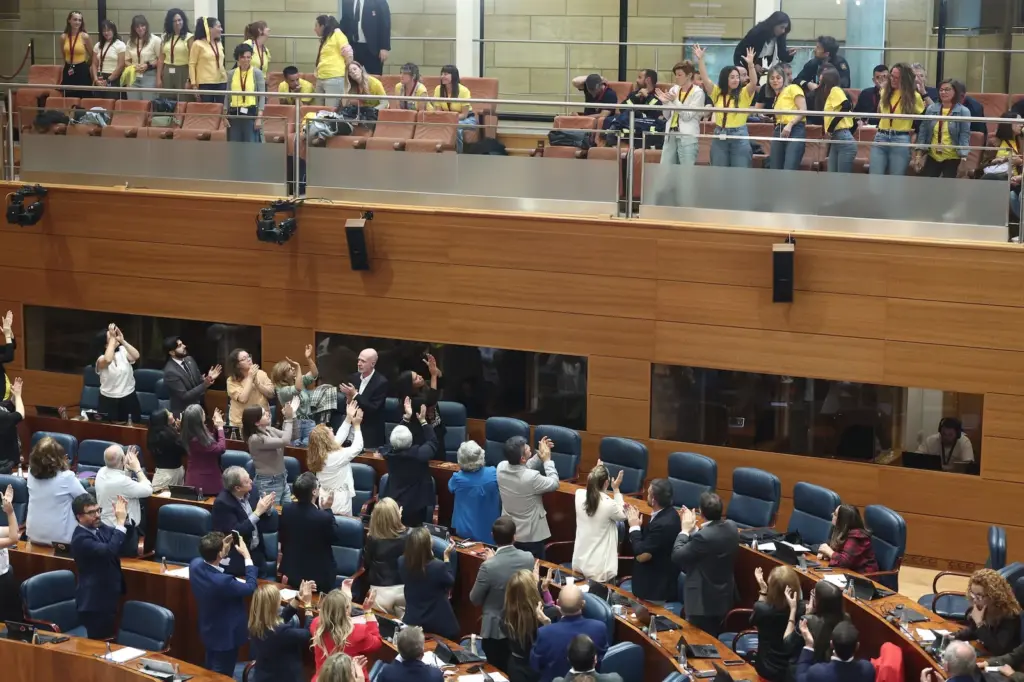
The strike call targets about 11,000 educational centers in Spain. Comisiones Obreras called it after a platform of teachers and educators, along with the CGT union, had been on an indefinite strike for a month in Madrid, and protests occurred in other parts of Spain. The strike started strong, but its participation has decreased as weeks have passed, union sources point out. Not so the mobilization of the Madrid Early Childhood Schools Labor Platform (PLEI), which has managed to maintain its protest in the streets and this Thursday gathered about 400 professionals in front of the regional Assembly. They demand a salary increase, a lower ratio, equalizing their conditions to those of workers in the second cycle of Early Childhood Education, 3-6, and an improvement of publicly owned facilities: “We have leaks, rooms unusable due to dampness, in July there are babies at 35 degrees in the classrooms and in winter they crawl on the floor without working heating,” denounces Esther García, 39-year-old educator.
A few meters away is Maki, 36, who prefers to give her nickname to avoid reprisals. She travels from a private nursery school to support her colleagues. “Educational privatization is the biggest mistake we can make as a country,” she insists. She admits that many times she cries at her workplace because she feels overwhelmed. “I attend mobilizations once a week, I cannot afford to be there every day, I lose between 50 and 70 euros in each strike,” she expresses. This Thursday’s strike means escalating the Madrid conflict, because workers face similar precarious situations throughout Spain, denounces the general secretary of the CC OO Education Federation. The mobilization faces, however, several difficulties. On one hand, between 0-3 workers in public and private education there is a chasm in working conditions, clearly better among the former, admits another union source. On the other hand, the private sector is largely made up of small companies and there are various public-private management formulas, which complicates unified actions.
“You end the day with a feeling of helplessness and sadness”
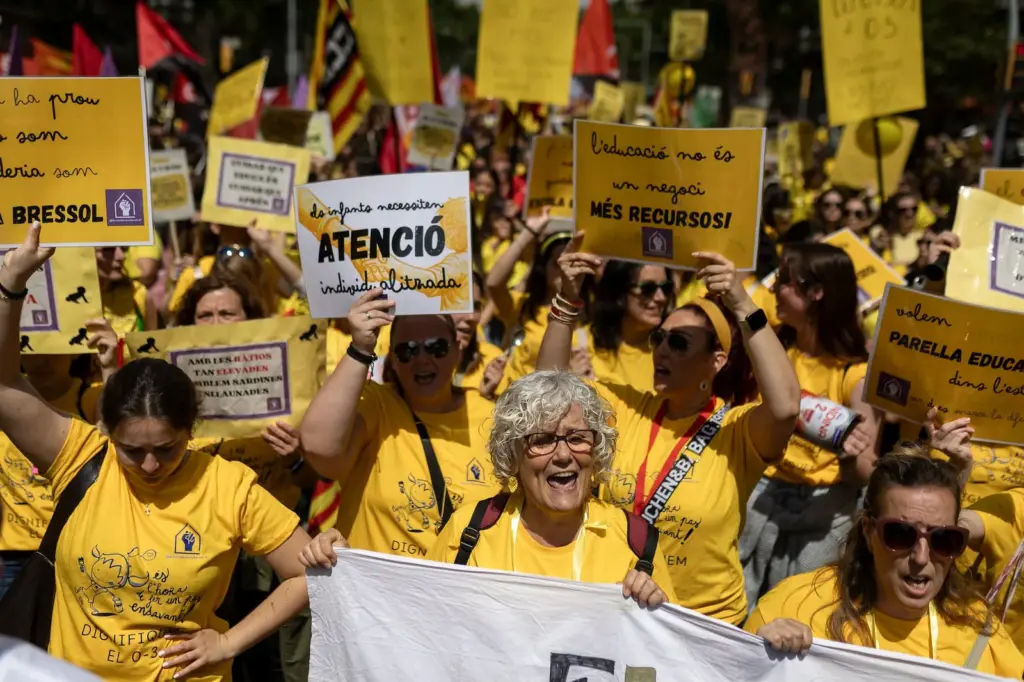
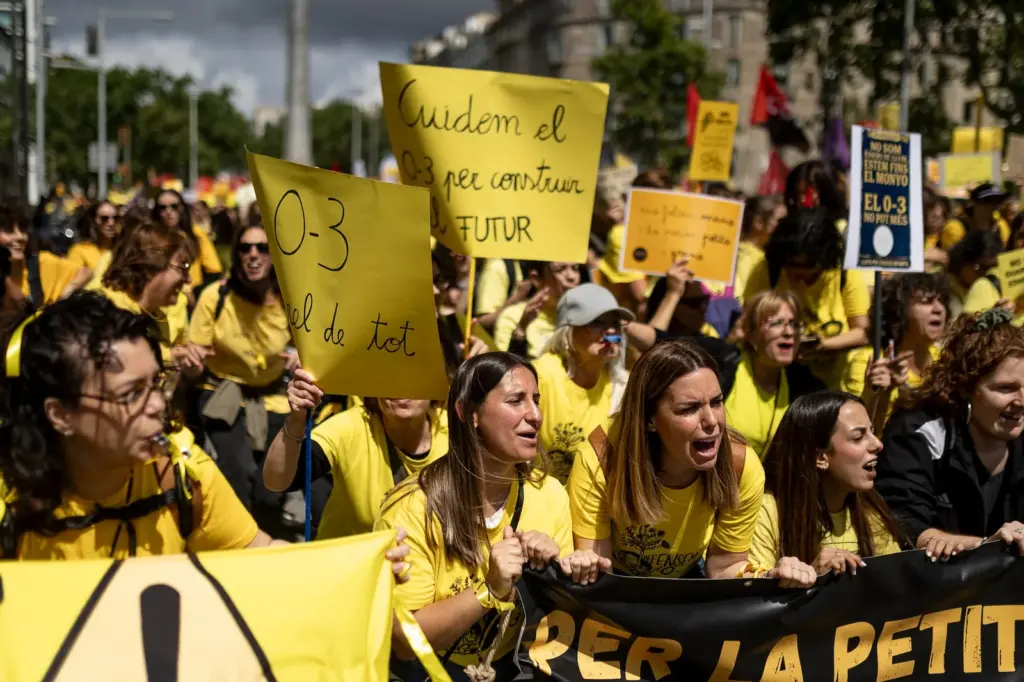
In Catalonia, the 0-3 strike inaugurates five weeks of educational stoppages, coming after massive mobilizations in March and February, and has been accompanied by a demonstration of about 2,000 people through central Barcelona. “Every strike day they deduct 100 euros from me, but I don’t have children and I can afford it. Many colleagues are single women and cannot. But we can achieve improvements and for that we have to take to the streets,” defends Marina Baro, educator in a public nursery school in Montcada i Reixac (Barcelona). The young teacher also summarizes her reasons for protesting again (she has participated in all strikes): “You can have five of the eight babies in the classroom crying and you cannot console them. Or you have two hands to put 13 children to sleep. If one needs arms, you cannot pick them up because you cannot reach everyone,” she laments.
The experience of the young teacher is the same as Núria Amat’s, with 40 years of experience and about to retire. “You see children with needs, but without support, a student vomiting, another fighting, another hurt… In the end, you finish the day tired, but with a feeling of helplessness and sadness for not having given the children what they needed,” explains the teacher. And she offers a solution: “The key is to recognize 0-3 as an educational stage, then everything would be solved. The first years are the most important because they lay the foundation for the child’s development, regarding relationships with people and their environment, self-knowledge…” she proposes while next to her a one-year-old baby bangs a small pot with a wooden spoon. In fact, many teachers have used classroom materials – stainless steel containers or infant powdered milk cans – to sound the march that started from Jardinets de Gràcia and ended in front of the Government Delegation.
Ernest Vilà, besides demanding better conditions, also advocates for the presence of men. “Some families make comments and may doubt whether you will be able to care for their child, but anyone is capable, it’s a matter of ability and trust,” demands this educator from a school in Sabadell.
From the 0-3 Platform, organizers of the protest, they regret the administrative mess of competencies in this stage (state regulation, ownership by municipalities, and silence from the autonomous communities, because it is not a compulsory stage). “We ask the Government to lower the student ratios per classroom, because they can be changed by decree, and that communities and municipalities do not pass the ball to each other, we need to dignify the conditions of students and teachers,” defended Gina Rius at the Barcelona demonstration.
Fleeing precariousness to Ireland
“What were you doing while they bit my son? Attending to 19 others,” read a banner demanding a ratio reduction at the gathering that took place in Seville, in front of the Junta’s Education delegation, attended by about 300 women wearing yellow t-shirts and noisy horns. 90% of the 2,200 Andalusian nursery schools are private, reports Javier Martín Arroyo.
“It is an unsustainable situation for these educators and technicians, who for 1,080 euros have endless shifts with high precariousness that affects our children. We demand an educational partner, more staff, and specific resources for special needs. Also, the price the Junta pays per student place ―340 euros― has been frozen for years,” reproaches Marina Vega, general secretary of education at CC OO. Despite the sector’s poor working conditions, the Andalusian Junta (PP) returned 112 million to the central Government to create 12,000 new public places two years ago under the argument that it would cause job losses in the sector, Vega recalls.
The clear consequence of so much wage scarcity is Sara Rojas, who at 30 emigrates to Ireland in a month: “I’m leaving to escape precariousness, to escape the minimum wage. There in Sandyford they will pay me 2,560 euros gross for a 40-hour week, although I would love to return soon to educate the new generations of my country,” she says with a certain sparkle in her eyes. Beatriz Fernández, educator in a nursery school in Alcalá de Guadaíra (Seville), concludes: “You are with 20 children in the classroom to educate them, feed them, and change them, because the ratios are abusive. You get home frustrated and exhausted, we can’t take it anymore. If the money is public, let it reach us.”
Read more Cara Delevingne confesses to Rosalía: “My weakness used to be heterosexual women”