







The use of artificial intelligence (AI) on social media is reaching new heights. Commonly known as slopaganda, a term composed of the words sloppy and propaganda, it refers to low-cost audiovisual content that is easy to share on digital platforms. In recent months, amid tensions over the conflict in the Middle East, Iran has increasingly resorted to posting satirical images and videos featuring the President of the United States, Donald Trump, for propaganda and humorous purposes.
Trump himself, now at the center of content generated by the Iranian government, has already made the use of AI a recurring practice during his second term. Since returning to the White House, the president has posted AI-created images on his social network, Truth, in which he appears excessively glorified. Some examples include the photo shared by Trump on Sunday, showing him dressed as Jesus Christ healing a sick person, following his confrontation with Pope Leo XIV; or the photo showing him placing an American flag in Greenland after threatening to take over the island.
But in recent months, as tensions between the United States and Iran grow, the biggest beneficiary of this technology is the Islamic Republic itself. The arrival of AI has allowed the regime and its supporters to spread their propaganda beyond Iranian territory and attract the attention of a broader and previously unreachable audience: the West. Slopaganda videos shared by Iranian embassies worldwide, caricaturing Trump and his administration, have been viewed hundreds of millions of times since the start of the war in the Middle East.
However, various experts warn of the risk that the popularization of this type of content trivializes the consequences of the conflict, which has already caused hundreds of thousands of deaths.
Jesus Christ
President Trump posted an AI-created image last Sunday in which he was depicted as Jesus Christ. The image, which appeared shortly after the Republican confronted Pope Leo XIV, was removed the next day after the president received a wave of criticism from Catholic, evangelical, and Protestant associations and representatives, as well as other conservative organizations aligned with him.
In the 24 hours between these moments, Iran took advantage of the post—and the criticism of Trump—to turn it into its latest meme: a video, also AI-generated, in which Jesus Christ approaches the president from behind, hits him, and he falls into what resembles hell.
The content, which has already amassed 46 million likes, has been shared five million times. Among its distributors is the Iranian Embassy in Tajikistan.
pic.twitter.com/JfIzjX1Glx
— Iran Embassy in Tajikistan (@IRANinTJ) April 14, 2026
LEGO
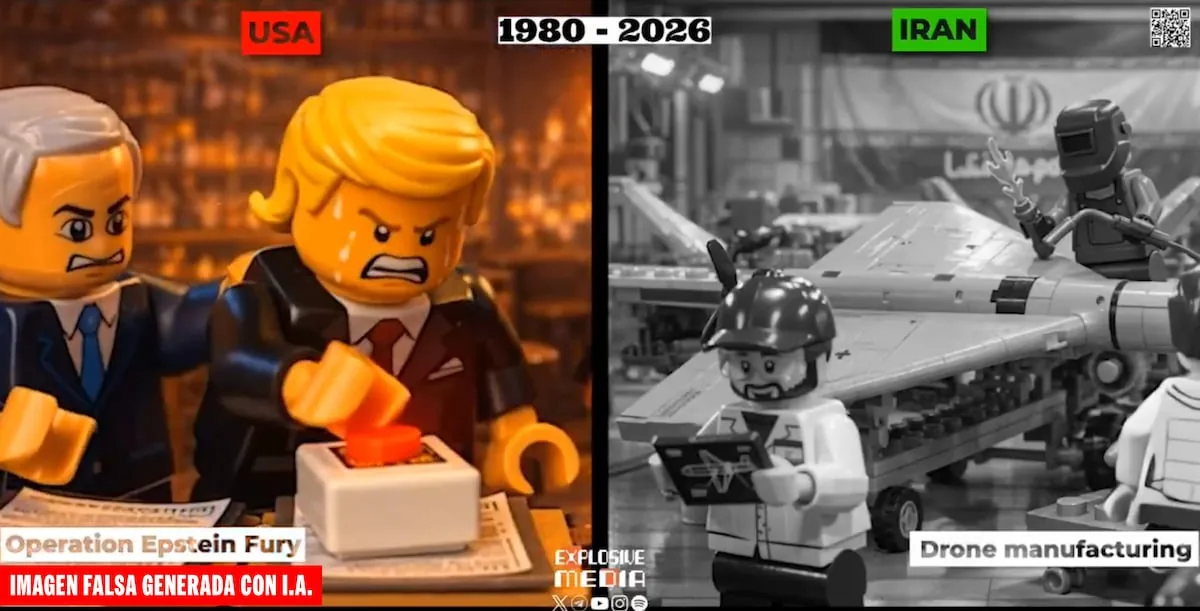
Another of the videos shared by the Islamic Republic on its social networks and that have gone viral in recent days are those created by the company Explosive Media, known for its AI-generated content and LEGO aesthetics.
In an interview with the BBC, a company representative, who asked the interviewers to refer to him as “Mr. Explosive,” admitted that the video was created at the request of the Iranian government, one of its “clients.” He stated that the message behind the generated content was that Iran resists “an all-powerful global oppressor,” that is, the United States.
Explosive Media has disseminated numerous videos with its usual aesthetic to denounce the war in the Middle East. On several occasions, the Iranian Embassy in South Africa has shared the content on its official X account.
Read more The Supreme Court rejects the urgent suspension of the immigrant regularization decree
I think it’s time for a history lesson for U.S. officials.
You said “Stone Age” 😎 pic.twitter.com/G1DpVKHPbY— Iran Embassy SA (@IraninSA) April 15, 2026
‘Blockade’
The artist Snicklink has also joined the slopaganda trend in his media campaign against the U.S. president. In a video titled Blockade, shared by the artist himself, Trump appears in a colorful suit and an ’80s-style haircut, playing a synthesizer while singing about the blockade in the Strait of Hormuz. The caption reads: “If you block me, I block you,” with musical note emojis.
The first comment on the post, left by Snicklink himself, links to the website of his online store, where merchandise with images from the video is sold. “Get your new Blockade merch HERE,” he wrote.
🎶if u block me, I block u🎶 pic.twitter.com/153cVrvCQm
— Snicklink (@snicklink) April 13, 2026
In a later post, in response to Snicklink, the Iranian Embassy in South Africa again praised the content: “You did very well. Your logo appeared in the video. So, like everyone else, we admire your talent and effort. Well done.”
Hormuz Pirates
The Iranian Embassy in Zimbabwe has also contributed by posting what looks like a poster for the Pirates of the Caribbean saga, in which Trump appears at the center of the image, dressed as the iconic Captain Jack Sparrow.
In this case, the satire is not limited to the image but is also reflected in the credits of the hypothetical movie. “A Pedoflix production,” “In betrayal we trust,” and “exposed by Epstein and Weinerstein” are some of the wordplays included in the montage, referring to the president’s friendship with pedophile Jeffrey Epstein.
But they’re still just wandering around in the Indian Ocean. pic.twitter.com/YdxoYBQKLs
— Iran Embassy in Zimbabwe (@IRANinZIMBABWE) April 13, 2026
2028 Campaign
Some of the content even includes references to the upcoming U.S. presidential elections, scheduled for 2028, in which Vice President J. D. Vance and Secretary of State Marco Rubio are emerging as favorites to lead the Republican Party.
“Are you ready, folks? Trump $20.28 per gallon [of oil],” reads a post shared by the Iranian Embassy in Thailand.
Are you ready folks? pic.twitter.com/SUSiPfdiua
— Iran Embassy in Thailand ☫ (@IranInThailand) April 13, 2026