







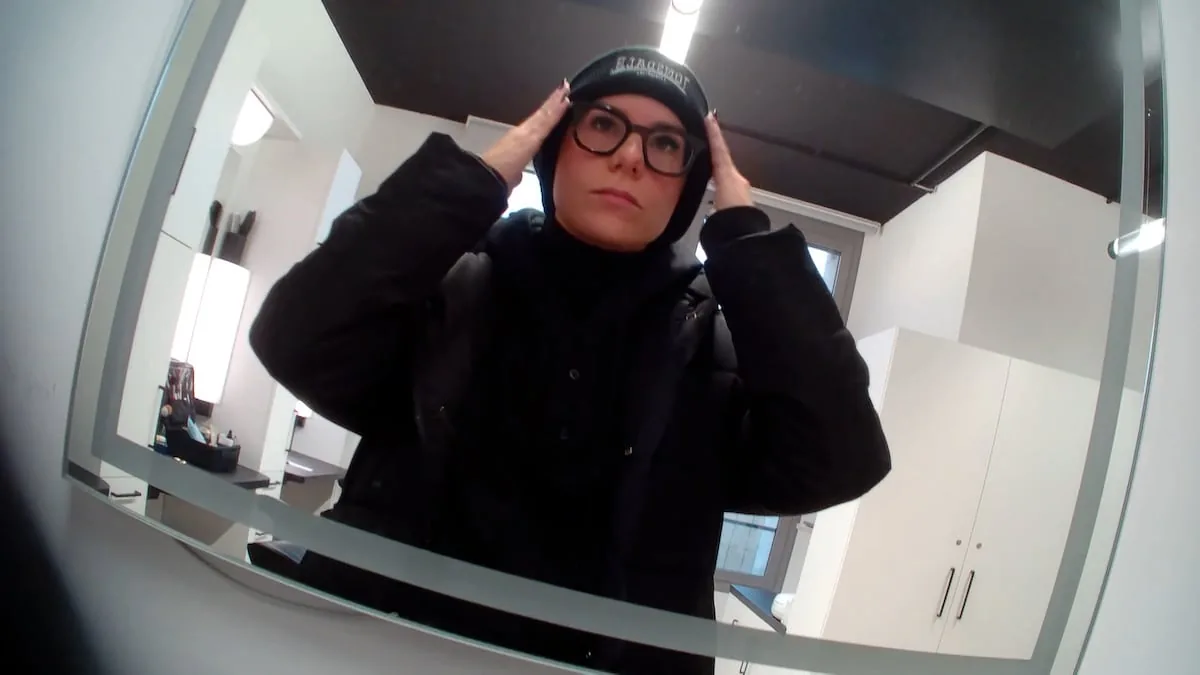
They are teenagers, or young people barely over 20 years old, but above all, far-right radicals who dream of “day X,” the day everything begins, the day they will massacre immigrants. Germans who go to school or their training or jobs, far from the neo-Nazi stereotype of shaved heads with bomber jackets, and who then immerse themselves in far-right extremist movements that talk about a “pure people,” relativize the Holocaust, and hate migrants, but now also feminists and the LGTBIQ+ community. The 33-year-old German investigative journalist Angelique Geray decided to infiltrate these groups between 2024 and 2025 to understand how they become radicalized. “I wanted to find out why far-right extremism is presenting itself again as a kind of cult or youth trend,” she explains earlier this month in a café in southern Berlin after publishing her experience in a book titled Undercover unter Nazis (Undercover among Nazis).
Read more A Cuba on the brink of collapse faces the vertigo of change imposed by the United States
Authorities have been warning about this phenomenon for some time. Far-right extremists use forums and platforms like Telegram, Instagram, or TikTok to recruit new followers, increasingly younger, whom they invite to private chat groups. Intelligence services warn of a new generation of neo-Nazis and in 2025 registered more than 5,300 young people — mostly between 14 and 17 years old — who allegedly committed far-right motivated crimes.
This is not the first time Geray has infiltrated these circles. She already did so in 2018, in the so-called Reichsbürger movement (Citizens of the Reich), which rejects the existence of the Federal Republic of Germany and whose leaders were arrested in 2022 for planning a coup d’état. It was then that she developed her undercover identity, that of Isabell, “that young woman who has an inner resentment, who is dissatisfied with Germany.” Under that name, she later entered the Identitäre Bewegung (Identitarian Movement) and in 2024, the Junge Nationalisten (Young Nationalists, JN) and Letzte Verteidigungswelle (Last Defense Wave, LVW), a group that surprised her because of how young its members are and the violent acts they intended to carry out and that the journalist ended up reporting.

“What I have observed during this time is that many, especially the very young, are precisely looking for recognition. It is, first of all, about belonging to those groups and also about being valued. These groups always have a very hierarchical structure,” Geray points out. That is the case, for example, with LVW, where there are positions like Gauleiter — as the Nazis called the heads of each area —, head of the Gestapo — secret police of Nazi Germany — or Minister of Propaganda. Meanwhile, many of the nearly 60 members, aged between 14 and 21, address the founder as their Führer.
Once inside the group, they are incited to action; words are not enough. “Everyone wants to climb a rung. And in these groups, you rise if you plan especially spectacular acts or even if you carry them out. From setting fire to mailboxes, painting swastikas on any house, to setting fire to the homes of political opponents; or even the plan to burn down a refugee reception center was hatched,” she recounts about experiences she later shared in a podcast, in a documentary for the RTL channel, and now also in a book.
As she explains, you can only be a member of the Young Nationalists (JN) if you are 100% European and at least 50% German. They recruit people between 15 and 35 years old whom they reach through social networks, but also in leisure activities such as boxing, concerts, or excursions.
“With the JN I had to fill out an old-fashioned form with a photo, my address, and my account number to pay a membership fee. In the case of LVW, contact was through TikTok. Then we moved to WhatsApp, and there they sent me a series of questions like: ‘Why have you become right-wing? What do you want to do for Germany?’.”
They immediately sent her videos with young people wearing balaclavas in a room full of weapons. “And they explained that it was about preparing for day X, for situations similar to a civil war, in which you go out on the street intending to kill immigrants.” In fact, one of their rules established that they had to equip themselves with “knives, brass knuckles, blank pistols, firecrackers, and more, to be more radical.”
“Sieg Heil Kameradin!,” they greeted Isabell in the chat groups where events and actions of all kinds are also reported, and addresses of what they consider enemies are shared. “We should pay this one a visit. Who has time next week?”
She thus immersed herself in a world where there were people with cars with the license plate AH 204: AH for Adolf Hitler and 204 for his birthday, April 20. Even in March 2025, she attended a secret neo-Nazi training camp organized by JN. No one suspected her. She also ventured into dating platforms like White Date. “I wanted to know how it works when neo-Nazis go looking for love,” she recounts. For a year and a half, she met with different men. “Many started the conversation saying: ‘You want to have four children, right?’ They made it clear that her time would be for the family and she would have to obey the man.
She went everywhere accompanied by a security team at a distance and equipped with a hidden camera whenever possible. Little by little, she gained the trust of her interlocutors and was able to see how young people radicalize at “a dizzying speed.” “Many join because they feel tremendously lonely, they barely have leisure options in their rural environment, and when there are any, they come precisely from far-right groups.”
They come from diverse backgrounds. “What surprised me the most, actually, is that these young people say things seriously. Often the argument arises that, well, they are young and don’t mean it seriously. But I am convinced that if even young people fantasize about something like that, such as a racial war, and are willing to undertake such brutal acts, it must be taken seriously,” Geray maintains.
Moreover, these groups do not have a good opinion of the far-right party Alternative for Germany (AfD), which in the last elections was the second most voted after the conservatives. “When I asked about AfD, they described it as a kind of ‘useful idiot.’ The party and its leaders are despised, but they are used strategically to increasingly shift the limits of what can be said to the right, so that, at some point, even more extremist parties may emerge,” the journalist recounts.
After months undercover, in May 2025, the situation became dangerous when she crossed the Czech border with LVW members to buy the so-called “spherical bombs” — large, extremely dangerous fireworks banned in Germany — with which, as they later revealed to her, they wanted to attack a refugee center. It was then that she decided to go to the police, who carried out raids and arrested eight young people, aged between 15 and 22, accused, among other things, of belonging to a terrorist organization, attempted murder, and serious arson. The trial against them began last March, and last week, Geray went to testify. “I was so nervous that I felt terrible,” she recalls.
At first, they did not know who had betrayed them, now they do. After her investigation, she wanted to come forward. “I didn’t want to give them the opportunity to unmask me,” something she believes would have only been a matter of time. “It caught most of them by surprise,” but there were also people who did not take it well, like a member of LVW. “He swears revenge. He contacted me through a letter and said he regretted bringing me into the group. He takes the blame and swears to kill me. He says he will find someone outside to carry it out.” She now moves “a little more carefully” and has bought a baseball bat. “I keep it next to the bed. I hope I never have to use it. But, in general, I try not to let this affect me in my daily life.”
Read more Juan Carlos Carpio, the financier who will take the reins of Pemex