





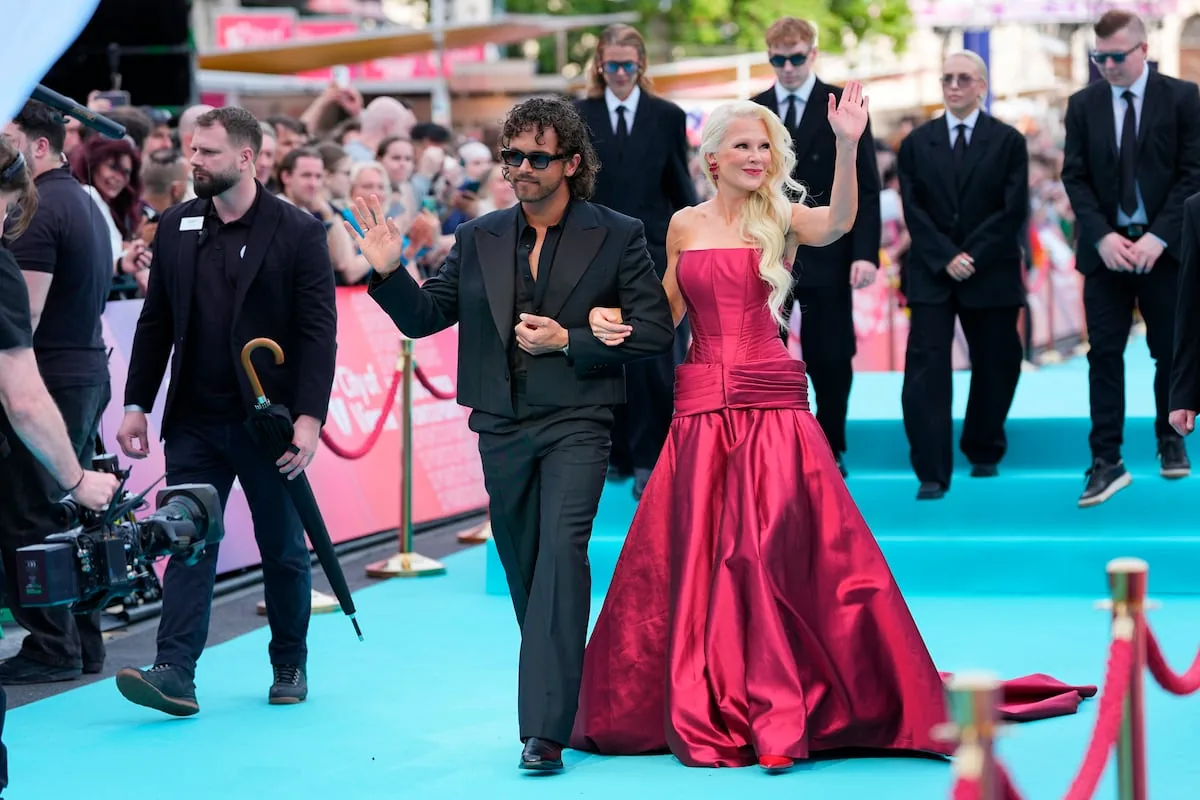
At Eurovision 2026 there is no red carpet. The contestants step on a turquoise carpet. It is not the color of the river nor the sea, but the exact Pantone shade of the Moroccanoil packaging, the Israeli cosmetics brand that is the main sponsor of the festival. The number of countries competing this year, its 70th anniversary, is the lowest since 2004 (only 35, after the departure of Spain, among others). But for several editions now, the competition has been a two-horse race: Israel against the country favored by the official bets. The situation becomes redundant and the contest loses excitement.
This time it is Finland (with permission from the Australian Delta Goodrem) that competes for the popular vote, increasingly marked by political leanings, with the Israeli Noam Bettan. The singer and the public broadcaster KAN were reprimanded a few days ago by the European Broadcasting Union (EBU) after requesting massive support for their proposal through ads that violate the contest’s rules.
The figures make it clear that Eurovision’s controversial support for Israel’s presence is taking a toll on its media impact. Audience reports for the two semifinals broadcast this week show a significant drop in viewers in much of Europe compared to last year. Even Sweden, a country obsessed with the festival, has lost a quarter of its viewers from one year to the next.
Reproductions on YouTube and Spotify have also plummeted compared to those obtained by candidates from the previous edition. According to data compiled by the ESCStreams portal, the impact of songs this 2026 is at the level of 2021, when the coronavirus pandemic led to a watered-down edition after a year of forced hiatus. Not to mention the budget blow caused by losing hundreds of thousands of euros from participation and broadcasting fees that neither RTVE nor four other European broadcasters pay after withdrawing from the competition.
Support for Palestine in Vienna
A stage set before the imposing statue of Empress Maria Theresa of Austria occupies the majestic square that bears her name throughout Friday afternoon. Keine Bühne für den Völkermord (No Stage for Genocide) is a small alternative festival organized by pro-Palestinian associations in Austria, as a protest against Israel’s presence at Eurovision. The lineup opens with the Palestinian folk band Shatat (diaspora) at an event that “demonstrates that culture is a form of expression where whitewashing has no place,” points out one of its organizers to this newspaper, Luis Cortés Barbado, a theoretical physics researcher residing in Vienna and coordinator of Izquierda Unida Exterior.
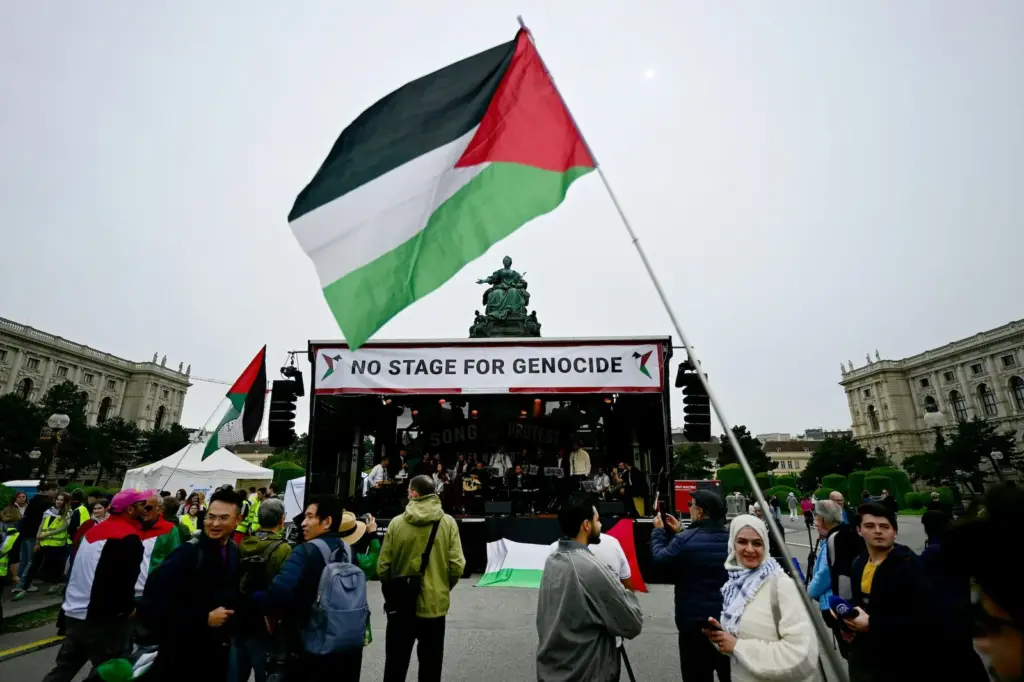
For this Saturday at 14:00, shortly before the Eurovision final begins, a demonstration is scheduled through the center of the Austrian capital aiming to surpass the 20,000-person turnout of a similar event last September. Although neither ORF, the Austrian public broadcaster hosting the music contest this year, nor the rest of the country’s media “have helped in recent years for people to become aware of what is happening in Gaza,” in Austrian society, Cortés Barbado believes, “the Palestinian cause is increasingly taking hold; the excuses for that perverse use of the Holocaust are running out.”
Read more 15 years of 15-M: it was not a crisis, it was a scam
The Spanish Minister of Youth, Sira Rego, has sent a statement of support to this alternative festival, in which she calls the fact that Eurovision organizers “allow this violence to be covered up” a “shameful complicity.” “The peoples of Europe refuse to be accomplices in the normalization of barbarism,” says Rego in her statement, after 72,736 people have been confirmed dead by Israeli fire in the Gaza Strip since October 2023, according to the latest report.
Eurovision is key for Israel
In 2017, the Israeli government, led by Prime Minister Benjamin Netanyahu, decided to abolish its public broadcaster IBA and replace it with a new broadcasting entity: KAN. The opposition expressed concern that Netanyahu wanted to control the media, as he had accused IBA journalists of being too critical of his right-wing coalition, the BBC explained at the time.
In its first participation in the festival, KAN already managed to win with Netta and the song Toy, a frivolous song in which the performer clucked like a chicken and which allowed Tel Aviv to be the host city the following year. Having become a powerful Eurovision force, the broadcaster has chosen representatives almost every year who exalt patriotic sentiment in their lyrics. In 2019, they competed with the song Home. In 2021, after the pandemic, they chose Set me Free. The politicization of the Eurovision candidate has intensified in the last two editions. In 2024, the country presented the song October Rain, a clear reference to the Hamas terrorist attack of October 7, 2023. The EBU requested changes to the lyrics to comply with the rules and the apolitical vocation the festival claims for itself. KAN had to change even the title. The song became Hurricane. And in 2025, the public broadcaster presented A New Day Will Rise.
This Monday, an investigation by The New York Times expanded on some data known for some time: that the Israeli government has been promoting votes for its Eurovision representatives at least since 2018, the year KAN took over. In this way, it tries to turn the contest into a powerful soft power tool, a term referring to a state’s way of imposing its criteria internationally without using weapons. For example, the American newspaper estimates that only 500 organized people would have been needed to guarantee the 12 points from the Spanish televote, which Israel obtained last edition and which led RTVE to request an external audit from the EBU that never arrived and was one of the reasons for Spain’s absence at Eurovision 2026.
Read more The encrypted ‘chats’ of the drug traffickers in the port of Valencia: “We control all police units”