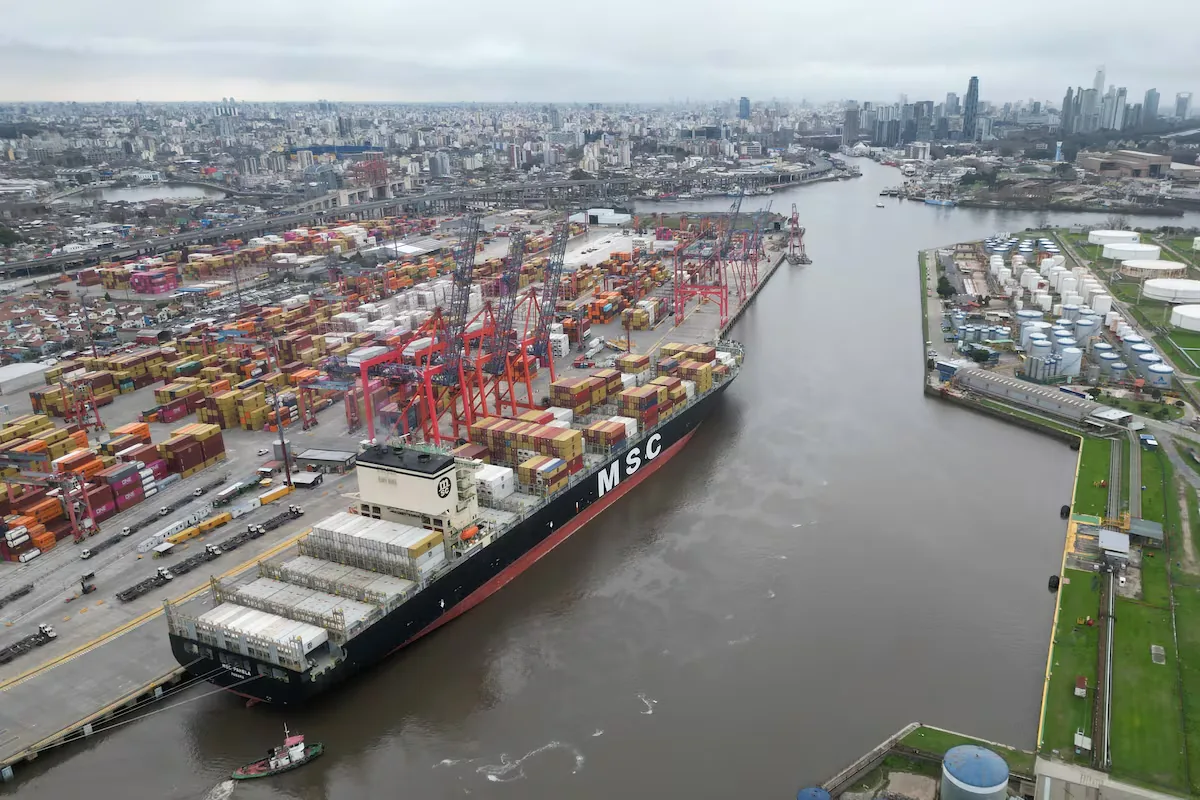
A protest by navigation pilots —local experts who board vessels to guide captains’ maneuvers when entering and leaving terminals— is disrupting the operation of the ports through which goods that Argentina trades with the world pass. Professionals in this sector have responded with a work stoppage to a decree by the Government of Javier Milei that seeks to relax the regulations under which they operate, preventing the normal activity of at least a hundred large vessels. While the Government assures that the new regime will reduce operating costs and promote greater competition among providers, the pilots point to a possible impact on safety.
Read more SpaceX shoots its revenue up 92% in the first quarterly results after its IPO
The strike affects both the port terminals of the waterway on the Paraná River and the various maritime nodes. According to specialized media, it involves almost three million tons of merchandise, mainly including agricultural products —corn, soy, wheat and their derivatives— and fuels.
The Argentine Naval Prefecture summoned this Tuesday a group of 536 professionals —identified by name and surname— to immediately make their pilotage and navigation services available under the new regime and warned that failure to do so would constitute a serious offense that could even be punishable by imprisonment. The presidential spokesperson, Andrés Ravier, also said that “there will be sanctions” for those responsible for the strike and stated that there is no official estimate of the total cost caused by the service interruption. Private calculations indicated that at least one hundred vessels are stranded, waiting to enter or leave terminals, and that each could lose up to 100,000 dollars per day.
“Argentina needs its rivers to be a highway for development, not a kiosk regulatory,” was the argument of the Minister of Deregulation and State Transformation, Federico Sturzenegger, when promoting the decree that establishes a new regulation for pilotage and navigation services for the country’s rivers, ports, passages, and channels. According to him, decree 690/2026 “modernizes” a regulation in force since 1991 by removing restrictions that limited competition and —according to the definition of the Argentine colloquial expression kiosk— established a captive business from which a few benefited.
One of the most sensitive points of the regulation is that it eliminates the mandatory use of pilots in some cases, which can be replaced by the foreign captains themselves as long as they prove “knowledge of the area and command of the English language.” “To limit the need to hire an unnecessary service, we also expanded the dimensions of vessels from which it is mandatory to hire a pilot and defined areas entirely free from the need to hire them,” Minister Sturzenegger said.
The Government assures that pilotage fees are disproportionate in relation to the income of the vessel crews and points out that the new regulation seeks to facilitate the entry of new providers into the service. It also sets maximum fees for tasks to avoid “unauthorized additional charges” and establishes that companies must periodically publish the prices of their services and report information on the operations carried out.
Read more The Prosecutor’s Office dismantles four fuel theft centers in three States
Additionally, the regulation published last Thursday in the Official Gazette relaxes the conditions for transporting pilots to the vessels they must guide, which would reduce costs considered excessive. According to a chart provided by the Ministry of Deregulation, in some Argentine ports, such as Buenos Aires or Quequén, the boat fee for transporting the pilot amounts to 2,000 dollars, far above the value in other ports worldwide such as Amsterdam (700 dollars), Valparaíso (300 dollars), or Everglades (200 dollars).
“There is talk of lowering logistics costs and, if necessary, using recreational boats for boarding, which entails compromising the safety of the crew and the pilot. These are very complex maneuvers, sometimes with vessels underway,” sources from the sector who question the new regulation said. “Local experience is not a formality, it is a safety barrier. A mistake on the river has no second chance,” adds a video released by the Pilotage Institute.
The entity that groups the pilots, the Chamber of Pilotage and Navigation Activities, denied to local specialized media that there was an organized strike. According to it, pilots are independent professionals and freely contracted, so it assured that the situation is explained by individual decisions of many professionals in the sector. When consulted by this medium, the chamber did not respond.
Meanwhile, various sector voices expressed concern about the conflict and its effects on the country’s economic activity. The Chamber of Private Commercial Ports (CPPC) issued a statement denouncing that the “service stoppage halts exports and imports, interrupts foreign currency inflows, breaks supply chains, and puts Argentina’s reputation at risk, while highlighting the urgency of updating the regulatory regime.” “That the decision of a small group of providers can completely paralyze Argentine foreign trade demonstrates that the path taken in favor of greater competition, transparency, and review of rigid schemes is the right way to provide competitiveness and predictability to our regional logistics,” it stated.