







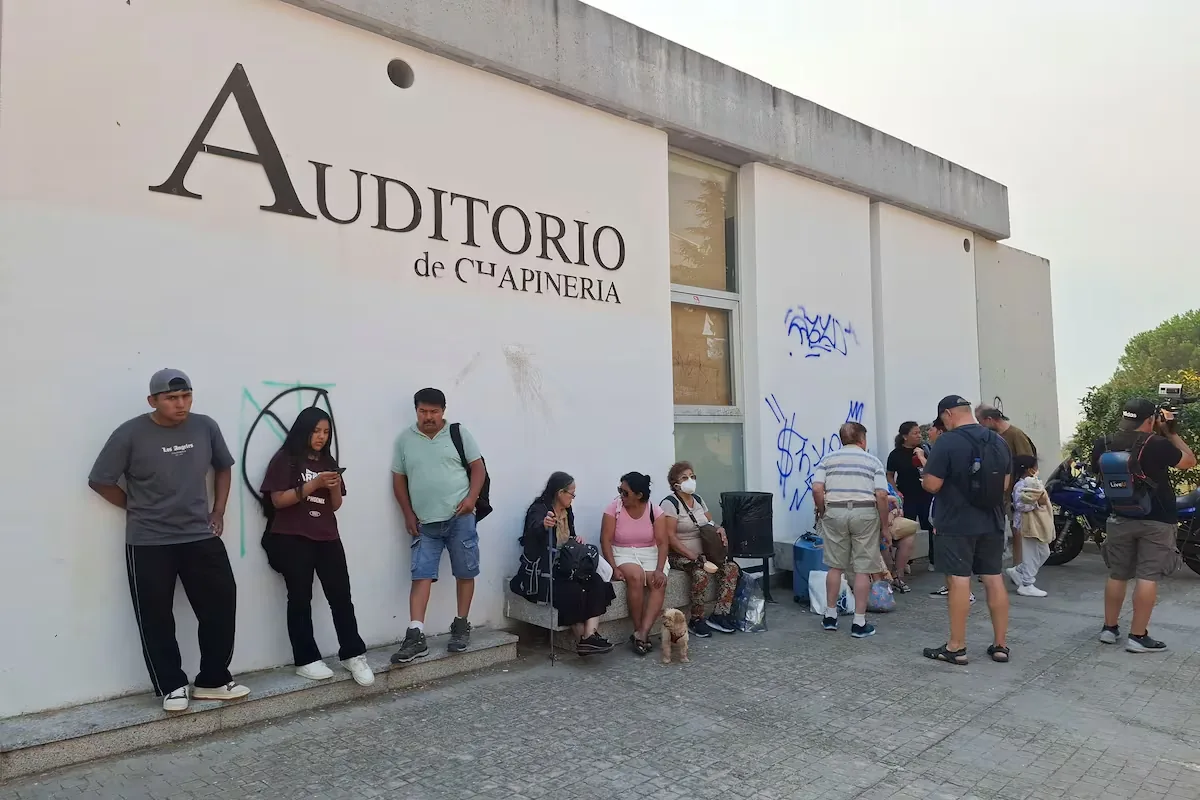
Honorina Hernández put her family, five dogs, and little else in the car. “I really just grabbed some pills I have to take, and that’s it,” she explains. Behind her, she left Chapinería (2,700 inhabitants), her village, which had become one of the localities that the Community of Madrid ordered to evacuate this Friday due to the advance of the fire. “It was all very rushed,” she tells EL PAÍS by phone.
At the moment the alert arrived, she recounts, there was no time to think. “We simply grabbed the animals, I put my pills in my bag, and we all got into the car,” she states. She describes those first hours as a mix of disorientation and great concern, even more so not knowing for sure what was happening in the village. Honorina believes the evacuation has been, above all, “a preventive measure to prevent the population from being exposed to smoke and pollution, rather than due to an imminent risk of the fire entering the urban area.”
Few families remain in Chapinería: most have evacuated the place with only the essentials. “We have to leave the village now,” a woman shouts from a car. Mobile phones vibrate with an emergency alert with a deafening sound. Ash flies over the small houses while a grey cloud covers the sky. A man leaves food for the animals before leaving. “We had just bought things for the house… and then the village starts to burn. We have everything inside, clothes, our belongings. We feel that if the house burns down, no one will answer for it,” says Brandon Orjuela, a Colombian who has been in Spain for four years. He leaves his house with his partner and family, not knowing if they will be able to return and with the uncertainty of losing everything they have worked for. They buy some bottles of water, try to calm the meows of their two cats, and get into the car heading to Getafe with the hope that they can return home in a few hours. Reported by Stephanny Pinzón.
Their departure is part of a day that has worsened hour by hour. The three fires that had been burning separately since Thursday in the Community of Madrid —the one started in Almorox (Toledo), the one in Villa del Prado, and the one in San Martín de Valdeiglesias— have merged into a single large front that, as confirmed by the region’s Minister of Environment, Agriculture and Interior, Carlos Novillo, is advancing directly towards Chapinería, which has forced its evacuation along with those of Navas del Rey and Colmenar del Arroyo.
The fire has already devastated more than 6,000 hectares and is still not contained. The seriousness of the situation led the Minister of Interior, Fernando Grande-Marlaska, last night to declare a national interest emergency in the Community of Madrid and in the province of Ávila, where another active fire in Burgohondo threatens to cross into Madrid territory. Marlaska, who has set up the command post in Cenicientos, described the day as “very difficult” due to the 50-kilometer-per-hour wind and high temperatures. Spain has requested the activation of the European response mechanism, and the European Commission has already mobilized four Canadair planes, two from Greece and two from Italy, to reinforce firefighting efforts. The number of evacuees in the region amounted to 19,000 by mid-morning this Friday.
Read more The Constitutional Court rejects the appeal by the Government of Extremadura against the amnesty law
Nori, as she is known in the village, is now speaking from the Madrid municipality of Brunete, where she arrived after a journey she describes as chaotic. It’s the first time in hours she has coverage to speak more calmly: “There’s no coverage of any kind there, we can only talk to emergencies.” For much of the day, she had been practically incommunicado, knowing about the fire only by what she saw and smelled around her. “Everything is full of smoke and embers,” she says. “It’s a situation you can’t imagine.”
Not all residents have left in the same way. Like Nori, those who were able to take their cars have mostly headed to Brunete. The rest, those who did not have their own vehicle, have been transported in buses provided by the Community of Madrid to Villaviciosa de Odón, as part of a deployment of 24 intercity buses with which the region plans to transport 1,200 people in this first phase of the evacuation alone.
Five dogs traveled with her, while the cats had to be left in the village. Upon arriving in Brunete, she encountered an unexpected problem: she didn’t know where to leave them. The village, she says, is overwhelmed, with cars parked wherever possible and “people with dogs everywhere,” residents from Chapinería and other evacuated localities who have ended up in the same place.
It also hasn’t been easy to find out how the rest of the family was doing. Nori has been locating them one by one through calls and what they told each other, although she hasn’t managed to speak with everyone. And for now, no one has been able to tell her what matters most: when she can return home. “They have only alerted us about the evacuation. They haven’t told us when we have to return,” she laments.