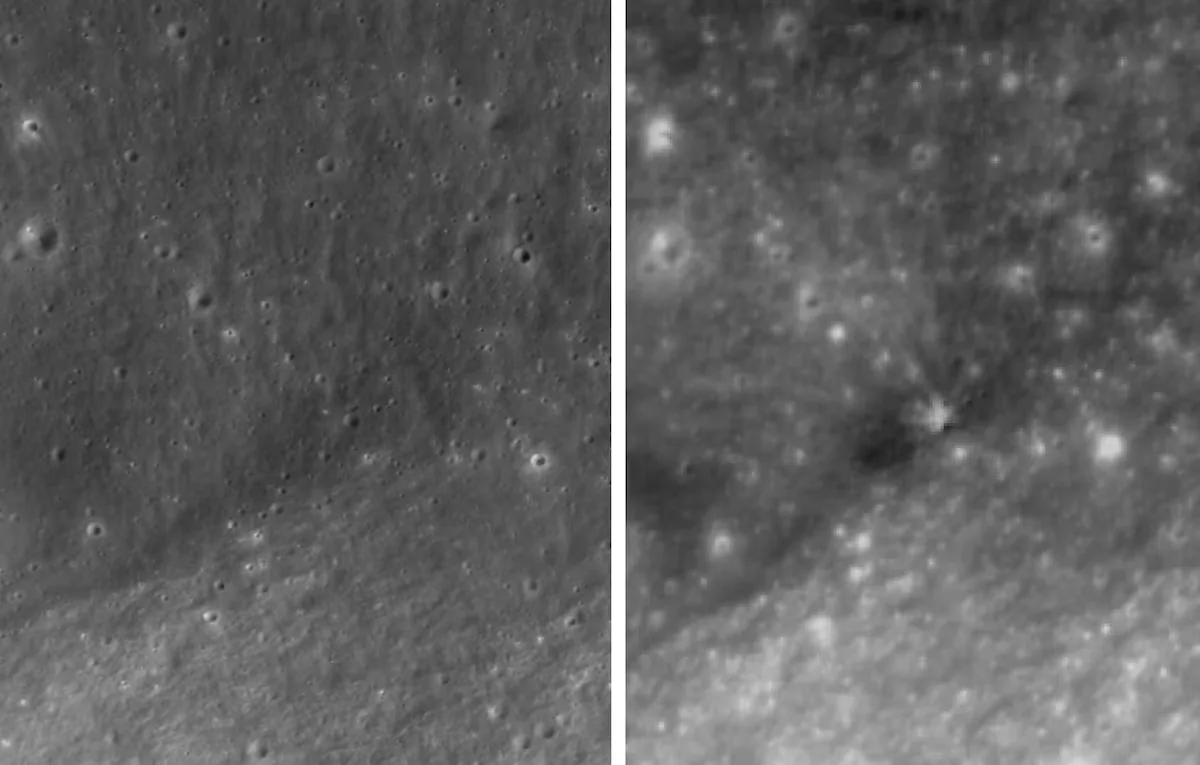
Part of a SpaceX Falcon 9 rocket, the company of billionaire Elon Musk, crashed into the Moon this Wednesday at 8:34 a.m. Spanish peninsular time. We knew this for sure because independent astronomers and later the company itself and NASA had confirmed without a doubt that the trajectory was safe and the destination inevitable. And various observatories had captured indirect signals of the event. But it was not until Thursday morning that we had official confirmation: the Danuri probe, from the South Korean Space Agency, has captured a small shadow that is undoubtedly the crater left by Elon Musk’s artifact when it slammed into the Moon.
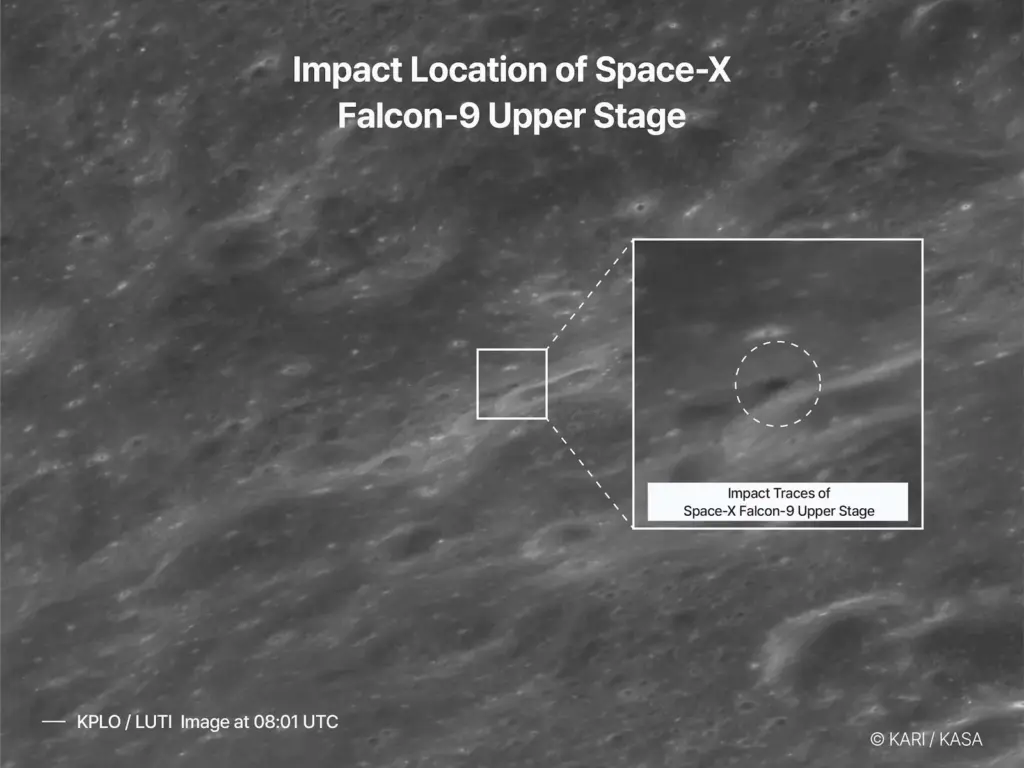
The Korean agency explained on social media that the probe passed over the area where the impact was expected and photographed the before and after of the impact against the lunar surface of the Falcon’s upper stage. “Danuri began observations about 30 minutes before the collision and, through orbital control maneuvers, flew over the impact area several times, conducting a total of eight photographic sessions. Thanks to these observations, changes in the terrain around the crash site and traces of the dispersion of the ejected material have been identified,” the agency explains.
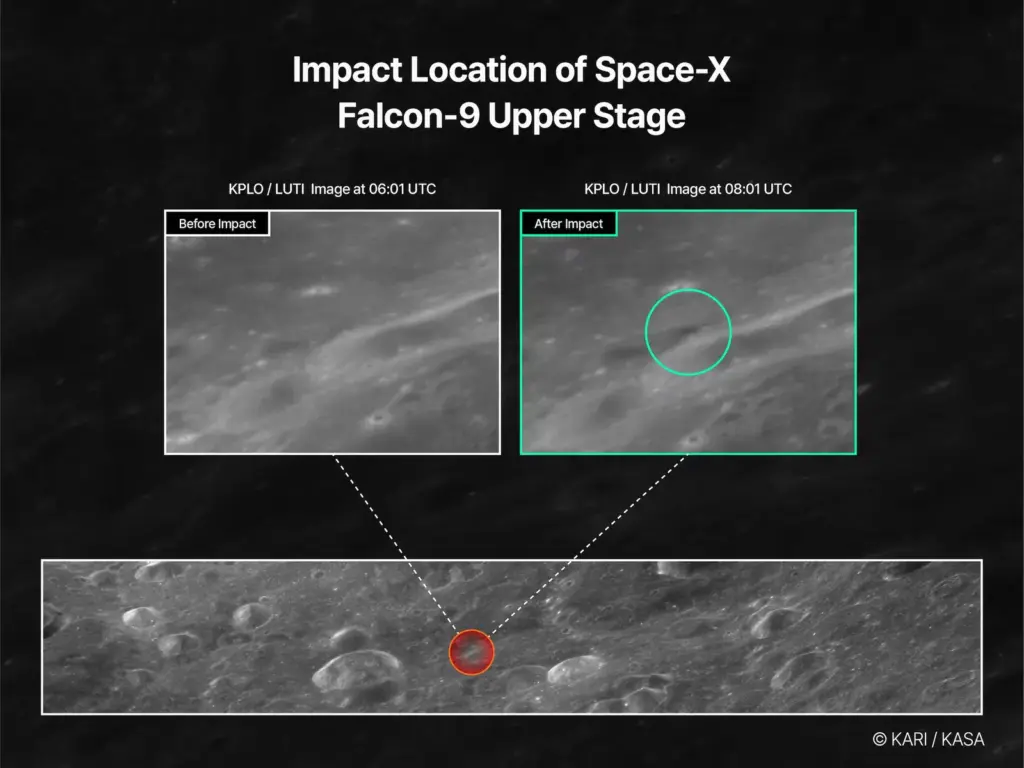
“The data collected by Danuri will be used in highly relevant scientific research. It is planned to be combined with subsequent observations from NASA’s Lunar Reconnaissance Orbiter (LRO) probe as part of an international scientific collaboration,” adds the Korean agency.
After launching two private modules destined for the Moon in January 2025, it was left abandoned without enough fuel to return to Earth. After drifting uncontrollably for over a year, its journey ended abruptly to the delight of astronomers worldwide. It crashed into the lunar surface at about 8,700 kilometers per hour, raising a cloud of gray dust that could be seen from Earth.
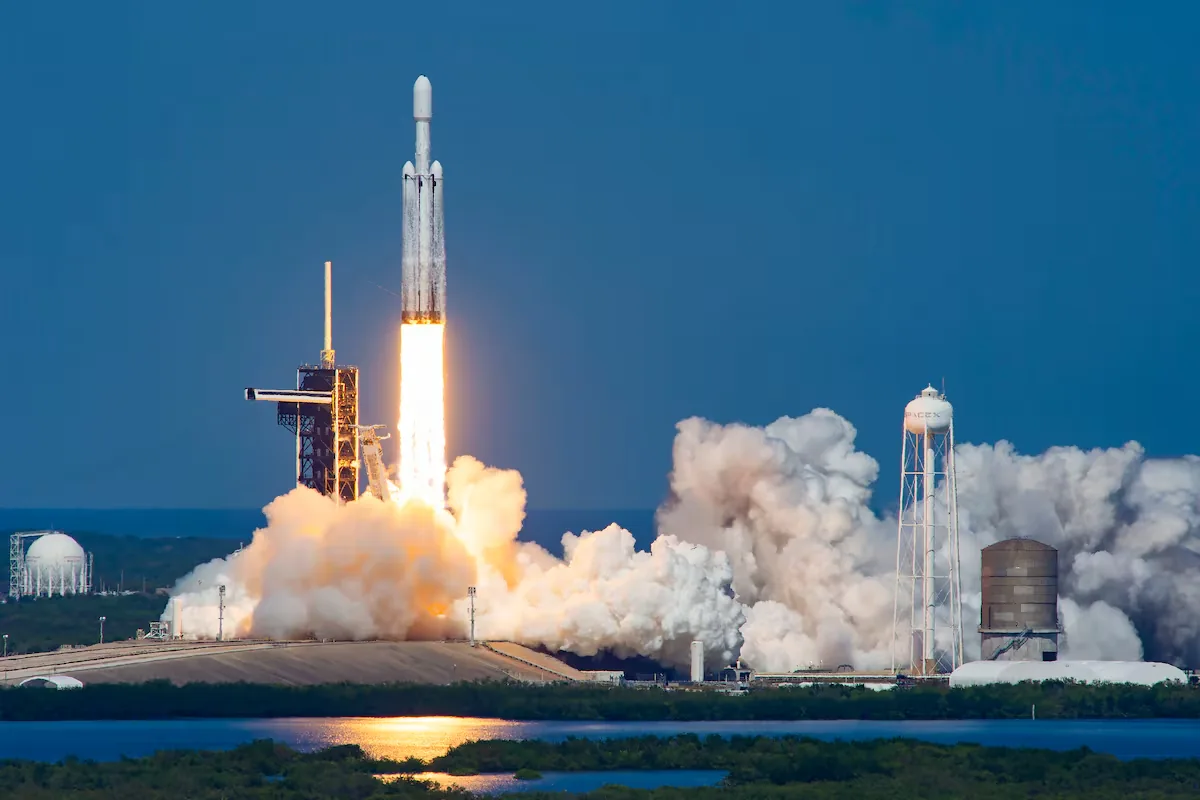
The object that crashed into the lunar surface is the upper stage of a Falcon 9, launched in January last year to transport the Blue Ghost lunar modules from Firefly Aerospace and Resilience from the Japanese company Ispace. These rockets consist of two stages: the first, larger one, propels the payload (in this case the modules) and then returns to Earth and lands on a barge, and can be reused. The upper stage, which enters orbit and cannot be reused, measures more than 12 meters and weighs four tons.
That launch was part of the Commercial Lunar Payload Services (CLPS) program, a NASA initiative integrated into the Artemis program to promote the return of astronauts to the Moon and establish a sustained presence on its surface. The project opened the door to the participation of private companies in transporting scientific instruments and technology demonstrators to the satellite. It involves collaboration from the United States, Europe, Japan, Canada, and other international partners.
Read more This is how the Topolino is made, the ice cream that stirs passions in Cádiz since the 1950s
For those interested in a spent booster impacting the lunar surface, this rare occurrence has decades of history, going back to the Apollo era, when NASA intentionally crashed spent stages into the Moon for science and seismic research. The reality is that meteoroids strike the…
— NASA Administrator Jared Isaacman (@NASAAdmin) August 5, 2026
Unlike natural collisions, from which only the traces they leave can be studied, in this case researchers know the object’s mass, its speed, its trajectory, and the angle at which it will hit the surface. Because the Moon has no atmosphere to slow incoming objects, it is hit by meteorites daily. NASA, which followed the event with interest, notes that a meteoroid with the same energy as the Falcon’s upper stage hits the Moon approximately every six days, so the lunar surface constantly absorbs impacts of the same force. SpaceX and NASA have already indicated that they will reconsider how to send artifacts to the Moon to avoid these scares, especially when there are bases on the satellite.
This is not the first time an uncontrolled rocket ends its journey by hitting the lunar surface. In 2022, an artifact was detected on a path to impact the Moon, initially thought to be a Musk Falcon. Experts eventually deduced it was a Chinese spacecraft that went out of control in 2014, which crashed in March 2022 after several years adrift. It was the first time a human-made object accidentally impacted the satellite.
According to estimates, the Falcon 9 would crash near the Einstein crater, but the scenario was unfavorable for observing a visible flash, as the impact occurred practically on the edge of the lunar disk and in a sunlit area, according to experts. It is estimated that the impact could have lifted about a ton of regolith with energy that could launch some of those fragments several kilometers high before falling back, almost invisible from Earth. But it was known that the crater could be photographed by probes studying the Moon, as happened with the Chinese rocket in 2022.
The impact posed no risk to our planet, but for experts it has great symbolic value regarding the poor management of lost space debris. It is estimated that about 140 million pieces of space debris orbit uncontrollably just around Earth, moving at more than 28,000 kilometers per hour, according to UN estimates. Among them are abandoned rocket stages like this one. The bodies of these vehicles are among the largest objects remaining in orbit after launches.
Read more ‘Jeans’ at 40 degrees: how can a man keep wearing jeans in the middle of a heat wave?