







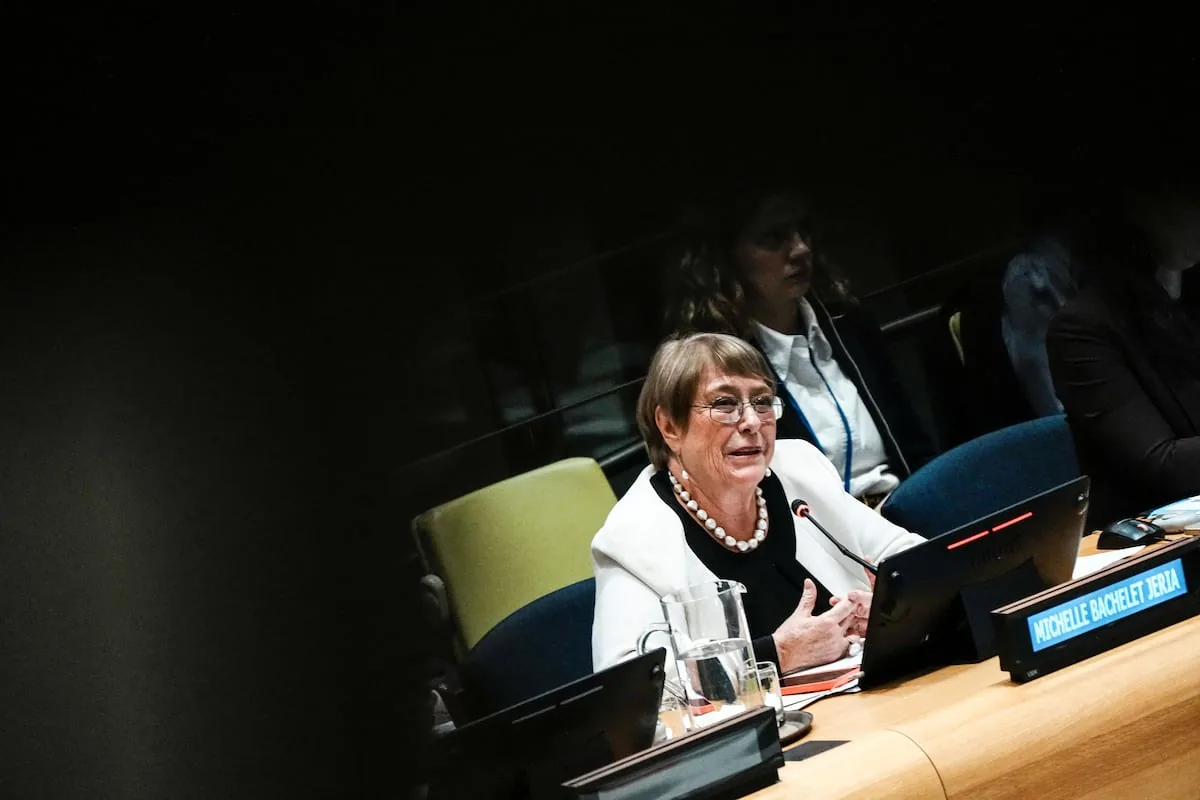
“I share with you this message of renewed hope in the future of the UN. This is a moment of danger and hope. The UN faces significant political and financial pressure, but it is more necessary than ever. Multilateralism is essential; the world cannot surrender to despair.” This is a quick summary of the program of Michelle Bachelet, two-time president of Chile, as an aspirant to the secretary-generalship of the United Nations. Three other candidates —two of them also Latin American— are competing for the position, but Bachelet, 74, has been the first to face the scrutiny of member countries and civil society, in an interactive dialogue held this Tuesday in New York.
“We need a modern UN, focused on real, sustainable, and verifiable results, that leads through administrative efficiency, coherence, and trustworthy leadership. I envision a United Nations that anticipates, prevents, creates, and unites, with a primary objective: to serve member states and their citizens,” she said.
Deprived of the support of her country’s conservative government, Bachelet, who has served as Human Rights Commissioner and head of UN Women, is aware that the organization has only two options: renew or die. Reforming implies structural changes, cost cutting, and an unprecedented exercise in relevance in recent years: conflicts in Ukraine, Gaza, or Iran have thrown a wrench in its gears, immobilizing it. All of this, in a scenario “of deep uncertainty, strategic competition, expanding armed conflicts, serious violations of international law and human rights, growing inequality, disastrous climate change, and technological disruption; an environment marked by corruption. Trust in institutions has been severely weakened. (…) Fractures that expose the architecture that needs to be redesigned.”
Bachelet, whose candidacy is sponsored by Mexico and Brazil, has made an unwavering defense of the international order, undermined by unilaterally declared wars, such as that of the US and Israel against Iran, and recalled how, after the 1973 coup d’état in Chile, “it was international pressure and global solidarity that helped restore peace and democracy in my homeland; at a time when we desperately needed hope, the world provided it,” she said at the beginning of her speech.
Both defenders and critics of the organization ask the UN to regain its peacemaking role, the one exercised in the past by the first secretaries-general. The UN as an arbiter not only moral but executive, to end conflicts and wars. But also, the Chilean politician declared, as an integral system that permeates the smallest detail of life, “[a system] interwoven into the very fabric of our daily lives, from civil aviation to humanitarian assistance, from intellectual property to monetary stability, from peacekeeping to meteorology.”
This year there are only four candidates to succeed Guterres, who in 2016 was chosen from 13 aspirants, seven of them women, a symptom for many of the institution’s growing irrelevance, mainly due to the ineffectiveness of the Security Council, on whose reform, demanded by many, Bachelet has expressed caution. “It is necessary to seriously consider such a reform so that the body represents today’s world. The secretary-general must offer good offices to all countries and generate ‘political viability’ for reforms, [but] also financial viability: more transparency and accountability,” she said.
Bachelet did not go into detail when asked about the situation in Palestine, where a UN expert report has denounced the commission of genocide by Israel, or in Cuba in the face of President Trump’s threats, about which the Cuban ambassador directly questioned her.
The President of the UN General Assembly, Germany’s Annalena Baerbock, who will preside over the hearings of the four candidates, has described the position of secretary-general as one of the most difficult jobs in the world, if not impossible. “But also one of the most important, as the next secretary-general will not only shape the future of this institution but —in their role as the strongest defender of the United Nations Charter— will also shape that of the rules-based international order,” she said.
If elected, Bachelet would be the first woman to lead the UN in its 80-year history. Her militant feminism is a drawback for countries like the US, with a permanent seat on the Security Council —which will ultimately determine the name of the candidate: her name will be eliminated if there is a single veto from that body. Washington denounces her defense of abortion as a fundamental right. Mike Waltz, its ambassador to the UN, torpedoed her candidacy this month by also accusing her of alleged lukewarmness towards China when Bachelet headed the Human Rights commission, for not classifying the human rights violations of the Uighur minority as genocide. Beijing’s vote, another permanent member, is an unknown.
Bachelet’s roadmap as a hypothetical UN leader clashes head-on with the hegemonic and unilateral policy of the Donald Trump Administration, among others. “Multilateralism is essential,” she said. “The secretary-general has a moral voice, a diplomatic stature that can be heard by powerful and not-so-powerful countries,” because, she recalled, “we cannot allow geography to determine the destiny of countries.” Bachelet reiterated her support for “UNRWA [the United Nations agency for Palestinian refugees] and other humanitarian entities [which] must receive the resources they need.” UNRWA, it should be remembered, is the bête noire of the US and its ally Israel, who have tried to undermine it by accusing it of complicity with Hamas.
“The next secretary-general must be very physically present on the ground and ensure that General Assembly resolutions are implemented,” she said, despite the long history of non-compliance with resolutions by some member countries (Israel in Lebanon, for example). The functioning of the Security Council, based on the right of veto of its five permanent members, has led the UN’s highest body to a deadlock: consensus, and therefore action, has been impossible in conflicts such as those in Ukraine, Gaza, Sudan, or Iran.
“I appear before you to assert the urgent need for dialogue, because deliberation and multilateral cooperation have been the operational platform upon which this organization was built and remain the bridge to our future,” she emphasized, reiterating her commitment to Article 33 of the United Nations Charter, “which prescribes the search for solutions through negotiation, mediation, and conciliation.” Exactly the opposite of what the Donald Trump Administration practices.
Bachelet responded to questions about the organization’s financial crisis —the main contributor, the US, only paid 4% of its quota last year— stating that, if elected, she would ask member states to “do what they have to do” regarding their obligations. With respect to her hypothetical government team, she stated that it is “necessary to improve geographical representation and gender parity. I am looking for candidates whose countries are not represented in the Secretariat or the Security Council.”
Although there is no official regional rotation policy to determine the origin of the secretary-general —nor the criterion of gender as definitive for the election—, this has traditionally been the case, and now it is Latin America’s turn, which may explain why three of the declared candidates —Bachelet, Argentina’s Rafael Grossi, and Costa Rica’s Rebeca Grynspan— are from that region. In successive hearings between today and tomorrow, Grossi, current director of the IAEA, who has not resigned from his post despite running; Grynspan, who headed UNCTAD (United Nations Conference on Trade and Development) until the presentation of her candidacy; and Senegal’s Macky Sall, with virtually no chances, will appear.
Read more Spain will face Germany, Japan, and Mali in the first phase of the 2026 Women’s Basketball World Cup