







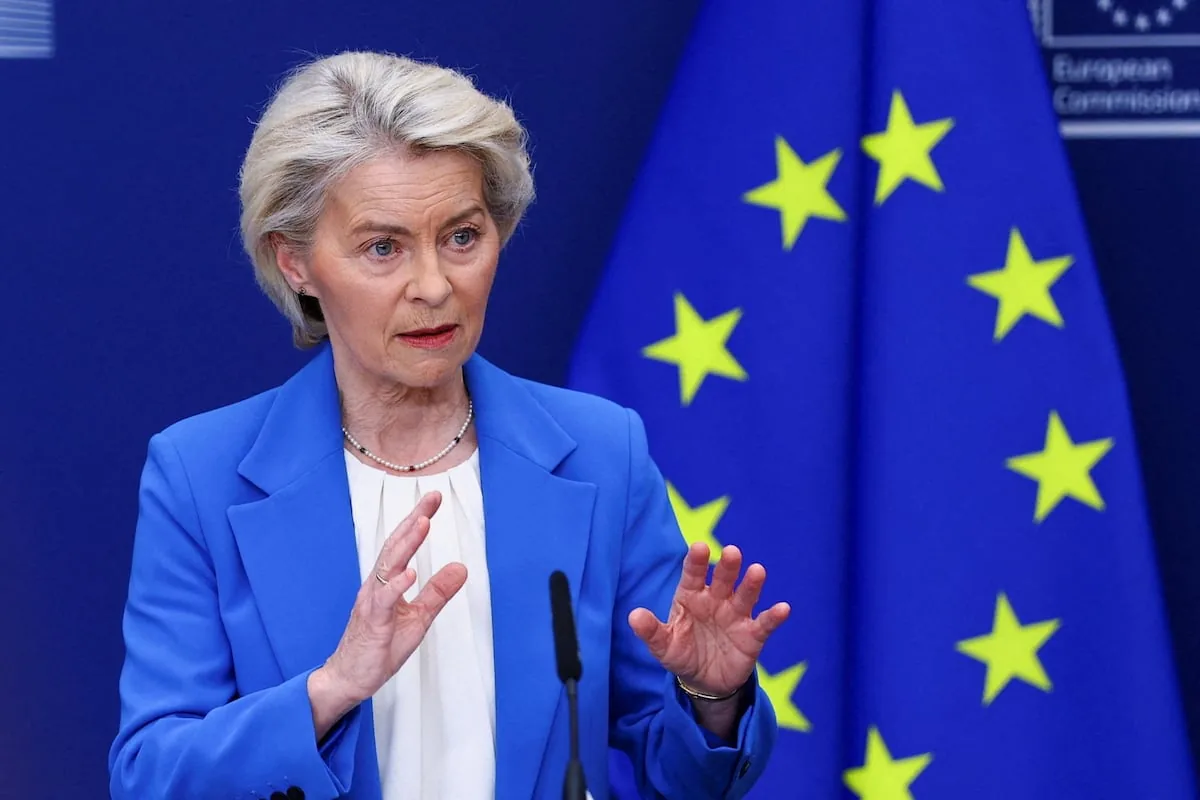
More teleworking, fewer flights, and more public transport. The European Commission is outlining its set of measures to mitigate the effects on the energy bill and supply caused by the war of the United States and Israel against Iran, which has spread across the Middle East. Faced with rising prices, but also supply problems, Brussels focuses much of its urgent initiatives on transport and demands that companies avoid air travel for work reasons whenever possible; and that air travel for public sector employees be minimized, according to a draft of the Energy Action Plan, which EL PAÍS has accessed.
Read more The Government is studying a law to boost the social housing promoters sector
The new strategy, which will be presented next week by the President of the European Commission, Ursula von der Leyen, asks States to implement subsidies on train ticket prices and launch measures to encourage workers to commute by public transport. Brussels, which has outlined a plan focused on several sectors ―industry and businesses, transport, and households— seeks to promote alternatives to car travel and support electric and smart vehicles.
“Electric mobility and the expansion of public transport offer immediate relief, as each kilometer traveled in an electric car costs significantly less than in a gasoline car at current oil prices,” the draft action plan states, which is now being supported by the community executive’s technicians and can still be modified. The conflict unleashed by Donald Trump and Benjamin Netanyahu, which has led to the closure of the Strait of Hormuz —through which 20% of oil and gas for world trade passed— has cost Europeans more than 22 billion euros in additional fossil imports, according to European Commission data.
And faced with uncertainty over negotiations between Tehran and Washington that are still uncertain to progress, Brussels believes action must be taken now. The leaders of the 27 Member States tasked Von der Leyen three weeks ago with proposing a response plan to avoid the crisis. And that is what the European Commission is now proposing. “We have tried to learn lessons from the previous crisis. What has been most effective. We cannot afford to go too far and later find out that we cannot go further,” European Vice President Teresa Ribera defended this Wednesday in Brussels. “The International Energy Agency offers revealing data on the destruction of gas, oil, aviation fuel, and chemical production capacity. The recommendation for moderation is useful,” she added.
In fact, European airports have already warned that there will be a fuel shortage in a couple of weeks if the Strait of Hormuz is not reopened, since 40% of the fuel consumed by airlines in Europe comes from the Middle East.
Shared bikes
Brussels —which has also included as one of its measures that companies implement at least one mandatory workday per week, as far as possible, as EL PAÍS reported— talks about promoting public support for shared bicycle systems and other micromobility solutions, developing and expanding car-free zones, and organizing car-free days in cities. It also calls for the creation of exclusive lanes, parking, and reduced tolls for high-occupancy vehicles.
In the document it will send to Member States, the Commission recalls that there are economic resources available at the European level to help mitigate the effects of the Iran war, including the Recovery and Resilience Mechanism (€184 billion) and Cohesion Policy funds (€38 billion). Brussels estimates that about €660 billion in annual investment is needed until 2030. It points out that institutional investors manage more than €12 trillion in Europe, a huge savings pool largely untapped for energy transition projects.
To support the transition to renewable energies and also towards an increasing reduction of fossil fuels, which have shown their vulnerability in this crisis, Brussels calls for public measures to support the purchase of electric and more efficient vehicles, and to accelerate the deployment of publicly accessible charging infrastructure, which remains a pending issue in many Member States. Additionally, it notes that the incorporation of electric vehicles in public transport fleets must be increased.
Read more Peridis: he doesn’t see, he doesn’t know, he doesn’t answer
The community executive includes in the draft plan several examples of good practices from Member States that can be exported to others. Such as Spain’s initiative to reduce public transport ticket prices by at least 30%, reaching up to 100% in some regions. Or the measure launched by France: large-scale subsidies for heat pumps, geothermal and solar energy; also, a “heating fund” of €500 million for the industry to abandon fossil fuels.
Taxes
The European Commission wants to reduce fossil fuel consumption. Not only for environmental reasons but above all for strategic and security reasons. Thus, it proposes lowering taxes on electricity to reduce consumption of non-renewable sources. In the strategy, in fact, Brussels talks about amending the Directive on the taxation of energy products and electricity to ensure that electricity is taxed at a lower rate than fossil fuels.
“In 2024, network charges represented 27% of the electricity bill for households and 21% for companies,” the draft plan says. “Taxes and levies on electricity accounted for another 24% of the price for households and 16% for companies. The introduction of harmonized rules to reduce these cost factors will have a significant impact on affordability and competitiveness,” the document notes, which accompanies a specific communication on the flexibilization of State aid due to the Iran war.
Brussels also opens the door to giving more flexibility for Member States to apply zero-rate electricity taxation to industries with high energy consumption.
The Government of Spain is very aligned with the approaches now put forward by the community executive. Since Pedro Sánchez’s arrival at La Moncloa, advancing electrification to reduce dependence on fossil fuels has become a mantra aimed at strengthening energy sovereignty. More specifically, the Third Vice President and Minister for the Ecological Transition, Sara Aagesen, has expressed the need to advance the implementation of clean energies and the electrification of the economy as a source of strategic autonomy. She even proposed a reform to shift costs from the electricity bill to fuels, although it ultimately did not pass due to lack of parliamentary support.
In the package of measures approved in March as a response to the current energy crisis, measures to accelerate renewables and specific aid to industry to reduce the cost of its electricity supply, among others, are proposed. This same year, the department responsible for energy has proposed the regulatory framework to implement offshore renewables. And this very week, this newspaper reported four public consultations that again seek to introduce more clean energy infrastructure, highlighting proposals for biomethane, which aims to reduce gas consumption from abroad by 10%.
In the crisis response plan, costing more than €5 billion until June, the Government also launched a general VAT reduction to 10% on electricity, natural gas, and other fuels, as well as a reduction of the special electricity tax to 0.5% and the temporary suspension of the electricity production tax. In the case of fuels, the Executive also promoted a VAT reduction to 10% and a reduction of the hydrocarbon tax to the minimum allowed by European regulations, which has partially lowered gasoline and diesel prices. Additionally, a direct aid of 20 cents per liter of professional diesel has been established, aimed at sectors such as transport or agriculture, to mitigate the increase in operating costs. Some of these measures are designed for short-term action and directly clash with the philosophy of decarbonization, but others fit with the Government’s horizon to reduce dependence on fossil fuels.
Read more El Roto: a strange feeling