









There is the shadow of the impact, for the moment unpredictable, of artificial intelligence models like the American Mythos. Also the fear of vulnerability due to excessive dependence on powers like China for the basic supply of leading industries. Or the high probability that a cyberattack could collapse a key sector of the economy. More than threats, these are realities that are forcing Europe to move forward, at a forced pace, towards technological sovereignty that makes it less susceptible to global geopolitical and economic swings. It will not be easy: as the Draghi report warns to relaunch the European economy, the EU remains structurally dependent on non-community suppliers for more than 80% of its digital products, services, infrastructures, and intellectual property.
Nevertheless, the European Commission believes it has found a formula to gain digital autonomy: this Wednesday it presented a voluminous package of legal proposals and strategies to promote European alternatives in the semiconductor sector, which it wants to give a strong boost to European production, and to break the excessive dependence —and exposure— of the community on cloud services in essential sectors, among other things tripling data centers on European territory in the next five years.
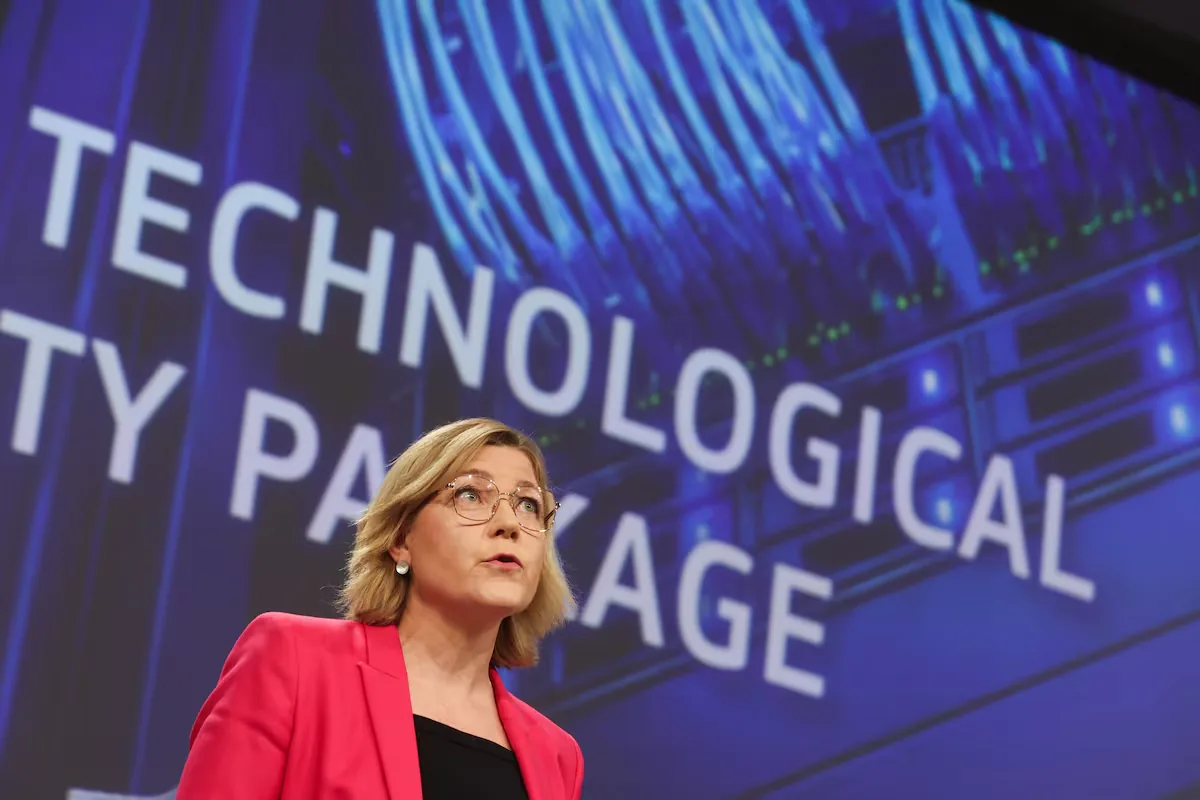
“We live in a world where geopolitics and technology are inseparable. Those who lead technological innovation will shape the future, and we must ensure that Europe plays a leading role in this,” emphasized the Commission’s Vice President for Technological Sovereignty, Henna Virkkunen, when presenting the “technological sovereignty package” that seeks to guarantee that Europe has sufficient capacity to be an important player in the global technology race while ensuring control over critical technologies and data.
One of the keys to this is to “mitigate” the risks arising from the “marked dependence” of the EU on a “limited number” of third-country providers regarding cloud computing services, explains the Commission: although in most cases, around 70%, there is no serious risk, it can become a problem if sensitive data, for example in defense or health matters, could end up in the hands of a foreign government not aligned with European values.
Therefore, in the proposal for a regulation on cloud development and artificial intelligence (AI), one of the two rules launched this Wednesday, Brussels proposes creating a “single European cloud security framework” that establishes four levels of “technological sovereignty” that progressively require more safeguards to prevent third countries from gaining access to sensitive data in the cloud: from the lowest, level 1, which only requires that data centers hosting public sector information be in Europe, something already met by the main massive cloud service providers such as Amazon, Microsoft, or Google, to level 4, the highest, for ultra-sensitive data such as defense and security, which will require not only that providers be owned by European citizens but also that there is European control over cloud services.
“We cannot afford to depend on others for the technologies that keep our hospitals running, make our energy grids stable, and our services secure,” emphasized the Commission President, Ursula von der Leyen, in a statement.
Read more The Princesa de Asturias, the award that Leo Messi surely did not expect
The proposed legislation, which must now be discussed both in the Council and in the European Parliament, also seeks to “triple the capacity of data centers” in Europe in the next five to seven years.
The second key regulation proposed this Wednesday is the “Chips Act 2,” which aims to give more momentum to the key semiconductor sector. Especially after the crisis caused by the Nexperia case, the Chinese company that the Dutch government intervened at the end of last year, which in turn led Beijing to temporarily veto the supply of semiconductors to the EU, shaking the European automotive industry, one of the sectors most dependent on these products.
Currently, the EU produces less than 10% of global semiconductors and is “almost totally dependent on the United States and Asia for the most advanced and latest generation chips under 5 nanometers, including artificial intelligence chips,” the Commission recalls in its defense of the need for a new Chips Act to strengthen the one that came into force in 2023. That first regulation already had a strong impact: it generated 52 billion euros in investments in the European semiconductor industry and led to the creation of 16,000 new direct jobs and 30,000 indirect ones. But there are still clear capability gaps — such as low semiconductor production and strong dependence on the US and China — that “still need to be addressed,” Brussels considers, which among other things also values creating a financial instrument to “ensure that our best tech companies get the funding they need to compete and succeed on the world stage.”
The technological sovereignty package also includes a “strategic roadmap for digitalization and artificial intelligence in the energy sector” and another strategy to better organize and support open-source initiatives, especially in public administration. To set an example, the European Parliament has announced that, starting this Thursday, Qwant, the French-origin search engine based on open source, “will become the default search engine in the Microsoft Edge and Mozilla Firefox browsers of the European Parliament.”