









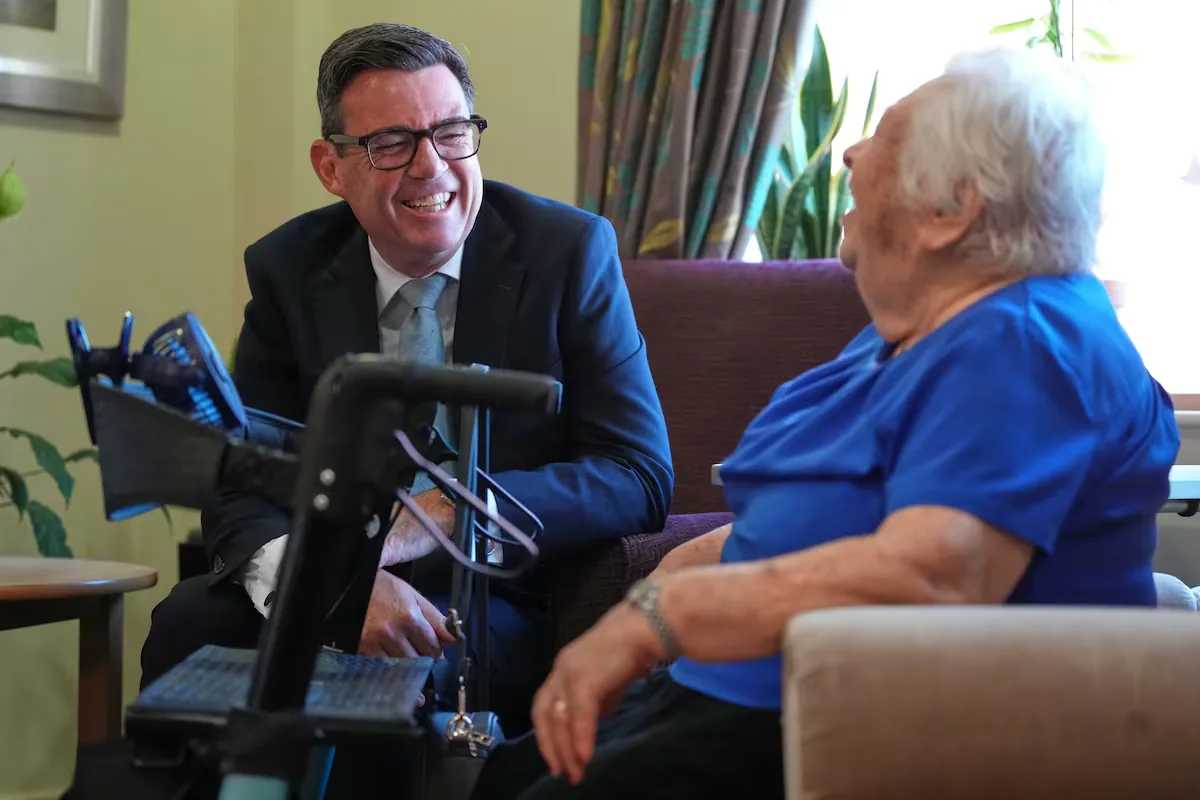
Great political projects receive an extraordinary boost when those who undertake them are driven by personal reasons. The new Prime Minister of the United Kingdom, Andy Burnham, has committed to putting all his public capital, all his accumulated prestige, on the line to push forward the reform of social care or dependency assistance, a public service that has been suffering an increasingly severe and unresolved crisis for more than a decade.
Read more Four women accuse actor Jared Leto of sexual violence in a BBC documentary
Burnham’s father suffers from an advanced stage of Alzheimer’s disease. On July 20, he did not realize that his son, the former mayor of Manchester, had become the new prime minister of the country. Seeing firsthand the high economic cost of caring for a dependent person is an extra incentive to change things, but Burnham already tried more than 15 years ago, when he was a young Secretary of State for Health in Gordon Brown’s government, to launch, with the consensus of all parties, a reform that would establish the new national social care system.
He failed. As have all successive prime ministers who have tried different formulas. Up to 22 failed attempts to solve the problem.
“There is only one group to blame for us having reached this situation, and that is our current generation of politicians,” Burnham said this Tuesday at the London residence for the elderly to announce the most ambitious goal of his newly inaugurated term as prime minister. “It has been 30 years since the establishment of the Sutherland commission [which was tasked by Tony Blair to find a solution to the problems of the aging British population], and in that time there have already been 22 unsuccessful attempts. It is a dereliction of our public duty that Parliament has been unable to face this challenge. It is shameful,” the prime minister denounced.
A financial trap
A fundamental part of why the problem has dragged on for decades is that it never appears in surveys as one of the priorities of British voters, who are much more obsessed with the debate on irregular immigration, the cost of living, or waiting lists in public healthcare. And because, as experts say, no one wants to talk about old age, even though it is a phase that sooner or later everyone will reach.
Social care is not a national service as healthcare is. Burnham now intends to create something similar in this sector to what the NHS, the National Health Service, the National Health Service that was for decades the crown jewel of the British welfare state, and which now suffers notable deterioration.
Local governments, with limited powers and poorly funded by the central government, are responsible for providing help to the elderly or adults with physical or mental disabilities.
There is a legal limit beyond which citizens themselves must pay for the help they need (to feed them, dress them, or help them go to the bathroom every day). Anyone with savings in the bank or assets exceeding just over 27,000 euros (23,250 pounds sterling) is required to cover their needs.
In many cases of aggravated vulnerability, dependents end up selling their homes or giving up receiving more help than they can afford, even if they need it.
Alongside that, the continuous political twists and turns regarding immigration policy after Brexit have worsened the problem. Qualified European workers on whom the sector depended no longer arrive in the United Kingdom. Those who come from other non-EU countries, equally skilled and necessary, earn low wages, which have only recently seen an increase thanks to the policies of the previous Keir Starmer government.
In the 2024-25 period, the latest for which public figures are available, local governments received two million new requests for dependency assistance. Not only from elderly people. The number of working-age adults who also requested it increased by 31% compared to the previous period.
The British government allocates more than 37 billion euros annually to a sector that consumes these funds inefficiently. 90% of social care is in the hands of saturated private providers, who squeeze costs and limit their services. Currently, there are nearly 100,000 unfilled jobs.
In previous years, formulas such as imposing a lifetime cap on personal expenses were tried. In 2024, the idea was floated that no one could spend more than 86,000 pounds (about 100,000 euros) of their personal savings on required assistance. Beyond that figure, expenses would be covered by the state. It did not work, as it proved financially unviable.
Attempts with property taxes to cover social care expenses were overturned by opposition from the most conservative sectors, who dubbed them with pejorative terms such as the “death tax” or the “dementia tax.”
“Today social care in England [in Scotland and Wales they have an autonomous service] is as unfair as healthcare in the United States. The most vulnerable end up paying everything and risk being left with nothing. It is a problem we have been dragging on for years and that, obviously, cannot be fair,” Burnham said.
For now, the prime minister has asked Baroness Louise Casey, head of the commission that Starmer tasked with a new review of the problem, to accelerate the deadlines of her study, so that it concludes with proposals next year, and not in 2028 as planned.
Burnham also wants to strengthen the sector’s staff with higher salaries and more training. But he has already warned that the system reform will require making “difficult decisions,” which will likely involve a tax increase.
The prime minister has extended a hand to conservatives and liberal democrats to seek the necessary consensus for such a profound change. Burnham has decided that his legacy, and the issue that will ultimately determine the success or failure of his era as prime minister, will be the way the British care for their elderly.
Read more Russia declares Pavel Durov, founder of Telegram, wanted for «collaborating with terrorist activity»