








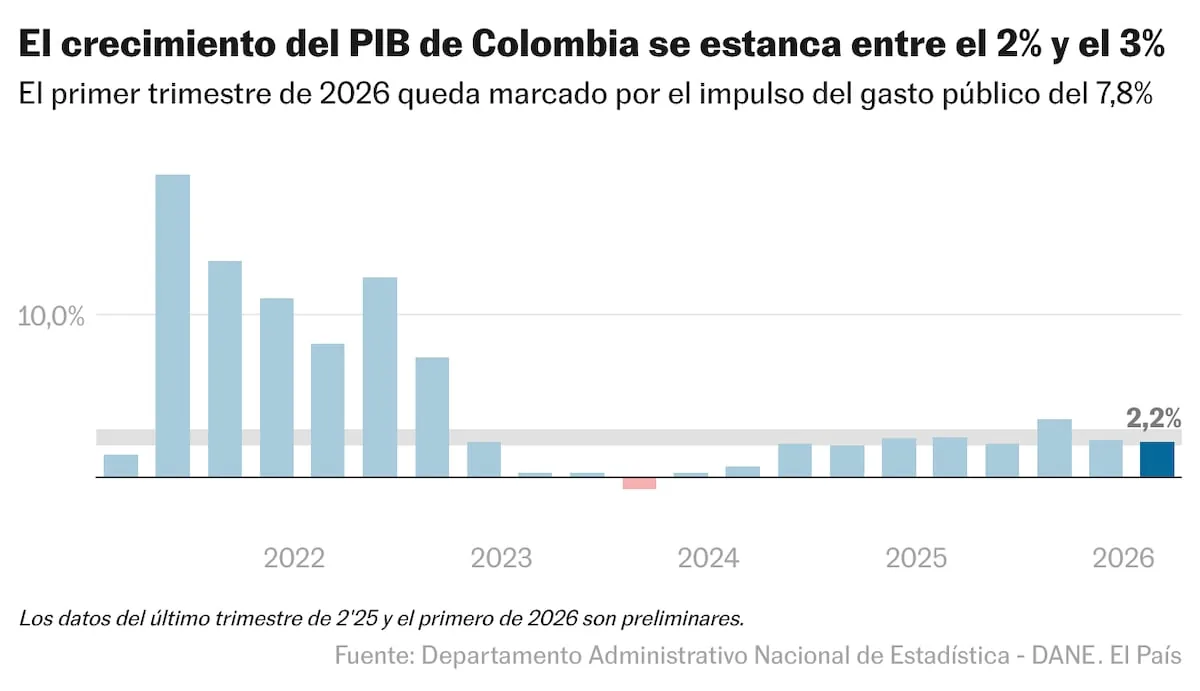
Colombia’s Gross Domestic Product — the sum of everything the country produces in goods and services — advanced 2.2% between January and March 2026, compared to the same quarter in 2025, according to figures published Thursday morning by DANE. A year ago, the figure was 2.5%, marking a slowdown. For Andrés Giraldo, professor in the Department of Economics at Universidad Javeriana, today’s figure is “relatively good” in market terms, as most analysts predicted 2%, but it hides a structural problem: “It can be seen as mediocre insofar as public spending has grown a lot (7.8% annually) and is not translating into greater production,” he argues.
The public administration, education, and public health were the main drivers of the quarter, growing 5.7% and contributing almost half of the total economic momentum. But even that number deserves a second look. Piedad Urdinola, director of DANE, explained at the press conference presenting the data that much of that growth is due to the temporary hiring by the Registraduría for the upcoming electoral process and the increase in military and police personnel, benefited by the extraordinary 23.7% increase in the minimum wage. “It is not reflected in effective economic activity,” Giraldo summarizes. That is: there are more people working for the State and more uniformed personnel, but not necessarily more production in the economy.
The breakdown of spending confirms this. Government disbursement grows at 7.8% annually — well above the historical average of 4.6% — and has become the main support of the Colombian economy. Household consumption, meanwhile, increases only 2.7%, well below the 3.5% projected by Bancolombia two weeks earlier. Colombian families are spending cautiously, squeezed by rising inflation and high interest rates that make credit more expensive. Commerce, transportation, and accommodation and food services contributed 2.9% annually. Manufacturing, after several difficult quarters, also grew 2.9%, a sign of some industrial recovery. Financial activities added 2.8%.
These are respectable numbers, but these sectors do not generate the same multiplier effect as productive investment or construction, where one of the difficulties lies. Construction, an engine of employment and development, fell 5.4% annually. Housing declined 8.6% and non-residential works — offices, warehouses, shopping centers — dropped 7.2%. Only civil works, driven by government projects, grew a modest 0.6%. Agriculture, a sector this government promised to make a pillar of its economic strategy, fell 1.4% in the last year.
Read more Sheinbaum raises teachers’ salaries by 9% under the shadow of new protests during the World Cup
In investment, contradictory signals appear and, curiously, some hope. Gross capital formation — which includes both the purchase of machinery and equipment and the inventories accumulated by companies — fell 3%, when a year ago it was growing 7.9%, a dramatic turnaround. But when looking only at gross fixed capital formation — that is, investment in things that last years, such as machines, vehicles, and buildings — the picture changes: it grew 3.7%, driven mainly by machinery and equipment, which rebounded 12.8%.
How is this paradox explained? Companies are reducing accumulated inventories, a typical sign of caution amid uncertainty, but continue investing in their long-term productive capacity. Bancolombia had projected much more negative numbers: a 10% drop in total investment and 3.2% in gross fixed capital formation. Reality exceeded those pessimistic expectations, showing that the private sector, although cautious, has not panicked.
Giraldo’s analysis ends with a warning that sums up the dilemma: “What public money is spent on is more important than how much is spent, and the productive part is not reacting. What we observe is temporary hiring due to elections and an increase in personnel, but productive activities are still being affected,” he concludes. In the context of market expectations, this Friday’s 2.2% is relatively good. But it is the result of an economy growing despite itself, sustained by spending from a government with very large fiscal limits, while the sectors that should drive growth — construction, agriculture, industry — remain stagnant or in decline.