
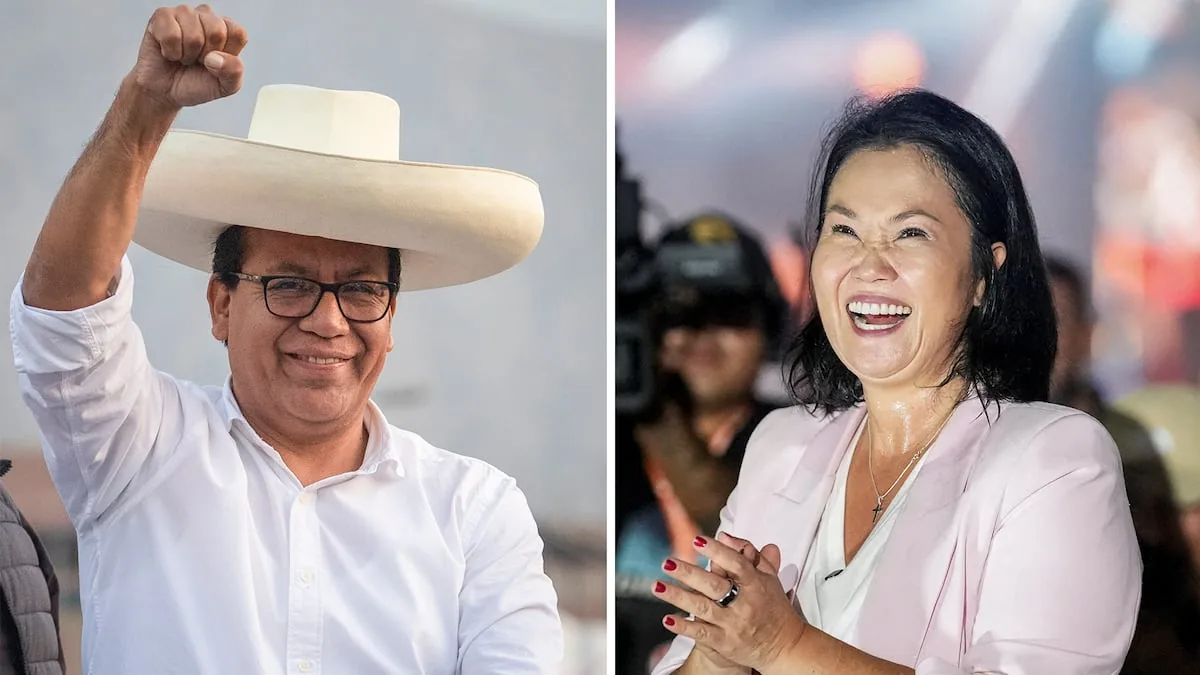
Peru finally has its runoff clear, although it took 33 days to get there. This Friday, after weeks of reviewing records, challenged votes, tables opened late, and an electoral system in the eye of the storm, the National Office of Electoral Processes (ONPE) has officialized the count of 100% of the votes and confirms what seemed irreversible: the presidential runoff on June 7 will face Keiko Fujimori (Popular Force) and Roberto Sánchez (Together for Peru), two figures embodying the extremes of the political spectrum: right versus left.
Read more Sheinbaum raises teachers’ salaries by 9% under the shadow of new protests during the World Cup
Alberto Fujimori’s daughter obtained 2,877,678 votes (17.18%), while Pedro Castillo’s political heir reached 2,015,114 votes (12.03%). In third place was Rafael López Aliaga (Popular Renewal) with 1,993,904 votes (11.90%). Sánchez advances to the runoff by a margin of 21,210 votes over his closest pursuer. It has been a process that took longer than expected and again exposes the deficiencies of a country where digital voting remains an unfulfilled promise. In the middle of 2026, the country still depends on physical ballots that travel from remote population centers to decentralized offices, crossing rivers and trails where the State arrives late or sometimes simply does not arrive.
But the delay cannot be explained solely by distances. In an unprecedented event, the election day had to be extended by one more day due to the delay in setting up 211 tables in Lima. While ONPE claimed “logistical problems,” the incident became fertile ground for distrust. The far-right Rafael López Aliaga turned the delay in counting into political fuel: he denounced an alleged electoral fraud and called to defend the vote wildly, despite not presenting conclusive evidence to support his claims. The word fraud was reinstalled in the Peruvian political vocabulary as an uncomfortable echo from 2021.
As the count slowly progressed, videos without context and unverified accusations began to circulate rapidly on social media. Every observed record fueled suspicions; every delay was interpreted by the most radical sector of the right as a conspiracy. Piero Corvetto, head of ONPE, resigned from his position after being accused as the main culprit. The Prosecutor’s Office issued an 18-month travel ban against him in the investigation for alleged aggravated collusion.
Political scientist Fernando Tuesta recalls that, except in 1962, elections with minimal differences have become increasingly frequent this century. And that the difference is not marked by the vote margin, but by the reaction of the losers. “While some recognized the results and helped preserve democratic stability, others chose to disregard them, eroding trust in the rules of the game. Democracy is sustained not only by votes but also by the legitimate acceptance of defeat. There the democratic system is strengthened or weakened,” he explains.
Amid the chaotic process, a runoff campaign emerges marked more by fear than enthusiasm. Keiko Fujimori, the daughter of the autocrat Alberto Fujimori, faces her fourth consecutive final to reach the Palace. The surname that has divided the country since the 1990s appears again in decisive instances. And she promises order despite being accused as the head who has orchestrated the cycle of instability Peru has suffered for a decade.
On the other side is Roberto Sánchez, a candidate who has moved from a more confrontational discourse to a narrative of moderation, trying to convince an electorate fearful of another leap into the void. The shadow of Pedro Castillo — the former president imprisoned since 2022 for a failed self-coup attempt — also hovers over his candidacy as a ghost difficult to dispel. In his case, it is a vindicative vote coming from the most disadvantaged areas.
This Sunday the National Jury of Elections (JNE) will proclaim the results of the first round, but ONPE has already finished the official count of the records after 33 days. Around 60 special jurors — bodies responsible for administering electoral justice — resolved 68,000 observed records in 2,300 hearings. Peru already knows its finalists, although the delay in counting has installed a sense of fragility in the electoral processes.
Read more Louisiana Primary Elections 2026: When They Are, How to Vote, and What’s at Stake