
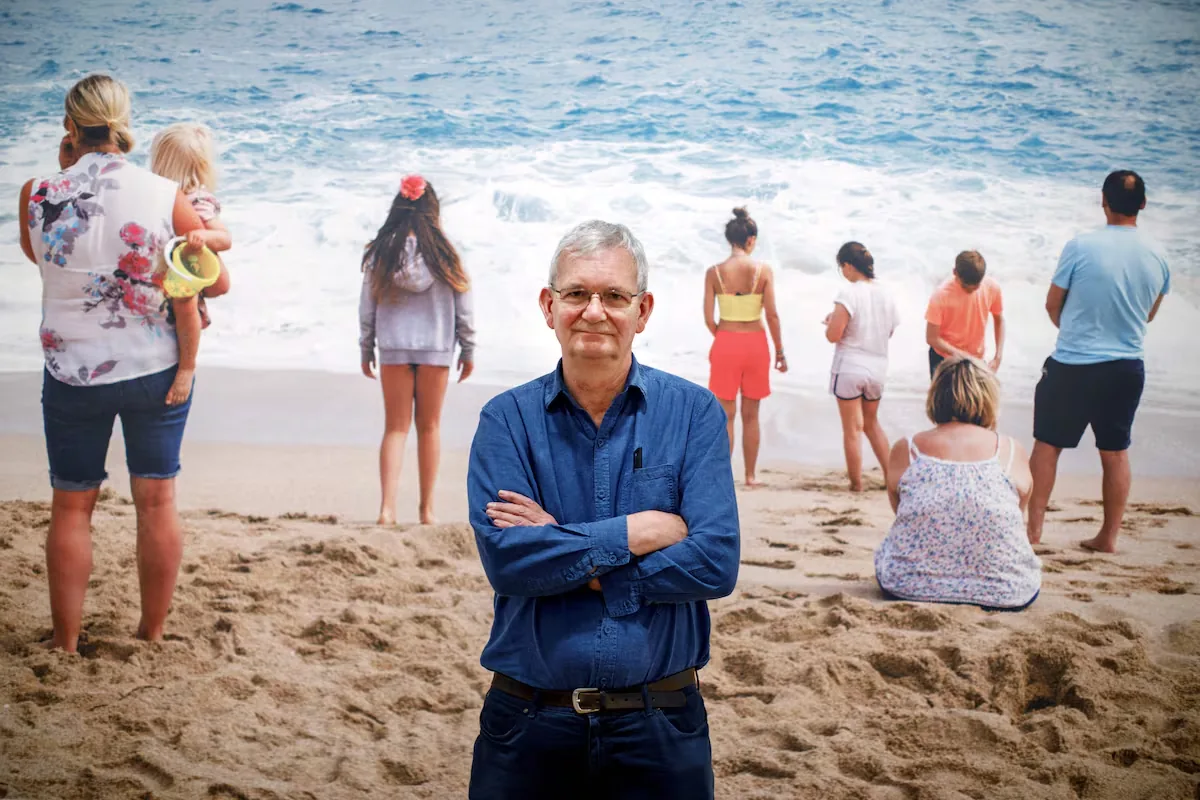
One of the most puzzling things about The Last Resort, the series with which Martin Parr (Epsom, United Kingdom, 1952-Bristol, United Kingdom, 2025) portrayed the holidays of the British working class, is that it barely provoked protests when it was first shown 40 years ago in Liverpool, very close to the place where he had taken his photographs. The controversy came later, when the photos traveled to the very refined Serpentine Gallery in London, to face an audience of critics and art lovers who saw there a grotesque and humiliating representation of those working classes; something that apparently had escaped the protagonists themselves. The debate was left open, and it still is: was Parr showing cruelty and lack of empathy towards the less fortunate, turning them into an object of a dehumanized gaze or, on the contrary, had he decided to show from a critical perspective the devastating consequences of Margaret Thatcher’s policies?
Read more Moria Casán, the immortal erotic myth: “Sex at 80 involves many devices. Batteries are a must”
It is important to point out, in any case, that Martin Parr did not have working-class origins, but was born into a middle-class environment in the affluent county of Surrey, in southern England. His father, a civil servant, was an ornithology enthusiast, and as a child he took him on excursions to observe birds. As a teenager, he was clear that he wanted to be a photographer: he studied art at the Polytechnic of Manchester, in the north of the country, because his mediocre academic record closed other options. During the first decade and a half of his career, his snapshots were in black and white, as was then expected of a non-commercial photographer, and although his subjects were not very different from those he would later develop, the absence of color added an element of seriousness and melancholy to his images, very direct and with an understated sense of humor.
Together with his wife, Susan, he lived for two years in rural Ireland, where he took some of his most sensitive photos. But in the early eighties the couple moved to Wallasey, near Liverpool, a working-class capital that had been severely hit by the industrial crisis and by Thatcher’s social and economic policies. Not far away was also New Brighton, a seaside town that hosted that impoverished working class during their holiday periods. “After having left the beautiful beaches and clean seas of the West of Ireland, I personally found New Brighton a bit excessive, with all that pollution and garbage. It was incredibly deteriorated; it truly represented the sign of the times of Thatcher’s Great Britain,” Susan would say. Between 1982 and 1985, that was the setting in which Martin Parr developed his project The Last Resort: in the mornings he would leave home with camera in hand and riding his bicycle, and he would go to New Brighton to do his work.
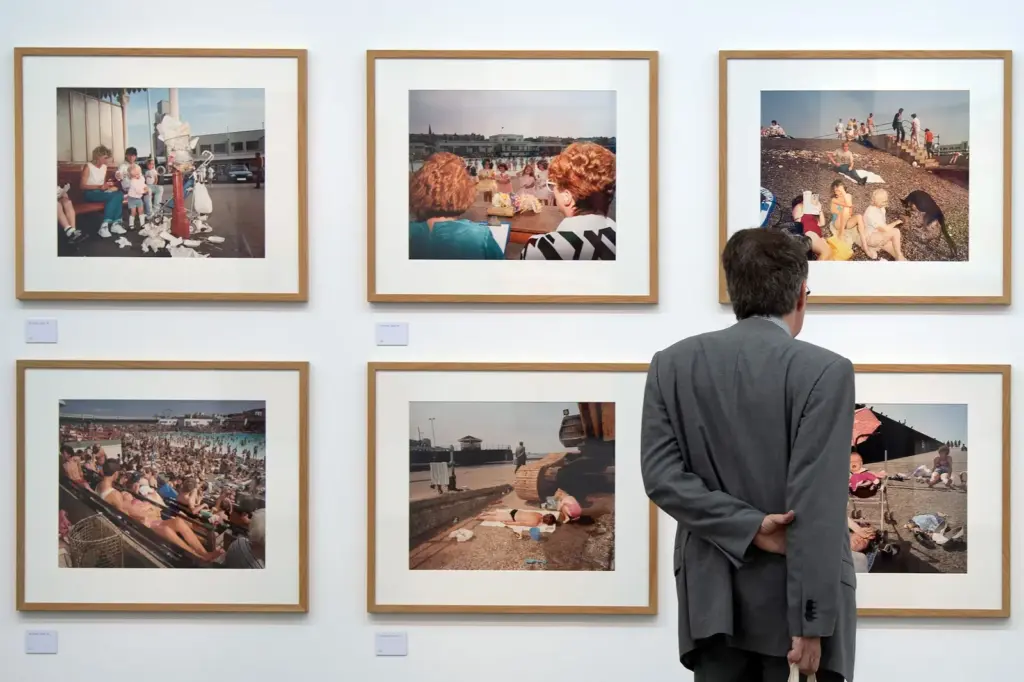
Formally, he moved from black and white to vivid color, and from there he never returned, except for rare exceptions. That color added an element of hyperreal harshness that emphasized the simultaneously everyday and bizarre nature of the images, and suggested a gaze loaded with humor that the viewer could interpret, according to their convenience or prior notions, as denunciation, cynicism, or even cruelty. Certainly, these were not scenes of an idyllic summer: there were families cooling their feet in sea waters the color of oil in which all kinds of waste floated, picnics on the asphalt next to garbage dumps, people lying in the sun resembling abandoned corpses, children holding ice cream cones with radioactive colors, beaches crowded with people that at the same time conveyed a certain atmosphere of desolation, impossible summer models and, in sum, much of the repertoire with which Parr would be forever identified.
“I don’t think my photos are unpleasant or harsh. If you look at them, there is always an element of that, but what I try to do is reflect what I find”Martin Parr in the documentary ‘I am Martin Parr’
The series was exhibited at the Open Eye Gallery in Liverpool from December 4, 1985, to January 18, 1986, as part of a joint project with another photographer, Tom Wood. Susan Parr recalled that no one blinked at those photos then. On the contrary, the general reaction was rather cheeky, and many of the guests at the opening showed up dressed in a peculiar combination of rain hats, swimsuits, floaties, and raincoats, as a knowing wink.
However, the following summer, about fifty snapshots from the series formed a solo exhibition of Parr at the Serpentine Gallery, next to the Kensington Gardens in London. The audience there was mainly composed of London’s middle and upper classes, intellectuals, critics, and members of the artistic community. And in that context, the reception was very different: accusations of condescension and disdain towards the sector of the population portrayed proliferated. In the specialized magazine Arts Review, critic David Lee wrote: “Our historic working class, which documentary photographers usually treat generously, becomes here an easy target for a more sophisticated audience. They appear fat, simple, styleless, tediously conformist, and incapable of asserting an individual identity.”
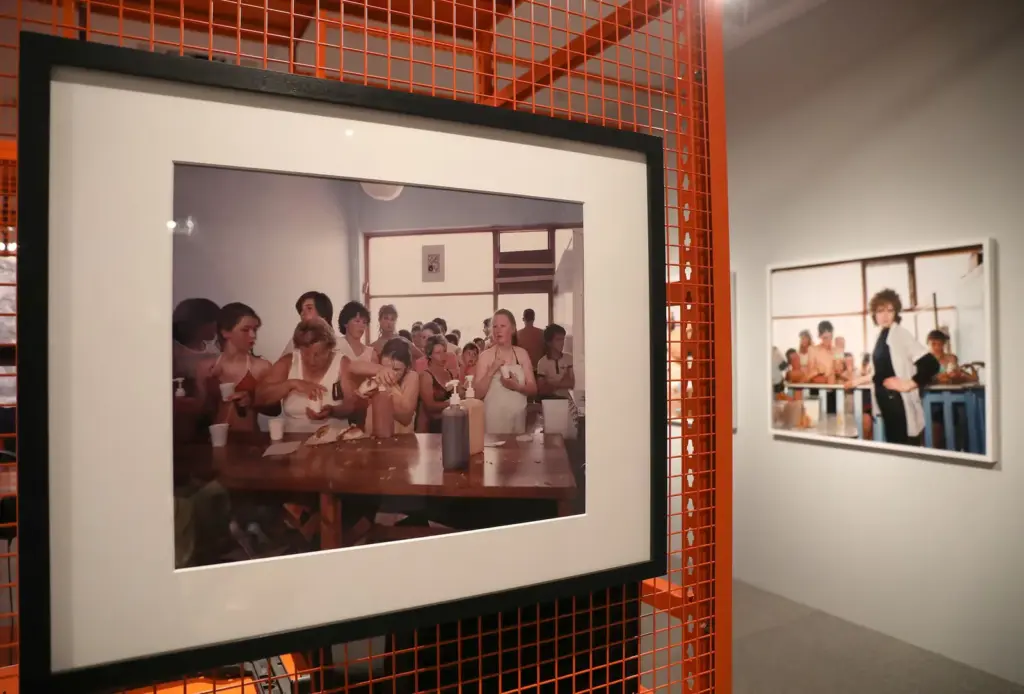
Another analyst, Robert Morris, valued in the British Journal of Photography that Parr’s photos represented “a wet and claustrophobic nightmare world, where people sink up to their knees in potato chip wrappers, bathe in black polluted waters, and contemplate a desolate horizon of urban decay.” And then he concluded: “It is hard to understand why Parr’s usual sense of humor, generally affable, has been replaced here by such a wild, almost disgusted gaze.” An intense discussion opened about the right an artist had to portray precarious classes from that biting register. And the issue bounced back to Liverpool and New Brighton, where the same controversy that had not caught fire before was reproduced. “The local reaction was initially lukewarm, [the problem] was only when [the series] arrived in London and the intelligentsia started to speak,” Parr would say. “The people of Liverpool knew that it was like that.” It was when they saw themselves through the reflection of other eyes that suspicions appeared.
When in 1994 Parr applied to join the prestigious Magnum Photos agency as a full member (he had been an associate since 1988), it became clear that he was still harmed by the shockwave of the case. They did not make things easy for him. Henri Cartier-Bresson described him as “someone from another planet” (alien). According to François Hébel, who many years later would end up directing the Cartier-Bresson Foundation, half of the members threatened to leave the agency. One of them, Philip Jones Griffiths, a Welsh photojournalist who had built his prestige covering the Vietnam War, led the fiercest opposition and even called his work “fascist.” Finally, Parr’s candidacy was accepted by the skin of his teeth: he obtained two-thirds of the total needed to enter as a member by a single vote margin. Much later, from 2013 to 2017, he himself would serve as president of Magnum.
But it was thanks to this series, immediately published in photobook format, that Martin Parr achieved international fame. He was forever associated with the representation of the holiday customs of the popular strata from a perspective that bordered on satire. It is also true that later assessments of that series nuanced that first impression. In the catalog published on the occasion of a major retrospective of Parr at the Barbican in London in 2002, Val Williams, the curator, considered that “it was unfortunate that that response, however scant and uninformed, ended up somehow being perceived as a debate. The Last Resort contains some unforgettable photographs. It is lyrical like a great pop song, and thunderous like a music-hall show.” For his part, in the documentary I am Martin Parr (Lee Shulman, 2024, available on Filmin in Spain), Grayson Perry, a friend of the photographer, himself a provocative visual artist with a certain history of controversies, defined the controversy generated by The Last Resort as: “It’s snobbery. And classism and overintellectualization.” The film surprises by presenting the photographer as a friendly humanist rather than the cynical jaded figure one might expect.
Parr himself never considered himself above those who starred in his photographs. “I don’t think my photos are unpleasant or harsh. If you look at them, there is always an element of that, but what I try to do is reflect what I find,” he explained in the documentary. At first, the inhabitants of New Brighton had simply recognized their own world in those images, while some London critics saw in it a spectacle of abjection. They were the same photos, but different eyes receiving them. As John Berger wrote in Ways of Seeing, we only see what we look at: “Looking is an act of choice.” By the way, the inhabitants of the town of New Brighton have now decided to undertake a fundraising initiative to install a mural as a tribute to The Last Resort, so the original wound seems to have begun its healing process.
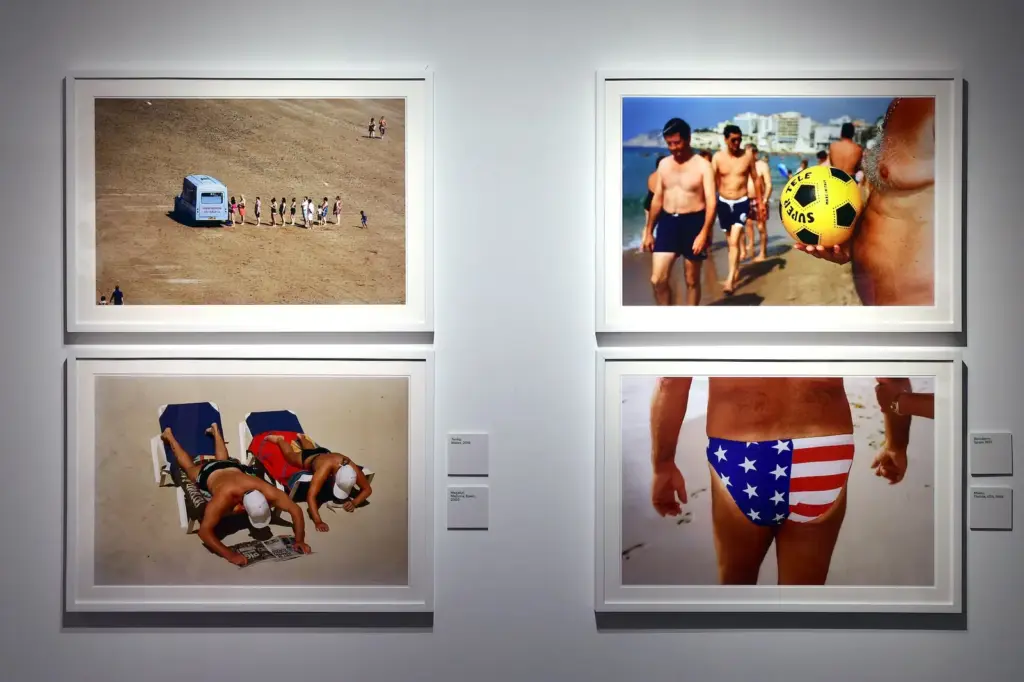
Parr continued photographing the customs of his fellow citizens—and tourists from around the world—with the same mix of curiosity, humor, and distance. After the series that made him famous, he focused on the less conflictive theme of the British middle class with a similar ironic treatment. Then he dedicated himself to traveling to different places around the world, and addressing issues now very exploited but that were quite novel for the visual arts at the time, such as touristification (with Venice, the Leaning Tower of Pisa, the pyramids of Giza, the Acropolis, the Andes, or the Californian beaches replacing the British north coast) or the excesses and lies of consumer society. His methodology was based on integrating into the environments of his interest to take photos without raising suspicion. Susan Parr revealed that her husband did not know how to swim, which seems in a certain sense ironic for someone who owes his fame to work done mostly on beaches. But it is also consistent with his way of being both inside and outside those environments that he captures and projects from his characteristic gaze. In the documentary, filmed when he was already suffering from the cancer that ended his life, it can be seen how, using a wheeled walker, he continues infiltrating festivals and popular celebrations to take his photos.
In 2017 he opened the Martin Parr Foundation to the public in Bristol, which organizes exhibitions, grants scholarships to emerging British artists, and maintains his archive and the personal collections of objects that feature in many of his photographs. In addition, it is supporting the platform created in New Brighton to develop the commemorative mural.
Forty years after The Last Resort caused that small earthquake at the Serpentine, Parr’s work seems definitely installed in the canon. This fall, his legacy unfolds again in several exhibitions: A Matter of Taste, which can be seen at the Marc Bibiloni gallery in Madrid from September 11, includes works from several of his series, with special attention to fashion photography. And from the 25th, a new presentation of The Last Resort can be seen at the London Rocket Gallery, so the series will return to the city where it was received with the greatest suspicion, accompanied by historic prints and material from his archive. Those photographs that some saw as a humiliation of the working class have ended up becoming one of the great visual documents of Thatcher’s Britain. And perhaps for that reason, a warning, a moral story.
Read more The methods AI can use to kill us