








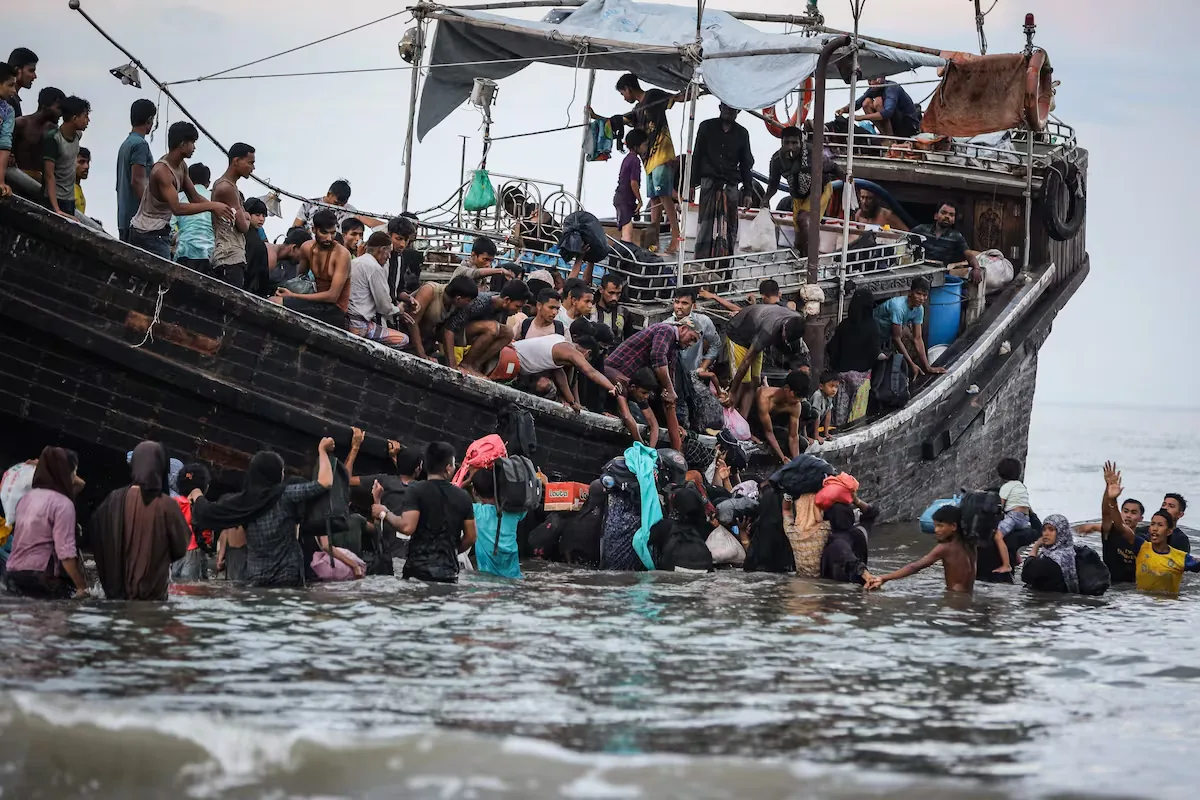
More than 500 people, mostly members of the Rohingya minority, are missing and feared dead in two possible shipwrecks off the coast of Myanmar, according to two United Nations agencies. The information has not yet been independently confirmed, but the International Organization for Migration (IOM) and the United Nations High Commissioner for Refugees (UNHCR) expressed their “deep concern” on Thursday over a possible “devastating loss of life.”
According to preliminary data collected by both agencies, the boats set sail at the end of June from the State of Rakhine, in western Myanmar. Most of the passengers were Rohingya and among them were also people from the refugee camps in Cox’s Bazar, neighboring Bangladesh, where around 1.2 million members of this Muslim minority live.
The first vessel was carrying about 250 people and all contact with it was lost shortly after departure. The second, with around 280 passengers, is believed to have sunk on July 8 off the coast of Ayeyarwady, a region located south of Rakhine. So far, no data on possible survivors have been released nor have any remains been recovered to establish an official toll.
The crossings took place outside the usual navigation season, at a time when the monsoon makes the waters of the Bay of Bengal and the Andaman Sea especially dangerous. The torrential rains and floods recently recorded in the region have further worsened maritime conditions, warn the UN agencies.
The vessels used for these journeys are usually precarious, travel well above their capacity, and lack the necessary fuel, food, and safety equipment.
If confirmed, the two shipwrecks would be among the deadliest episodes recorded on this route. According to the IOM and UNHCR, nearly 300 people have been declared dead or missing in these waters so far this year. In April, about 250 people disappeared after an overcrowded boat sank while heading to Malaysia.
In 2025, nearly 900 Rohingya died or went missing in the same region, the worst toll recorded to date. More than 6,500 made the crossing last year, and one in seven did not reach their destination, the highest mortality rate among the main maritime routes used by refugees and migrants worldwide, according to UNHCR. In recent years, more than half of those who have embarked have been women and minors.
Read more The Madrid Court supports the case against Begoña Gómez to proceed by jury for two crimes
The Rohingya are a Muslim minority to whom Myanmar (formerly Burma) has denied citizenship for decades, institutionalized discrimination under the 1982 nationality law. They also suffer severe restrictions on movement and access to employment, education, and healthcare.
The military campaign launched against their communities in 2017, led by the current Burmese president, General Min Aung Hlaing (then commander-in-chief of the Armed Forces), forced more than 700,000 people to flee to Bangladesh. A United Nations international mission concluded that there were elements of “genocidal intent” and called for investigations into the general and other senior commanders.
This is the greatest stain on the biography of the 1991 Nobel Peace Prize laureate, Aung San Suu Kyi, who at the time held the position of State Counsellor and is accused of having remained silent and even being complicit by defending her country in 2019 before the International Court of Justice against the genocide accusation. Suu Kyi has been imprisoned since the 2021 coup d’état, carried out by Min Aung Hlaing.
In the five years since the coup, the situation has further deteriorated within Rakhine due to the war between the Burmese Army and the Arakan Army, a powerful guerrilla group mainly composed of members of the Buddhist majority in the region. The United Nations has documented abuses against the Rohingya committed by both sides, as well as forced displacements and severe restrictions on humanitarian aid entry.
For the IOM and UNHCR, the possible shipwrecks show “the devastating impact of prolonged conflict and displacement,” as well as “the persistent lack of sustainable solutions” for this community. In Cox’s Bazar, the lack of prospects combines with cuts in international funding, insecurity, and limited opportunities to study, work, or move freely. These conditions push thousands of people to pay traffickers to try to reach Malaysia, Indonesia, or Thailand.
The IOM and UNHCR warn that trafficking and smuggling networks continue to exploit “the desperation of people seeking safety.” Both agencies call on countries in the region to strengthen search and rescue, allow access to asylum and protection, and act jointly against networks profiting from these crossings. “Greater regional and international efforts are needed to prevent further loss of life on one of the world’s deadliest maritime routes,” the statement concludes.