








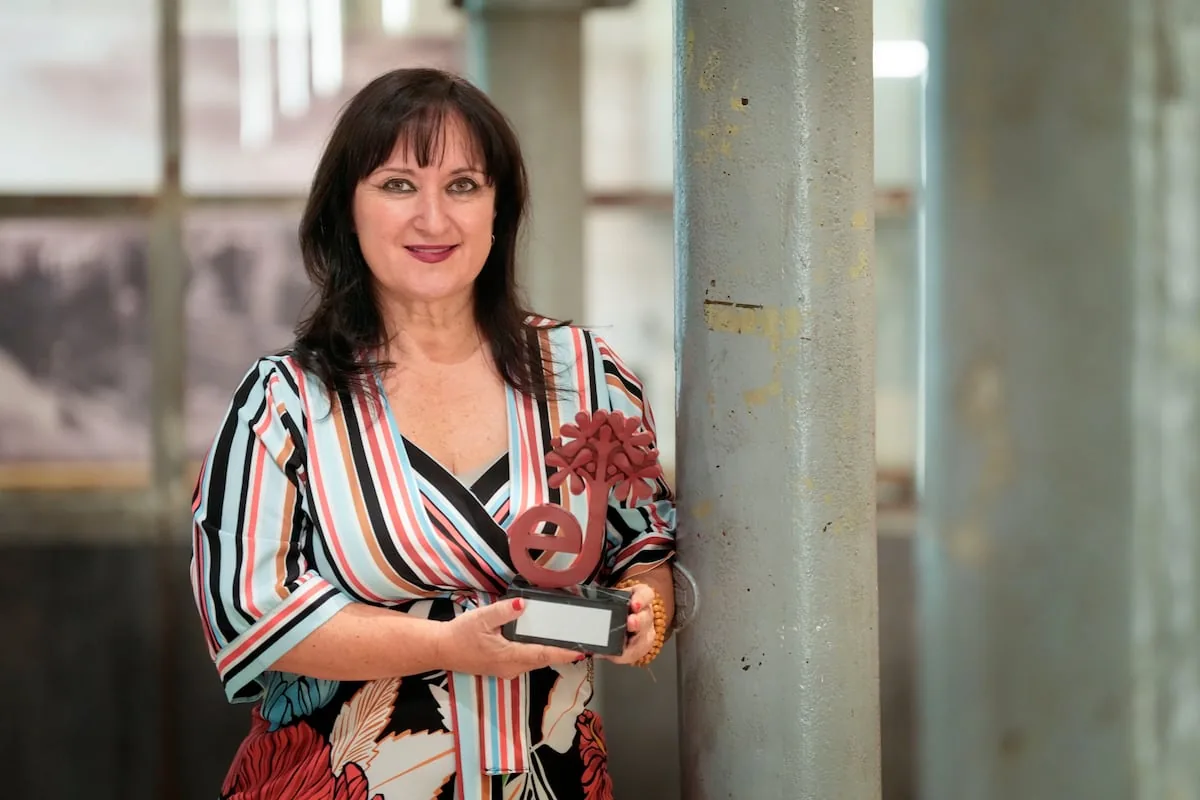
A novel that recreates the splendor of the Umayyad Caliphate of Córdoba and the rise of the leader Almanzor, The Light of Medina, by writer Emma Lira (Madrid, 55 years old), has been declared today the winner of the Edhasa Historical Narrative Award in its ninth edition. The jury, which includes Mari Pau Domínguez, Carlos García Gual, María José Solano, and Sergio Vila-Sanjuán, has praised “the extraordinary sensitivity” with which the novel describes “with rich details and a veiled exoticism, the Arab-Muslim Hispania of the caliphate, at the height of Medina Azahara, as well as the story of Almanzor before he became a legend.”
The Light of Medina focuses especially, besides the warrior leader, on the historical figure of Lubna of Córdoba, a slave who became secretary of the chancery of al-Hakam II and played a decisive role organizing the great library of the caliph, which he wanted to be the largest in the world and to emulate the lost one of Alexandria.
The award, convened by the publisher Edhasa and endowed with 10,000 euros, received 284 novels this edition. Lira, author of eight previous novels, including The Moon over Rome (2024) about Cleopatra Selene, daughter of Cleopatra and Mark Antony, and The Captive (2025), the novelization of Alejandro Amenábar’s film, is a contributor to various history and cultural guide publications (one of the experts for EL PAÍS Viajes), especially to Muslim countries such as Morocco, Algeria (from which she has just returned), Jordan, Lebanon, or Saudi Arabia. Passionate about history and archaeology and well acquainted with the Arab world and Islam, she wanted to highlight in The Light of Medina the significance of the Caliphate of Córdoba against a Spanish memory quite reluctant to give it, she says, the importance it deserves.
Edhasa’s editor, Daniel Fernández, highlighted at the award ceremony in Barcelona the relevance with which Lira writes about the era and the way she brings to life very powerful Muslim figures and asserts the role of women in those times. Fernández pointed out the added interest of showing the splendor of the Caliphate of Córdoba at a time like the present when there is much debate about the mass regularization of immigrants, many of them from Islamic countries. The editor took the opportunity to joke that Abascal “goes around as a great Christian knight but looks like a caliph,” adding that he even reminds him of the wicked vizier Iznogud from the comics created by Goscinny.
Lira noted that unlike the Roman past, which is unanimously accepted and valued, the Muslim one “seems to cause more reluctance, and if the Romans are seen as civilizers, Muslims are considered conquerors and are generally regarded as something foreign when they are an integral part of our history and culture.” In this regard, she recalled that “al-Andalus was much more than Andalusia and reached up to the Cantabrian coast.”
She pointed out how the Caliphate of Córdoba was like a papacy — “there could only be one caliph” — but in the 10th century, there were three: the Abbasid in Baghdad, the Fatimid in North Africa and part of the Middle East, with its capital in Cairo, and in Córdoba the one of Emir Abd al-Rahman III. Lira highlighted the splendor of that Córdoba and its capital Medina Azahara, a civilization that celebrated life and poetry, where courtly love was sung, including homoerotic love, and, surprisingly, wine was not lacking. “That refined world allows you to use a flowery prose like that of the time,” she said.
The awarded author highlighted the character of Lubna as the architect of the famous library of 400,000 titles of Abd al-Rahman III’s son, al-Hakam II, a library from which she speculates that part of its collection might have passed to the famous School of Translators of Toledo of Alfonso X the Wise.
Lira valued the usefulness of historical novels to recover and delve into little-known and documented characters like the Cordoban scholar, who came to lead 200 female scribes who copied books for the library, or to portray another like Almanzor, who everyone knows (the one with the drum, precisely) but few know in depth “despite having been born in Algeciras, lived in Córdoba, and died in Medinaceli.” In this sense, she reflected that Almanzor is “like the Hannibal of the Christians,” that feared warrior leader whose true personality has been obscured in a kind of damnatio memoriae.
The Light of Medina is not, however, despite the prominence of Almanzor the Victorious, a book of battles, but rather a quite intimate portrait of the era. “I like to tell what is not seen, and in battles you usually see everything; I am interested in why human beings cry or sigh, the life behind the doors of Medina Azahara.”
On the book cover, Almanzor has a retreat similar to Ridley Scott’s Saladin in The Kingdom of Heaven. Emma Lira laughs: “He looks alike, true; Saladin was also a great strategist like Almanzor and if someone like Ridley Scott is to bring him to the cinema, I couldn’t agree more.” The author ended by assuring that she trusts The Light of Medina will prove wrong “the publishers who believe that al-Andalus doesn’t sell.” Meanwhile, Fernández committed to taking everyone present at the award ceremony (including the jury) to Cairo if the novel sells more than 50,000 copies.
Read more The police arrest a man for shooting pellets at a school in Granada, injuring two minors