



The Faroe Islands are not an easy destination. The weather is unpredictable. Prices are high. The roads are narrow. But precisely because of that, they are more attractive. For now, these northern islands protect themselves from the arrival of mass tourism with tourist taxes, limiting access to some trails and promoting slow and different experiences, such as eating in the homes of local inhabitants.
Read more The war in Iran has not taken place
The Faroe Islands barely catch the eye on the map: they are 18 volcanic islands lost in the North Atlantic, between the United Kingdom, Norway, and Iceland, very far from Denmark, of which they are part with a special status as a “constituent nation,” like Greenland. The landscape of these islands has not yet been tamed, despite being just over two hours from Copenhagen and their international airport, in Vágar, having direct flights from Copenhagen and, seasonally, from some cities in Spain, Scotland, or France.
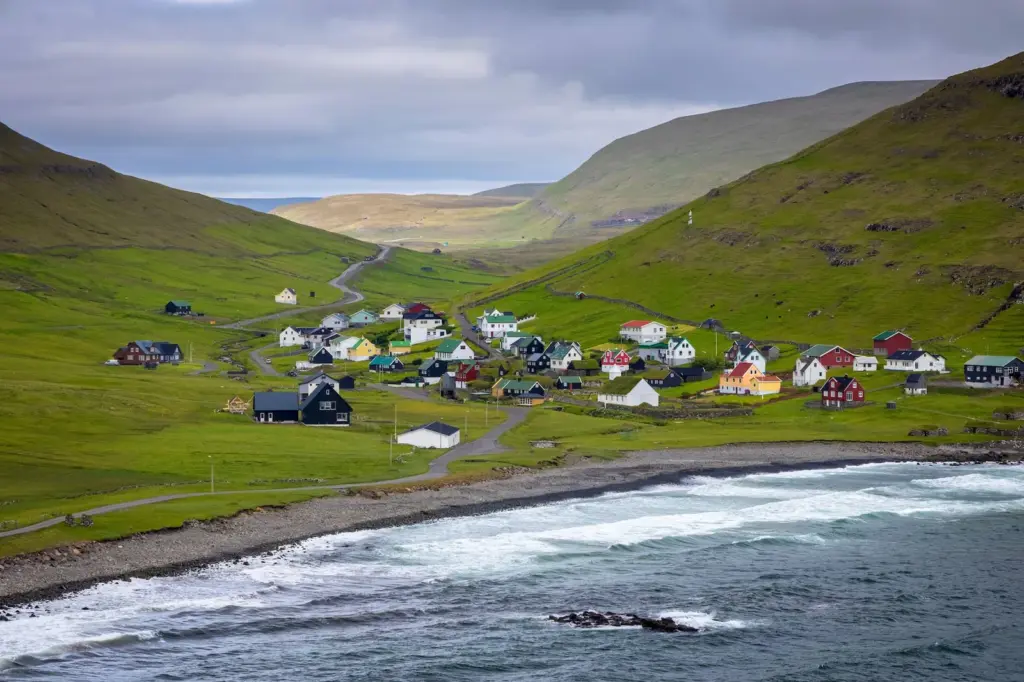
And why go to such a remote and lonely place? Perhaps for that reason: for the isolation and originality. It is worth exploring their lonely lighthouses and timeless villages, hiking mountain trails and birdwatching, but you must always be prepared for truly unpredictable weather, with wind, rain, and fog. It is a destination to travel without rush: here time moves at a different pace. Slowly. The roads do not lead us to cities, but to cliffs, where you will have to fight the wind. The feeling of radical isolation is its greatest attraction, with basalt mountains, sea straits, and cliffs full of birds. It rains or snows here more than 250 days a year, and perhaps because of that, visitors quickly learn that traveling in the Faroes is not about accumulating places, but about accepting the weather, silence, and uncertainty. Luxury is not in comfort, but in experiences like traveling on traffic-free roads, with sheep crossing the way.
In the Faroes, it is still possible to feel, as travelers, that we have arrived in a different, more real Europe. Less tamed. You can visit the 18 islands, 17 of them inhabited and different from each other: some are mysterious, wrapped in mist and wind, others are green and even have some cultural life. Some are served by a café or accommodation, and others can only be visited on your own with a sandwich and by undertaking hiking routes known only to the sheep. Here the expression “off the beaten path” is out of place, as all the islands seem virgin.
Perhaps the most beautiful way to see the Faroes is by boat, on wooden schooners with red sails, but there are many other ways to approach and explore the islands, even by local buses.
More information in the Lonely Planet guide to Denmark and the Faroe Islands and at www.lonelyplanet.es
Tórshavn, the smallest (and most unexpected) capital
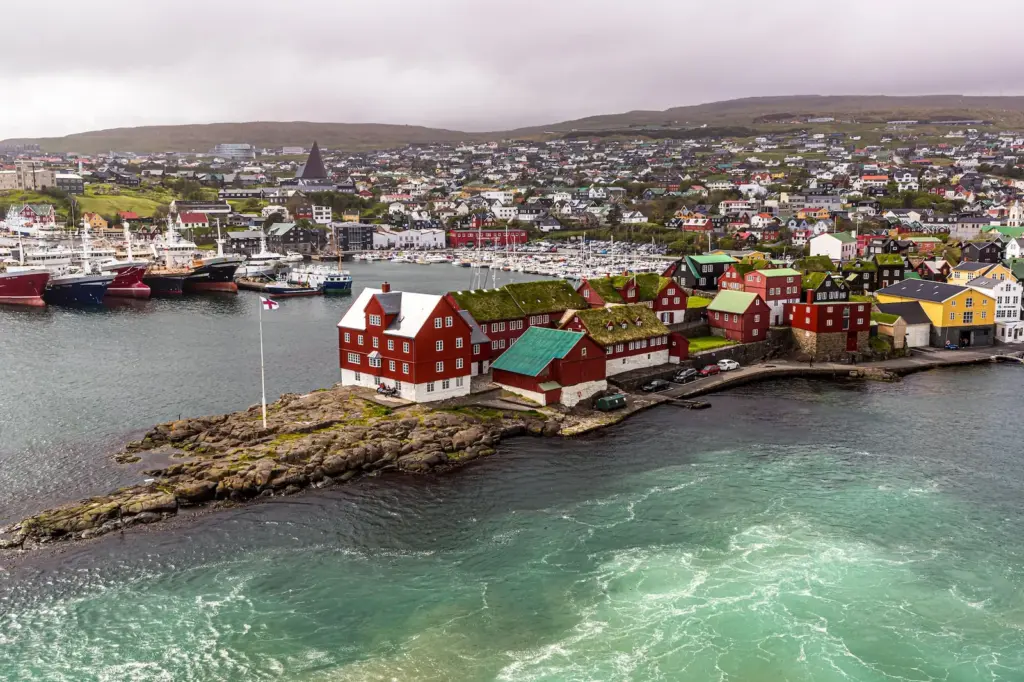
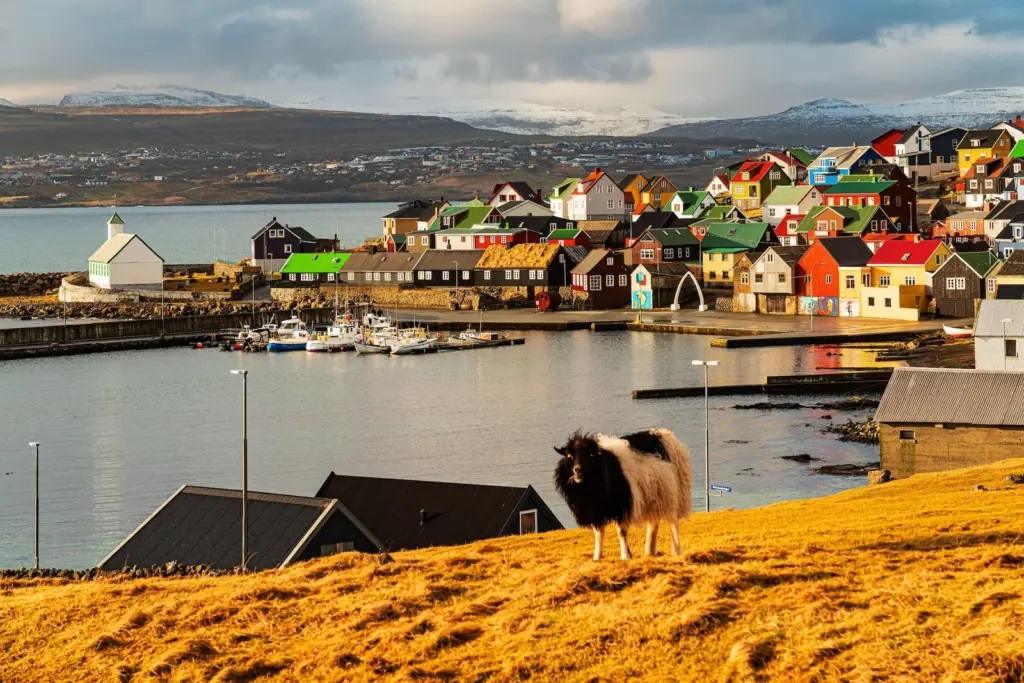
Tórshavn is the best starting point to understand the Faroes: with only fourteen thousand inhabitants and streets that can be walked in minutes, it has an unexpected cultural life. The capital of the Faroes does not impress by its size, but by its ability to condense culture, history, and gastronomy in a minimal space, almost at the end of the world. There, on the Tinganes peninsula, among dark wooden houses with grass roofs, stands one of the oldest parliaments in the world, where more than a thousand years ago, the Vikings gathered to decide the fate of the islands. Today, the place remains the political center of the archipelago, but also an intimate, almost domestic space.
Life in Tórshavn revolves around the harbor. Fishing boats, cafés, and restaurants where tradition is reinvented. Here you eat fermented lamb, air-dried fish, recipes born out of necessity that today are part of sophisticated cuisine. The most revealing experience, however, does not happen in restaurants, but in homes. The heimabliðni — that Faroese hospitality that invites you to eat with locals — transforms the visit into something closer to living together than tourism. Besides eating in private homes, you can stroll through the old town to the Skansin fortress, visit the national museum to understand Faroese culture, or dine at restaurants like Rae Ræst or Áarstova, where the tradition of fermenting food becomes haute cuisine.
Kirkjubøur, the medieval origin of the archipelago
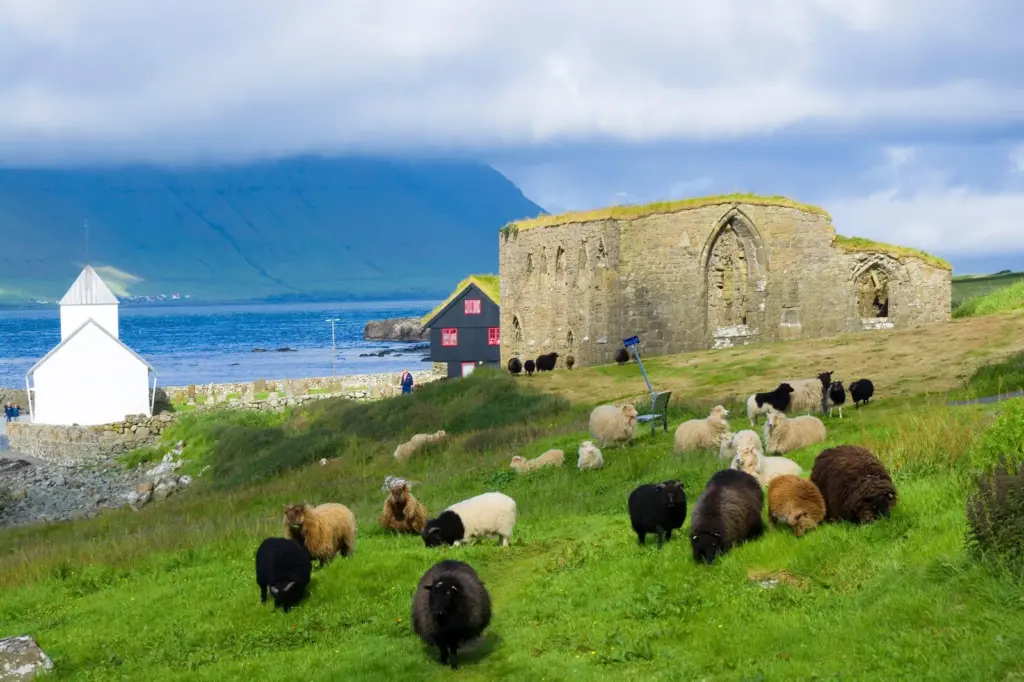
Just a few kilometers from the capital, the scale changes completely. In Kirkjubøur, less than half an hour away, on the same main island, the landscape opens towards the sea. It is the place where it all began: the ruins of St. Magnus Cathedral, roofless and with walls that have withstood the wind for centuries, dominate a village that was the religious and cultural center of the archipelago. Next to it, a 12th-century church is still in use. There are no spectacular reconstructions or grandiose museums. Only stone, silence, and continuity. It is a place where the greatest experience consists of walking historical trails or visiting Roykstovan, a farm inhabited by the same family for a century.
Saksun, the natural amphitheater
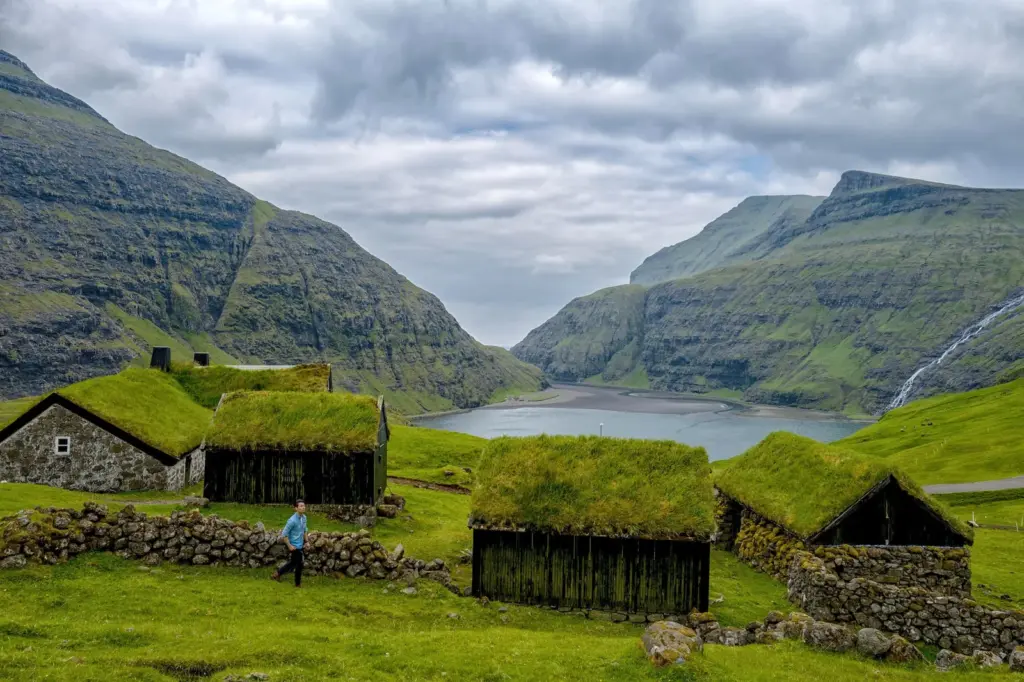
The true character of the Faroes, however, is revealed in motion, on the road, which seems designed not to reach a destination, but to cross the landscape. To the north of the main island, for example, the curves leading to Saksun wind through mountains until they end in an almost unreal scene. Because Saksun is not a village: it is a scene, a village isolated at the end of a narrow road, surrounded by mountains and open to a tidal lagoon of black sand. With a white church that seems placed with scenic precision. Everything is so perfect it seems unreal. But it is real, so much so that its inhabitants have begun to set limits on tourism, reminding that this landscape is not a set, but a lived place.
You go to Saksun to walk to the Pollurin lagoon, or hike towards Tjørnuvík. And if you don’t want to move, you have the option to visit the Dúvugarðar museum in a traditional house.
Tjørnuvík, surfing in the coldest Atlantic
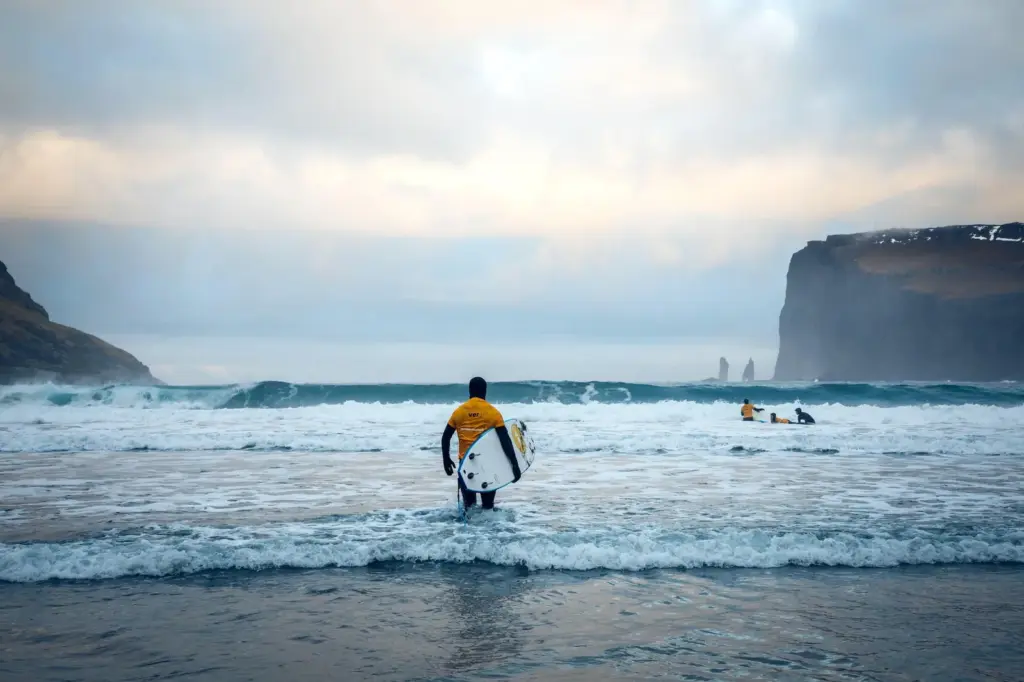
In a U-shaped bay, Tjørnuvík offers one of the most powerful images of the archipelago: open sea, dark sand, and the sea stacks of Risin and Kellingin rising from the ocean. The sea enters an open bay where the wind always blows and the two sea stacks emerging from the water off the coast look like petrified mythological figures. According to legend, they are a giant and a witch who tried to drag the islands to Iceland. They failed, and the dawn turned them to stone. On days with waves, the Atlantic hits hard and turns the beach into an inhospitable place, but surprisingly, someone decided at some point to surf here, with thick suits, gloves, and hoods, defying temperatures that rarely exceed eight degrees. Nothing like surfing in Hawaii. Here jumping the waves is an extreme sport. The other option is birdwatching from the cliffs or walking to natural viewpoints.
Read more Forms in Congress
Funningur and Slættaratindur, the summit of the islands
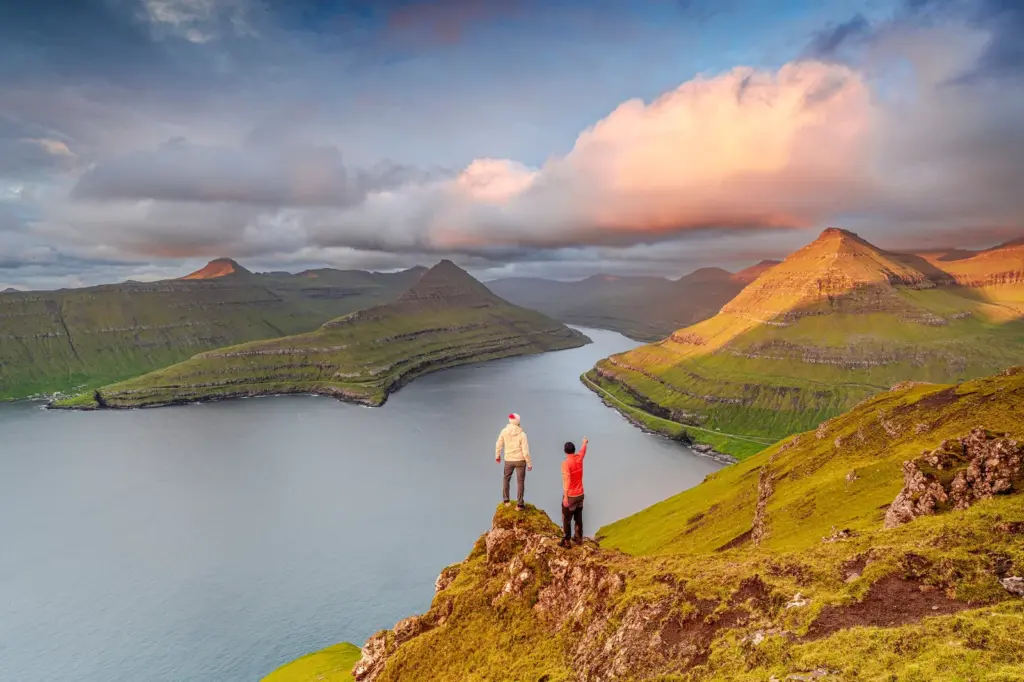
Funningur looks like a set: houses sheltered by mountains and a zigzag road descending among sheep to a handful of houses. Little more. From there you can climb Slættaratindur, the highest point of the islands. The ascent is demanding, the terrain changes and so does the weather, but on a clear day, the reward is total: a panoramic view that encompasses the entire archipelago, as if the world had been reduced to a group of islands scattered in the ocean. The adventure consists of stopping at improvised viewpoints on impossible roads.
Nólsoy, the island of silence
There are places where the feeling of isolation intensifies even more, if that is possible. Nólsoy, just twenty minutes by ferry from Tórshavn, seems to be years away. A single village, trails crossing damp hills, a lighthouse at the end of the island… for a conventional tourist there is nothing to do here. And precisely for that reason, it is attractive, especially for that type of traveler who seeks something different: walking, birdwatching, listening to the wind, understanding the rhythm of a small community. One option is to follow the 13 km route that leads to the Nólsoyar Viti lighthouse. Another, birdwatching. And for some, the best will be visiting the traditional 17th-century houses. Almost no tourists reach here, and that is its true luxury.
Vágar, waterfalls and impossible landscapes
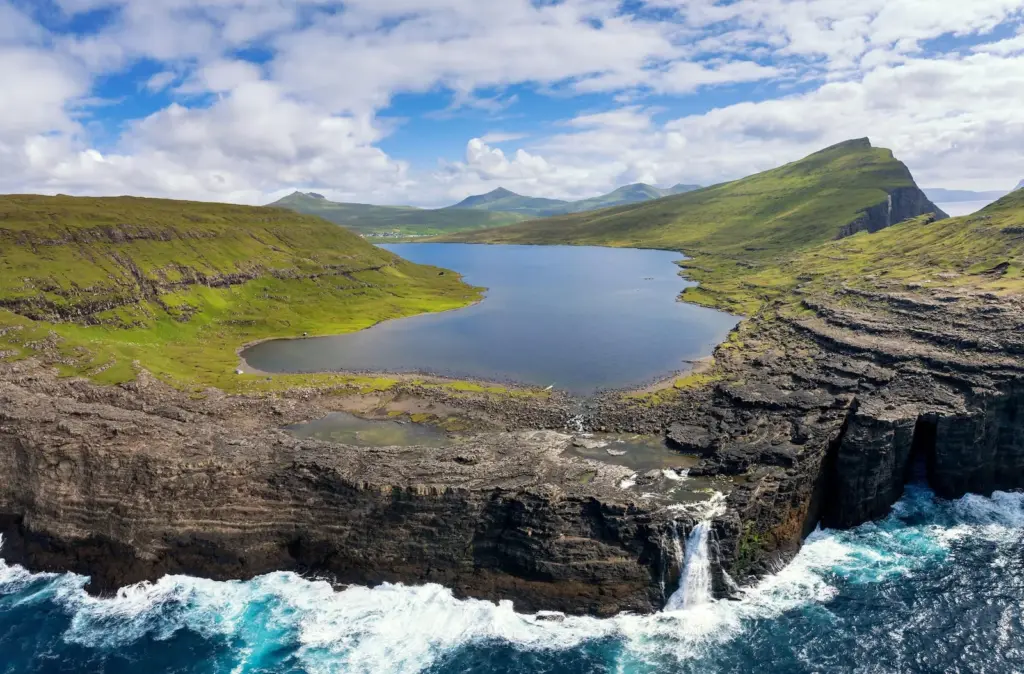
Vágar, to the south, is the island of the airport, the gateway, but also one of the most spectacular places in the Faroes. The Múlafossur waterfall falls from a cliff directly into the sea, with the small and isolated village of Gásadalur as a backdrop. It is one of the most photographed images of the archipelago, especially at sunset, but getting there — driving the road, passing through the tunnel, walking to the viewpoint — still has something of a discovery. Nearby, the Sørvágsvatn lake seems suspended over the ocean, an optical illusion that defies perception and well summarizes the Faroes’ ability to surprise. It is the quintessential Faroese postcard.
Mykines, the island of puffins
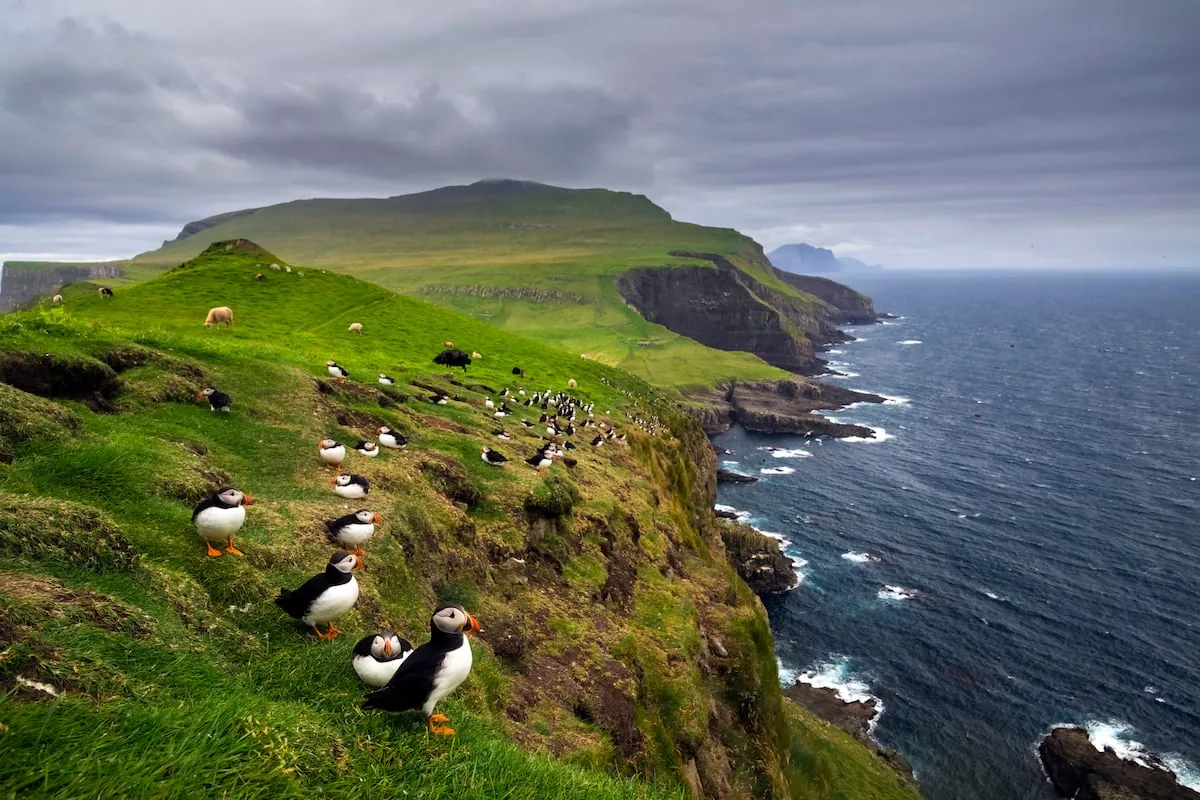
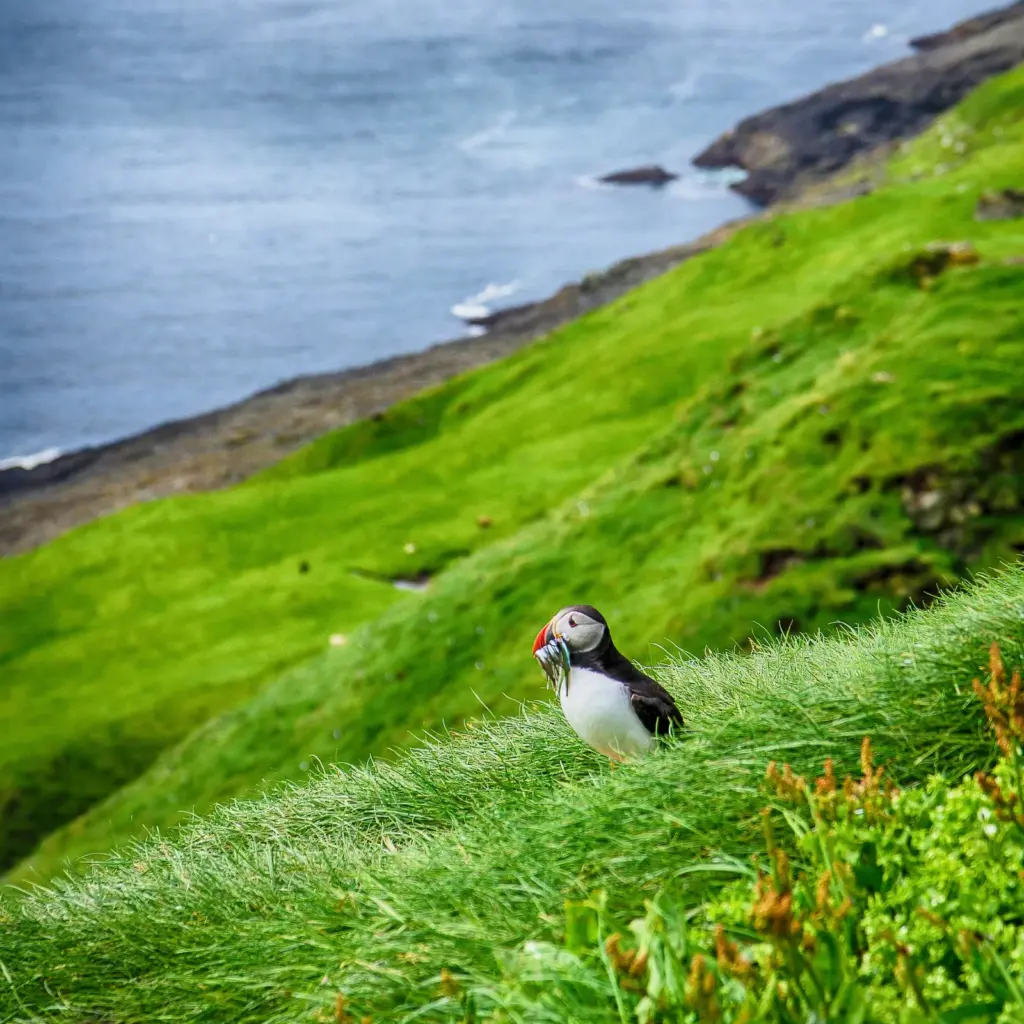
The westernmost island is also one of the wildest, where nature regains absolute protagonism. It is the island of puffins, where thousands of birds nest on cliffs that drop steeply into the Atlantic. Access depends on the weather. The wind, fog, and sea decide, and that is part of the journey. In Mykines, you can hike to the Mykineshólmur lighthouse, photograph birds in freedom, or venture along paths with hardly any infrastructure. Walking to the lighthouse, surrounded by birds that barely fear human presence, is one of those experiences hard to describe. A true pleasure for solitude lovers.
The northern islands and the Kallur lighthouse, the end of the world
In the northern Faroes (Kalsoy, Kunoy, Borðoy, Viðoy, Svínoy, and Fugloy) is where you really feel that isolation. Even more than on the other islands, which is saying something. As soon as you pass the second largest population of the archipelago (Klaksvík, 5001 inhabitants), a world of sharply contoured fjords crossed by winding roads, narrow tunnels piercing towering mountains, and paths leading to a scattered handful of houses at the end of the world appears.
If you like that poetic image, you can keep driving to Viðareiði, where the road ends at a small historic church with views of the sea stacks in the distance, or to the abandoned village of Múli, a ghost town in northern Bordoy. Its last inhabitant left in 1992. For something more blockbuster, you have to go to Kalsoy, an island that appeared in the latest James Bond movie with Daniel Craig, No Time to Die.
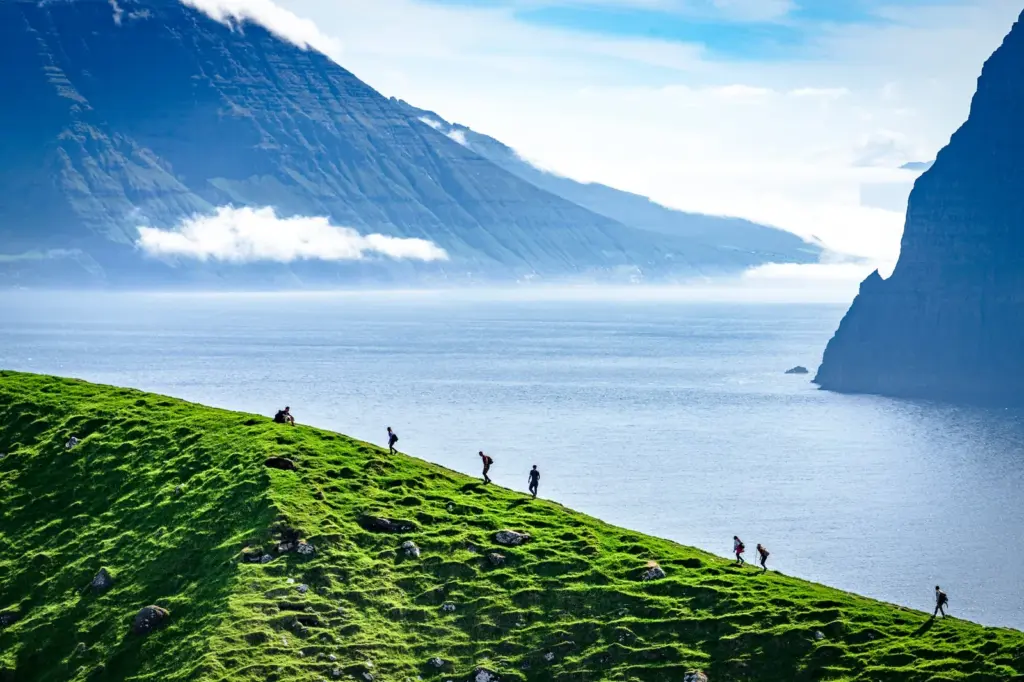
Kalsoy is the place that best synthesizes the spirit of the islands: a narrow island, crossed by tunnels, with small scattered villages. At its northern end, the Kallur lighthouse rises on an impossible ridge and is one of the most iconic visits in Europe. Getting there involves walking along a path that narrows between steep slopes. The wind is constant. The sea, omnipresent. The feeling is clear: there is nothing beyond.
Southern Islands, escaping the hustle and bustle
To the south of Tórshavn are the southern islands of Sandoy and Suðuroy. Since 2024, Sandoy is connected to Tórshavn by an underwater tunnel, making it easy to reach by car from the main island. Despite this, it remains little frequented and seems light years away from the hustle and bustle of the main points of interest in the archipelago. Sandoy consists only of soft pastures, farms, and sea views, is quite flat and generally quieter than the rest, but conveys serenity. It can be crossed by car from north to south in about 30 minutes.
A tunnel to Suðuroy is planned, although for now the ferry remains the only way to get there, making it even more remote from the hustle and bustle. Suðuroy is the southernmost, with a rugged landscape of basalt columns, winding roads, and spectacular mountains. It is sensational for hiking, quite empty even in high season. The roads end at cliffs full of birds and with a lighthouse at the southern tip. The views of the untamed ocean and the unique uninhabited island of Lítla Dímun, covered in clouds, inspire both artists and hikers. And there are still places to discover off the beaten path, like Stóra Dímun, where only one family lives and which is only accessible by helicopter.
But curiously, in Sandoy or Suðuroy, if we get tired of so much walking and birdwatching, there are some small cultural offerings: museums or art galleries linked to the original Faroese culture.
Closed for maintenance
Every April, the Faroes close to the public for a weekend and host 100 international volunteers who carry out maintenance work at their points of interest. The program started in 2019 and since then has continued to receive participants from all over the world. These, chosen at random, pay their travel expenses but receive accommodation and food while spending three days working on about 12 ongoing projects, including repairing and building trails or installing signs and viewpoints. They rave about the experience, make lifelong friends, and develop a strong attachment to the archipelago. It is a creative initiative designed to demonstrate that tourism can bring all kinds of values beyond the merely economic, and it is considered an example of regenerative tourism worldwide.