








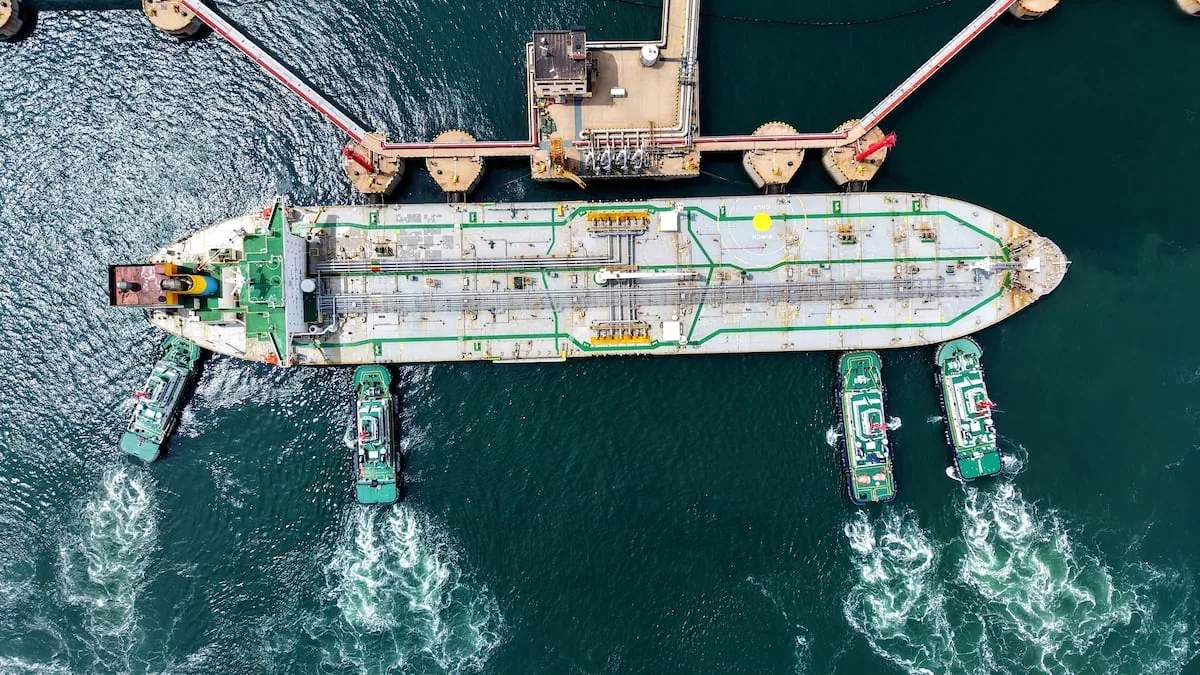
Today we would not be so worried about the situation in the Strait of Hormuz if Donald Trump had not made the tremendous mistake of embarking (hand in hand with Benjamin Netanyahu) on an illegal war that has achieved none of its objectives. And if before Tehran relied on its controversial nuclear program as its main bargaining chip, it now adds control of the strait as an even more powerful lever to continue resisting the onslaught. Aware that militarily it cannot defeat its aggressors, it has found in the selective disruption of maritime traffic through those waters the most effective method to punish the entire planet, fantasizing that pressure on Washington will allow it to emerge even stronger from an unwanted conflict. For his part, Trump, desperate to get out of the hole he has dug himself into, now imposes a blockade that, by economically strangling his enemy, continues to seek its surrender.
Read more Faroe Islands: the wild Europe that resists mass tourism
In any case, signs are multiplying that suggest Trump has not properly gauged where his latest whim is leading him. Ideally, the naval blockade he has announced — with the intention of preventing passage through Hormuz to all ships departing from or heading to Iranian ports, as well as those transiting the routes established by Tehran, even if they do not touch Iranian ports but have accepted its navigation conditions and paid a toll — must be legal and effective.
The first condition, as is the case with the one imposed by Iran, is not met, since neither Washington has an explicit mandate from the UN Security Council, nor can it claim legitimate defense. This explains, as Trump now realizes, the rejection by many countries — both NATO members and Gulf Cooperation Council members — to contribute their forces to collaborate in seeking a solution to a problem that did not exist until February 27. Meanwhile, the initiative advocated by the French Emmanuel Macron and the British Keir Starmer to guarantee freedom of passage in Hormuz is postponed until “the necessary conditions are met.”
Regarding the effectiveness of the blockade, while the Iranian only needs to intimidate and/or attack some isolated ship, the American imposes on himself the task of a total prohibition to completely nullify Tehran’s plans. For this, he needs to have in the area of operations a volume of naval, air, and land forces far superior to those currently deployed there. It is currently estimated that he only has about fifteen ships — among which is the aircraft carrier Abraham Lincoln, once the Gerald Ford has withdrawn to Crete and the George W. Bush still has days of sailing before approaching the area — directly involved in the operation. However, a voice as authoritative as that of the American admiral James Stavridis estimates that two aircraft carriers and about 16 destroyers and frigates, as well as about fifty other ships operating between the Persian Gulf and the Arabian Sea, would be necessary to achieve appreciable results.
Read more The war in Iran has not taken place
And to the difficulty of controlling the large number of ships currently trapped in the Gulf is added the aspiration to break the Iranian blockade. That means being able to neutralize hundreds of fast attack boats, thousands of mines, surface drones and submarines, ballistic and cruise missiles, as well as land units located along more than 1,500 kilometers of coast, which gives Iran a remarkable capacity for action despite its technological inferiority. And it remains to be seen what will happen if the United States Central Command (CENTCOM) decides to block the passage of a Chinese ship, when Beijing has already warned: “Don’t get involved in our affairs.”
If there is still some rationality left in those who have to make decisions in such a complex environment, one would expect that, on the edge of the abyss, deepening a dynamic that offers no successful outcome for any of the contenders will be avoided. Trying to escape the most catastrophic predictions, it is clear that, despite the exchange of blows that might indicate otherwise, the path chosen by both Tehran and Washington prioritizes the geoeconomic factor over the military one; basically because both know they are not in a position to achieve a definitive victory by arms. That offers some room for understanding insofar as Tehran needs an agreement to survive and Washington needs it to allow Trump to get out of the quagmire (Netanyahu lives off war and, therefore, neither seeks nor desires an agreement). But even so, with so many weapons deployed, plus mutual distrust and the complexity of the issues to be resolved, the probability is very high that something will trigger an uncontrolled escalation in a duel in which the US stakes its role as an improper world policeman (and the preeminence of the dollar) and Iran its existence; all this forcing shipping companies to choose between the legality established by Washington or the fait accompli of Iranian control.
Read more Forms in Congress