







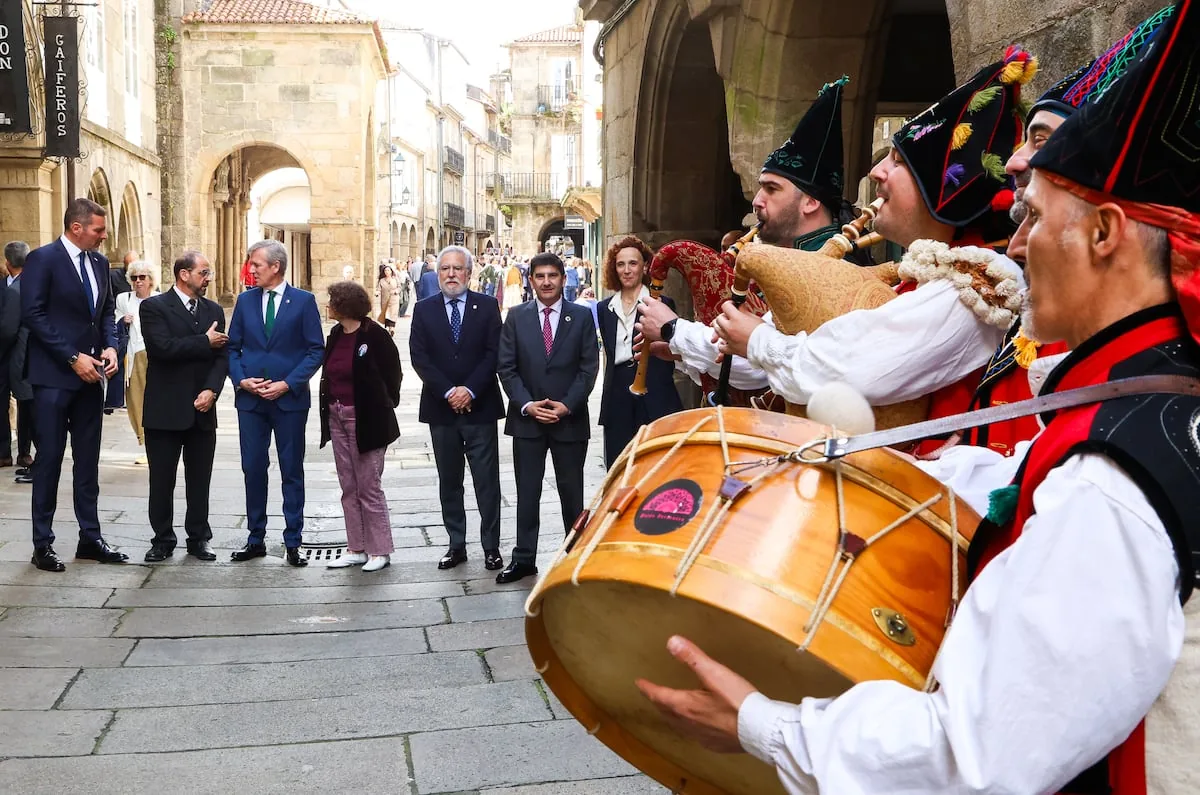
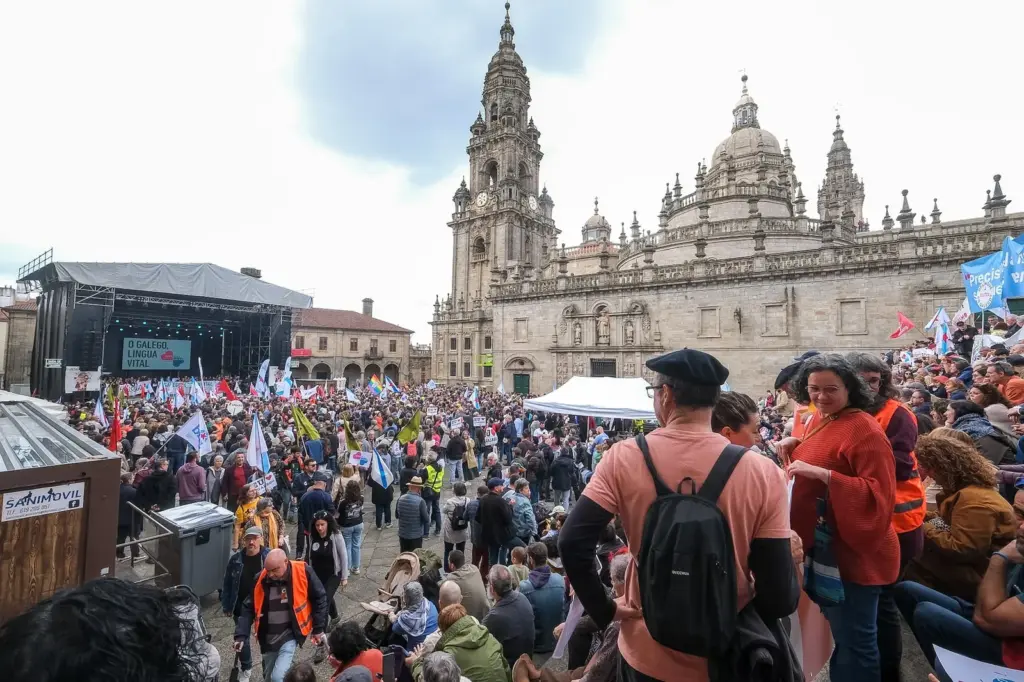
“It is the time of feminism: that is to say, of justice, equality, freedom, dignity. And also, why not, of happiness.” Begoña Caamaño (Vigo, 1964-Santiago de Compostela, 2014) defended this way, at the presentation of her last book, Morgana en Esmelle, one of the driving forces of that energetic and positive struggle for her values that her short life consisted of. The radio announcer and writer died at only 50 years old due to cancer, but her voice has been sounding for months in hundreds of cultural actions, school works, publications, and tributes that this Sunday, May 17, Galician Literature Day, reach their peak with the plenary held in Santiago by the Royal Galician Academy (RAG). At the same time, the streets of the historic center of Compostela have served as the setting for the demonstration called by the Queremos Galego platform. Thousands of people have gathered in Praza da Quintana in defense of their own language to call for an end to the “linguistic emergency” it suffers from.
Read more Félicien Kabuga dies in The Hague, accused of instigating and financing the genocide in Rwanda
The slogan of the march O galego, lingua vital, fits perfectly with the profile (vitalist, curious, critical, and constructive) that on this day several language academics coincided in drawing when talking about Caamaño, in the extraordinary session of the RAG, open to the public at the Teatro Principal. Her legacy, the Academy claims, is “brilliant and seductive in literature, challenging intellectually and ethically, and always in Galician.”
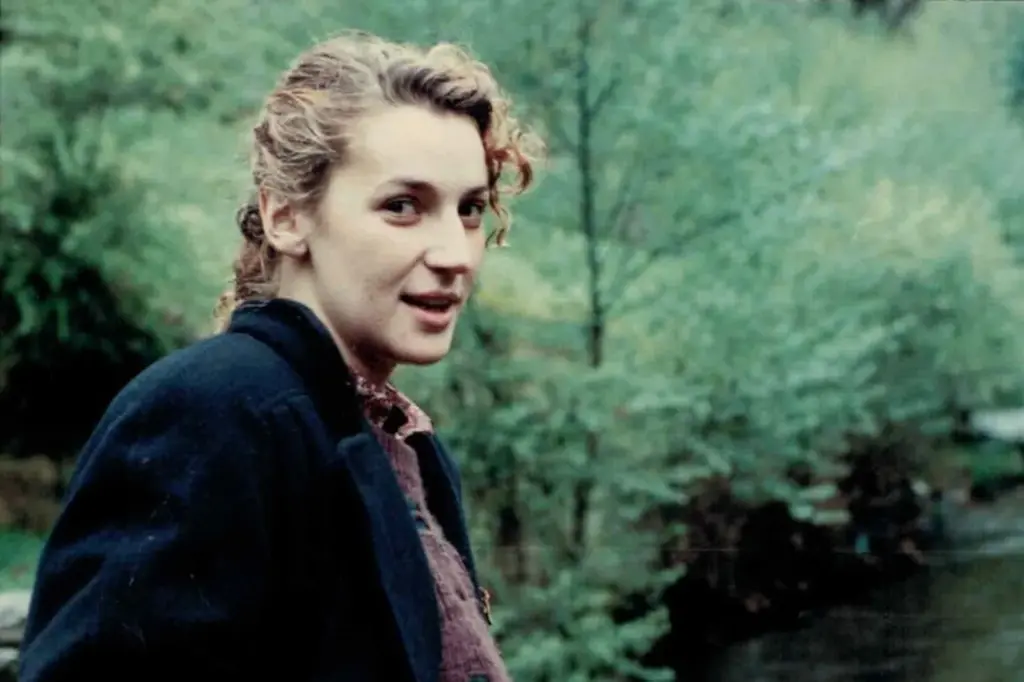
The poet Ana Romaní, colleague at Radio Galega, friend and biographer of Caamaño, the writer Marilar Aleixandre, and Víctor F. Freixanes, as editor of Circe ou o pracer do azul (2009) and Morgana en Esmelle (2012), have been the academics who have unraveled the “joyful insurrection of feminism” that underpins the life and work of the author honored this year. In her novels, she rewrote two myths of Western culture, giving voice and placing women at the center. The trilogy was to continue with the revision of Scheherazade, the storyteller of One Thousand and One Nights. She had begun writing it, but illness cut short a literary career that lasted only five years.
Ana Romaní, her colleague on the program Diario Cultural, has defended that “Begoña Caamaño’s radio collectivizes thought. It moves away from clichés, fosters openness, attends to complexity, emphasizes diversity, what differs.” For his part, the current president of the RAG, Henrique Monteagudo, has called for unity to guarantee the future of the language and has held Caamaño up as an example: “Raised in Spanish in the Vigo neighborhoods of O Calvario and Coia, she became a neospeaker in Galician when she was very young.” “Commitment, activism, joy, affection: that is what our language needs,” Monteagudo has proclaimed in his speech, although he has also stressed how “essential” political “impulse” is, in a speech delivered in the presence of Alfonso Rueda (PP), president of the Xunta.
Read more Five numbers to follow the count in Andalusia and know who wins and who loses
“A radio for a country, for the future of the language, journalism for citizenship, a public media model that makes us wiser and freer,” Romaní formulated in her turn the dream of Caamaño, with words from the author. Meanwhile, Marilar Aleixandre has delved into the feminist reconstruction through the myths carried out in the creative work of the celebrated writer. “Begoña Caamaño, the feminist narrator, is mending cut tongues with violet thread. Tongues that in myths are physically cut in what constitutes a symbolic castration,” said the 2022 National Narrative Award winner. “Mending is a more difficult art than embroidery. It is not patching, it is imitating the fabric where it is worn or torn,” she recalled next, “Begoña Caamaño appropriates myths, Greek and Arthurian, and mends the blank spots, the torn fabric from which women, their voices, their stories disappeared.” Thus, in all facets of her life, the writer “defended freedom, denounced injustices” and “raised her voice for Palestine, for the Galician language, for feminism, joy, and life,” Aleixandre concluded.
Freixanes, writer, editor, former president of the RAG, recalled a “Begoña-Scheherazade, weaver of stories.” He met her, he said, after she finished her teaching degree, the career in which she trained, already working for Radio Popular de Vigo, which in the early 80s allowed her to use Galician on air. “Journalism is the first path that interests her to understand reality, to know the world she and her generation will live in,” reflected Víctor F. Freixanes, who remembers Caamaño as “a bomb of energy, of joy.” But it was when the writer entrusted him with the original of her first work, Circe ou o pracer do azul, that he was surprised. “When I started reading it, I couldn’t put it down. The text was magnificent, written with a stylistic maturity that gave it a special strength.”
Begoña Caamaño’s family also attended the event, which marks the culmination of months of work, editorial and audiovisual products, and all kinds of tributes in Galicia. Born in Vigo in October 1964, she spent her early years in the family home in the O Calvario neighborhood. Her reivindicative and militant character was forged shortly after, when the family moved to Coia, a new and young neighborhood that extended to the other end of the city in the mid-70s and where the labor movement and combative spirit beat. Years later, in Vigo and Santiago, she was part of Mulheres Nacionalistas Galegas and got involved in the World March of Women.
Read more The Modena hit-and-run sparks a fight in the Italian right over “remigration”