









This is a newsletter from Kiko Llaneras, an exclusive bulletin for El País subscribers, with current data and explanations: sign up to receive it.
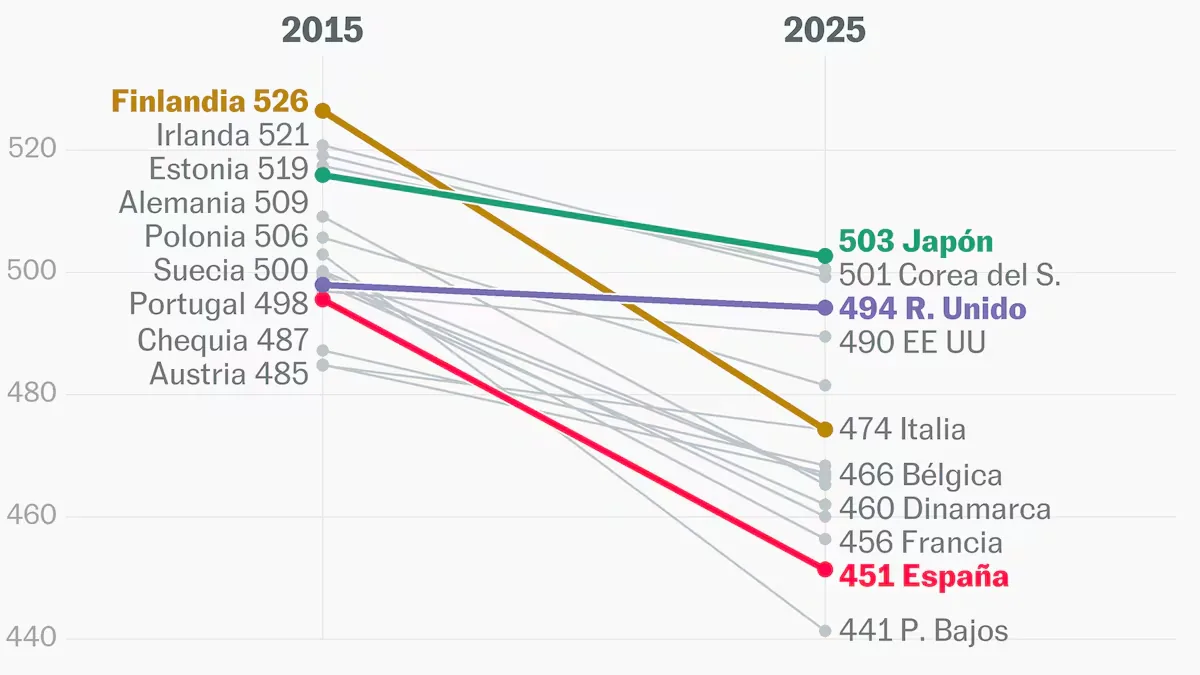
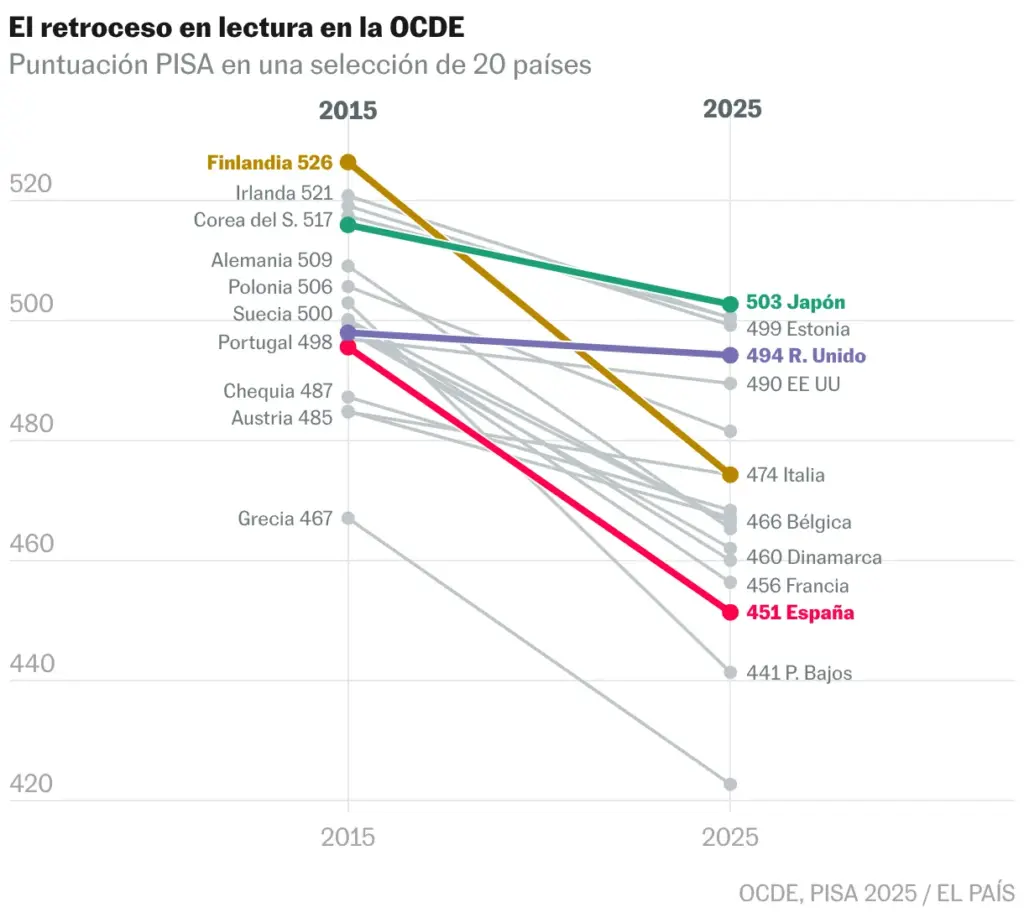
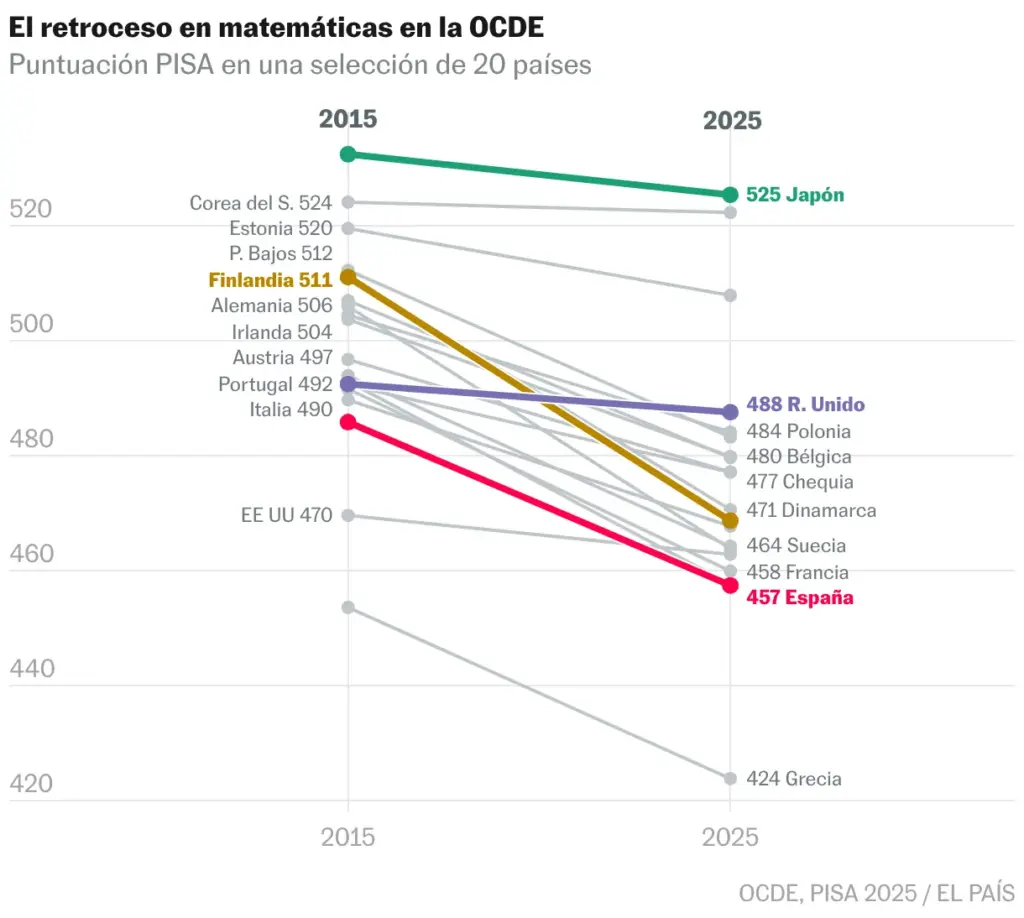
PISA scores have plummeted in a decade. Since 2015, 15-year-old students in the OECD have lost 7 points in science, 22 in mathematics, and 27 in reading, roughly equivalent to one school year. In Spain the drop is greater, but the phenomenon is widespread. Math and reading scores have fallen in 37 of the 38 OECD countries.
The question is obvious: what is happening?
I think there is no single answer. It is disturbing: academic results for boys and girls are worsening across half the world and we don’t know why. The debate these days has shown a battle of favorite theories: some explain everything with screens; others with discipline, privatization, or immigration. Some explanations are more solid than others. But I am quite sure there is no single cause that explains what we see in each country. First, let me review some of the most popular hypotheses.
Is it the pandemic? For months we closed schools and sent children to learn from home. There is evidence that during the pandemic they learned less, especially those from poorer families. This will be part of the explanation, but the decline had started earlier.
Is it immigration? Students of immigrant origin are already 20% of 15-year-olds in Spain, almost double what it was in 2015. Many grow up in families with fewer resources; some study in a language they do not speak at home. And they score about 40 points less than natives. If their proportion increases, the average will drop even if no one learns less. But that mechanical effect cannot explain the entire national drop, because native students’ scores also fall: 23 points in math and 39 in reading since 2015.
Is it mobile phones? It is inevitable to look at technology: screens, phones, social networks, short videos. The PISA report says that in Spain 80% of students spend more than an hour on their social networks. The tiktoration is recent and profound: few novelties have occupied so much time and mental space (and my feeling is that it offers little in return). And these are not just feelings. A recent study with Italian schoolchildren finds worse results in language and math among those who started using social networks earlier, even accounting for their prior level. But we are far from knowing what part of the collapse is explained by looking at the phone. Also, we lump together playing RPG video games, watching documentaries on YouTube, or binge-watching reels.
Is it lack of sleep? “I get many messages from friends all night,” explained a 14-year-old English boy in an international study. We don’t talk enough about this: among Spanish adolescents aged 15 to 18, those who say they sleep more than eight hours dropped from 50% to 30% between 2014 and 2022, according to the HBSC survey.
Is it the decline of reading and attention? In the US, which has the best data, we know that teenagers who read for pleasure almost daily have fallen from 35% in 1984 to 14% in 2025. In Spain, young people who say they read weekly also decline. PISA itself adds another clue: between 2018 and 2025, student performance fell more on questions with long texts. That fits with students who have more difficulty sustaining attention. But also with students who read less and have lost practice.
Is it artificial intelligence? A surprise in the latest PISA is that, in the OECD, the drop since 2022 is greater among students from higher-resource households. Lucas Gortazar suggested a possibility: maybe those households adopted AI first? It is not the only evidence pointing to chatbots. A study followed thousands of students in China and observed that after starting to use AI, their homework grades improved and their exam grades worsened. Chatbots allowed hacking homework. But ChatGPT arrived at the end of 2022: we don’t know what weight it has had and it also cannot explain the earlier drop in PISA.
Are pedagogical changes to blame? Many look to England: there results have barely fallen. Since 2015 math scores have risen 16 points and in the average of the three subjects only one non-Asian country (Estonia) surpasses it. Also, the comparison with Wales and Scotland offers a kind of natural experiment: their two systems worsen, but not England. Why? Analyst John Burn-Murdoch suspects part of the difference lies in educational decisions. He points, among other things, to England’s commitment to a structured curriculum focused on knowledge, while Wales and Scotland reduced the weight of basic subjects and eliminated minimum content. “It seems those experiments have failed,” he says.
* * *
This review only leaves clues. Which factors are more important? Which are actually harmless? What other changes have gone unnoticed? We cannot expect PISA to tell us how many points TikTok costs or which reform has worked. As Lucas Gortazar wrote, “it is a snapshot of 15-year-old students that does not allow establishing causes or following them over time.” His proposal for Spain is to have its own evaluation that reaches every school and follows students year by year. I would like to better observe what happens in classrooms, evaluate new methods, and measure how much each school contributes to learning. I would like, in short, that we devote as much energy to testing our theories as we put into defending them.
Also, I thought about the value of appearances. Before summer I visited many schools in Madrid for a mundane reason — my daughter was starting school — and I found graffiti-covered facades, chipped chairs, and classrooms without air conditioning. The lack of resources has obvious costs. But I am also concerned about the message: a shopping mall looks more modern than a school.
Schools should be the vanguard of society. Schools that impress upon entering: piles of books, scale dinosaurs, an aquarium, 3D printers. A luxurious place dedicated to learning. If schools were spectacular, their ideals would feel more powerful, from creativity to effort. It would be a sign. Today, for many children, school is poorer than their home, slower than their phone, and older than their shopping mall. How could we make school enviable?
This is a newsletter from Kiko Llaneras, an exclusive bulletin for El País subscribers, with current data and explanations: sign up to receive it.
Read more Moria Casán, the immortal erotic myth: “Sex at 80 involves many devices. Batteries are a must”