




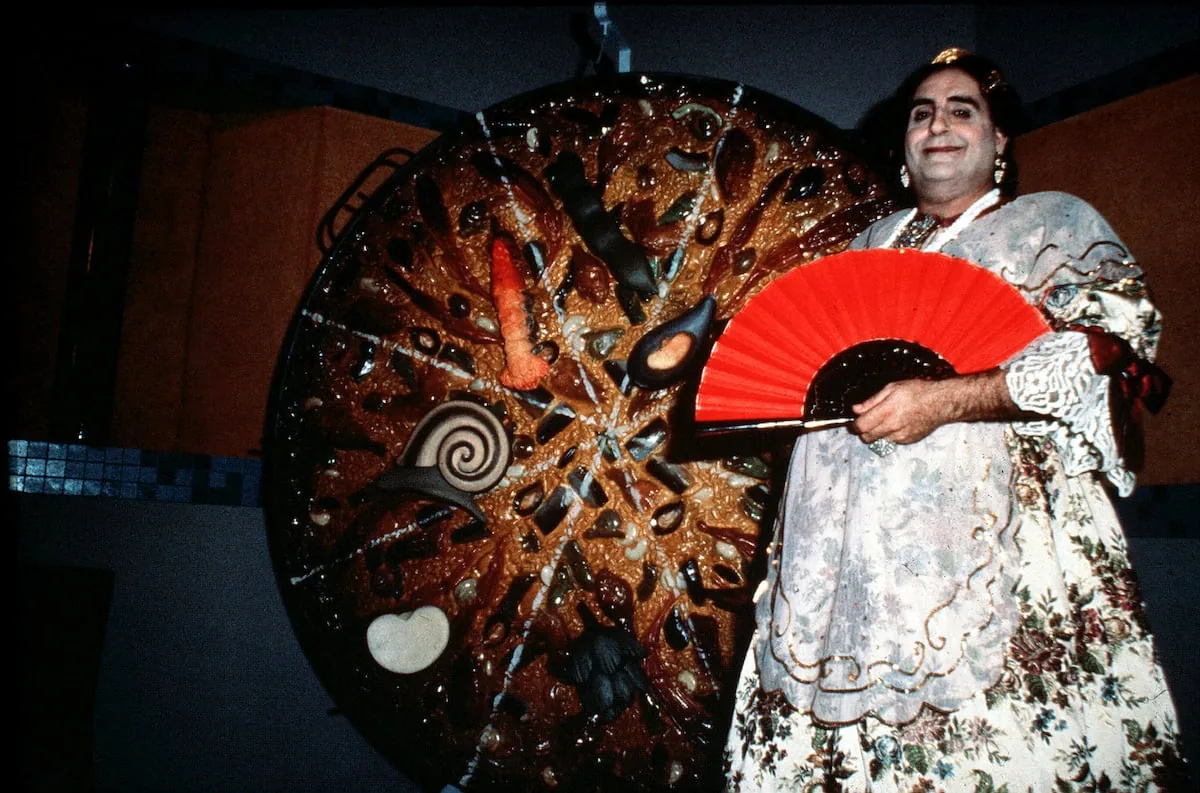
I am taken to the facilities of the Valencian regional channel À Punt for an interview, and in the lobby, half-hidden or half-displayed, I come across the Russian paella from El show de Joan Monleón, the star of that channel in its origins, back in 1989, when it was called Canal 9. Next to it is the sofa from Tómbola, the channel’s other contribution to television history, but I am only moved by that roulette wheel in the shape of a mixed paella (oh dear!) that presided over one of the most hilarious, festive, baroque, saturnalian, crude, and avant-garde sets, a myth of my Valencian childhood. Joan Monleón was an unrepeatable character, impossible to pigeonhole, perhaps partly comparable to Javier Gurruchaga: an overwhelming, energetic, immensely popular, and always entertaining stage talent.
After the nostalgic shock, I stayed for a while next to that paella-roulette and thought about the nice museum that could be set up with the remains of lost sets, costumes, furniture, various objects, and props from the most beloved and remembered TV shows. RTVE has a museum in Barcelona, but it is more didactic and technological than nostalgic. I propose something that works like a Proustian madeleine, not just an interesting place for audiovisual students.
The Smithsonian Museum of American History in Washington has a core part of its collection dedicated to pop culture, in which television forms the central axis. There are other popular culture museums around the world, but no Spanish Minister of Culture has thought of rescuing what remains of that heritage to honor and eternalize it as it deserves. It seems we resign ourselves to television being a fleeting art, which only persists in the unreliable meninges of old viewers.
Read more Spain and the Global South
Shared memory is a totem before which many things are sacrificed, but always with solemnity. The word memory is burdened with sadness, trauma, blood, fog, and horror. We allow ourselves few frivolities in its name and let the trinket sellers dominate the nostalgia market, always despised, always condemned as a kitsch weakness or the antechamber of who knows what fascisms. Perhaps, by the time the Ministry of Culture sheds its solemn crust, understands the importance of this legacy, and assumes the need to preserve and disseminate it as other facets of Spanish culture are preserved and disseminated, there will be nothing left to preserve or disseminate.
Read more The paradox of Madrid’s public bike: many bicycles, few lanes to cycle safely