







The Ministry of the Interior has designed what it has defined as “the greatest security logistical challenge” to ensure there are no surprises during the six days that Pope Leo XIV will be in Spain. The pontiff begins his visit this Saturday the 6th in Madrid, then will travel to Catalonia and will end his tour in the Canary Islands, from where he will fly to Rome on June 12. The National Police has named the operation Operation Grace and plans the deployment of more than 15,000 National Police officers, joined by personnel from other forces, 600 vehicles, and the use of elite units for the Pontiff’s protection team.
The largest contingent of police personnel will be deployed in Madrid, where it is expected that 10,300 will participate in the operation, including members of the National Police, the Civil Guard, and the Municipal Police. It is the “largest police deployment of the democratic era,” defined the Government delegate, Francisco Martín, last week. Spain maintains the reinforced level four of the anti-terrorist alert, on a scale of five, which represents a high risk. This level takes into account the risks associated with an event of this nature, such as the action of radical groups. Prevention during those days will be active on all possible fronts: intelligence, cybersecurity, citizen security, and transportation, among others.
🚔 We deploy the greatest logistical challenge of #security on the occasion of the visit of Pope Leo XIV
👮🏻♀️👮🏻♂️ More than 15,000 agents, 600 vehicles, 7 helicopters, 16 drones, and a large deployment in #Madrid, #Catalonia, and #CanaryIslands
Maximum security to guarantee the normal development of… pic.twitter.com/8eMbhkHPix
— Policía Nacional (@policia) June 3, 2026
The Madrid Superior Police Headquarters will host the coordination center, where there will be representatives from the Royal House, the Presidency of the Government, the state security forces and bodies, and emergency members. This unified command post “will manage, supervise, and coordinate operational security in real time.”
During his movements, the pontiff will be permanently protected by a “security capsule” that will include members of the Central Protection Unit and those of the Special Operations Group, the well-known elite GEO unit.
Catalonia, which will receive the Pope on June 9 and 10, will mobilize more than 6,000 mossos d’esquadra and Urban Guard agents, who join the 600 national police officers and 300 civil guards. The Mossos headquarters in Sabadell will host the coordination center with all the actors involved in the security operation.
The second largest deployment of national police officers will be in Las Palmas, where 1,200 agents have been mobilized; followed by Tenerife, with 1,000 personnel. Within Operation Grace, 2,600 trainee police officers from the National Police School in Ávila have been included. The force has already deployed more than 170 vehicles and 215 agents from various National Police units to Gran Canaria and Tenerife, along with 16 dogs from the Special Canine Guides Unit, which have departed from the port of Huelva.
More than 170 vehicles and 215 agents from @policia have just boarded at the port of #Huelva heading to the #CanaryIslands
They will participate in the security operation on the occasion of the visit of Pope Leo XIV to #GranCanaria and #Tenerife pic.twitter.com/WL7PqYEU1c
— Policía Nacional (@policia) June 2, 2026
The range of material resources will also be immense. 600 vehicles will take to the streets, including 250 van-type vehicles from the Police Intervention Unit, 17 trucks from the Cavalry Unit, 24 vans from the Canine Guides specialty, 38 vehicles for GEO use, and 91 vehicles assigned to protection capsules. Additionally, the Police Air Unit will have an airplane, seven helicopters, and 16 drones; and the Subsoil and Environmental Protection will have eight vans from the specialty.
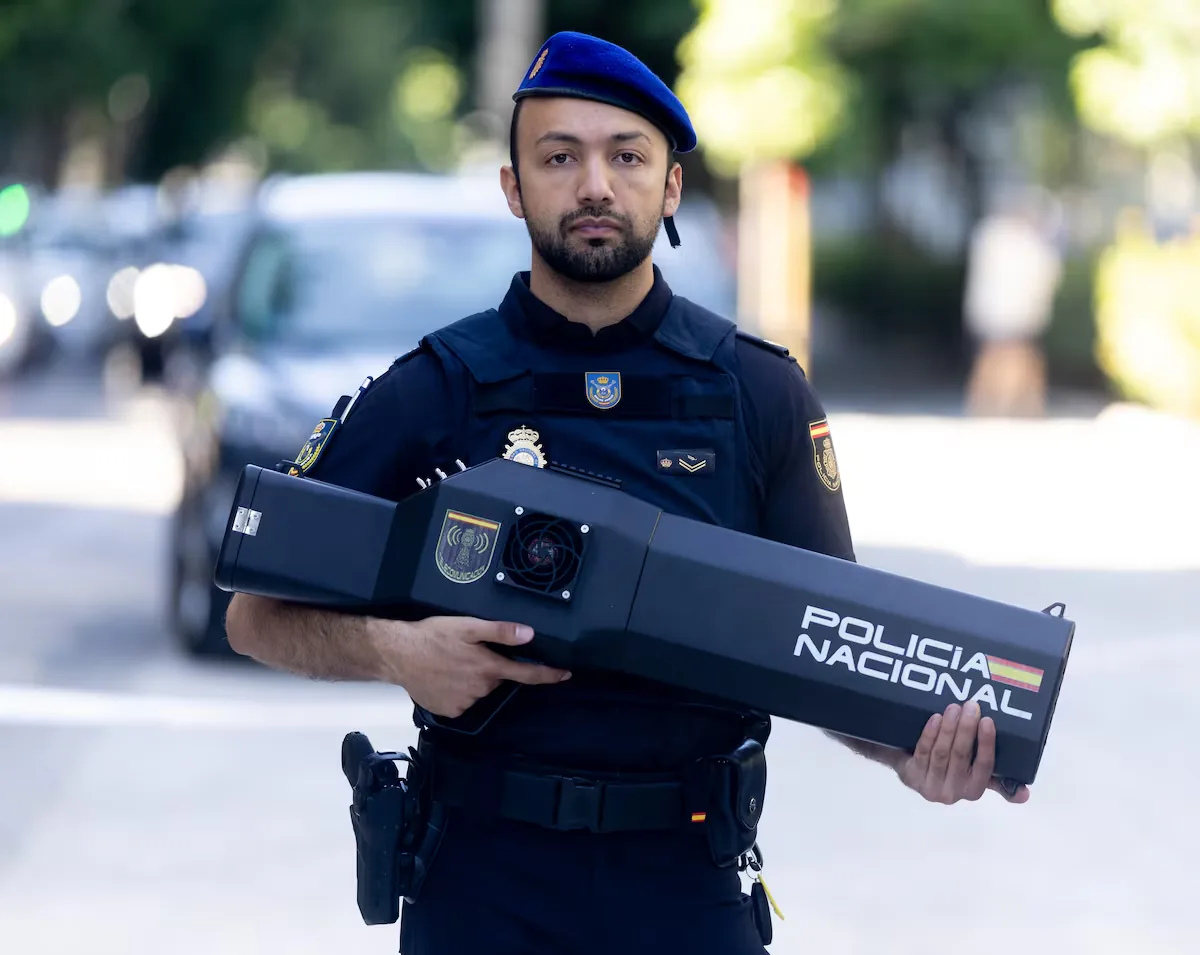
Officers will have 40 early threat alert recording cameras, 160 metal detection arches, 162 security scanners, 302 metal detectors, 43 frequency jammers, and 44 individual evacuation kits.
The National Police has reminded that the use of drones and unmanned aircraft will be restricted in areas affected by official acts, movements, public gatherings, and specially protected spaces planned in Madrid, Barcelona, and the Canary Islands. Around 120 personnel will shield and monitor the airspace of the different cities. Chief Inspector Ángel Siles, from the Security and Air Protection area, explained this Wednesday that drones are the main “risk vector currently in any security operation.”
“Drone flights will not be allowed in restricted areas without prior authorization, even if the flight is intended for private, recreational, informational, or image capture purposes. Any unauthorized operation is detected by the early warning system SIGLO-CD (Global System Against Drones), and may lead to the immediate intervention of agents, identification of the pilot or operator, immobilization or intervention of the equipment, and, if applicable, the processing of administrative or criminal responsibilities that may correspond according to current regulations,” the force states in a statement.
Not only will the skies and streets be monitored, but also the digital universe. The police have launched a so-called intelligence desk, which will be managed from the General Information Commissariat, and will be dedicated to making a “permanent monitoring of social networks and possible emerging threats” to make the information obtained “available to the units involved to promote operational coordination.” Additionally, a Cybersecurity Cell is already operational, led by the National Police’s Operations and Digital Transformation Division, which is responsible for coordinating “cyber patrolling on networks” through monitoring and analysis of digital information.
Read more Emmanuel Kwafo Mintah, Ghanaian activist: “We have to put women at the center of any development”