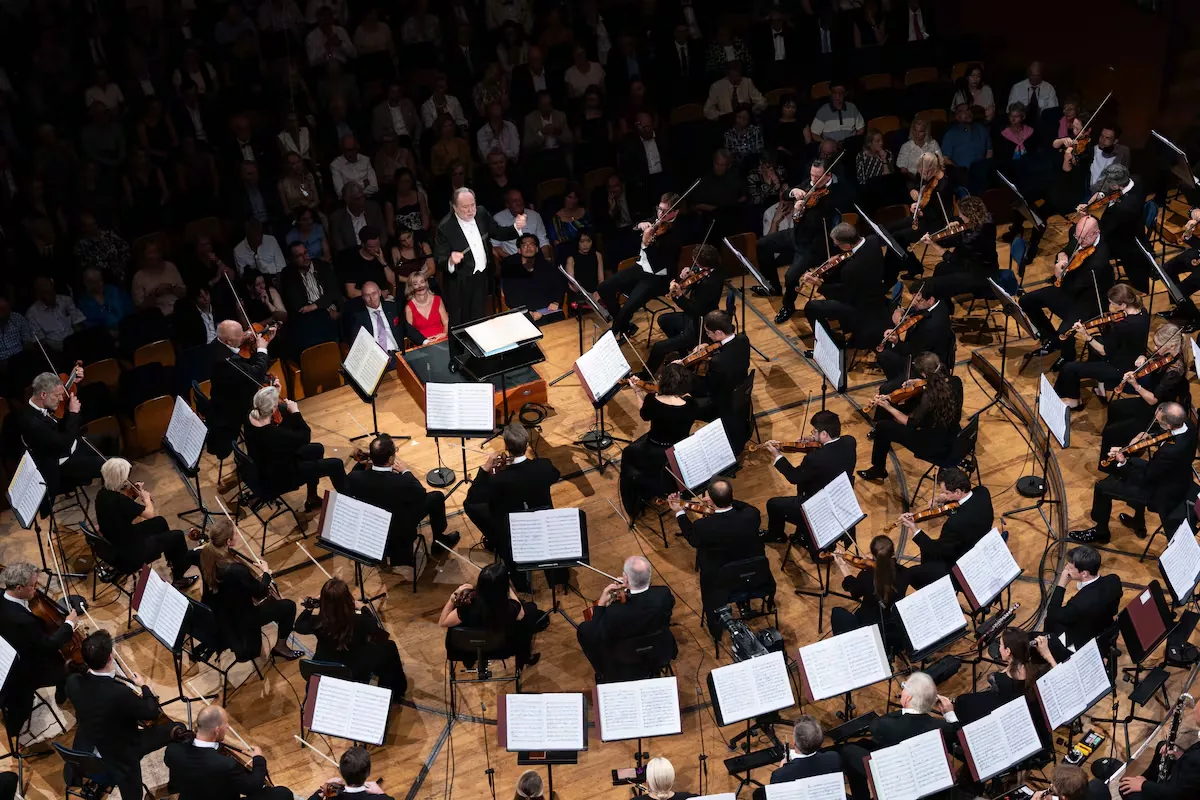
There are traumatic and orderly successions: everything points to the fact that, at the Salzburg Festival, the one affecting the artistic direction will be one of the first to make headlines after the sudden dismissal of Markus Hinterhäuser a few months ago, while the one that has already taken effect at another of the summer musical giants, the Lucerne Festival, will be an example to follow among the latter, since in May 2023, more than two years in advance, it was announced that Sebastian Nordmann would take over from Michael Haefliger, who stepped down last summer after more than a quarter of a century as the driving force and great renovator of the Swiss musical event with a very long farewell concert, aptly and Beethovenianly titled Les Adieux, which then led to a grand party to which the entire audience was invited. Schemes and sharp swords in Salzburg versus food, open bar, and a playful and relaxed atmosphere in Lucerne. At least on the surface.
Read more The mirage of the center or the difficulty of carving out a space between the PSOE and the PP
A new era of a festival is therefore just beginning, whose foundational stone, so to speak, was laid by Arturo Toscanini in 1938 when he conducted, a few months before the start of World War II, a concert in the gardens of the villa of Tribschen, on the outskirts of Lucerne, also on the shores of Lake Lucerne, which was the residence of Richard Wagner during several of the most family-oriented and happiest years of his life. There is a long way from that almost symbolic gesture to the month-long macrofestival with dozens of musical events of all kinds, with a profile that has fundamentally changed over the last quarter of a century, with three other festivals lasting only three or four days in spring and autumn and, above all, with the creation of three relatively recent institutions that now seem inseparable from its ultimate essence: the Orchestra (2003), the Academy (2004), and the Contemporary Orchestra (2021), three entities closely linked to the Lucerne Festival, born within it and taking part of their name from it in the manner of a demonym. Sebastian Nordmann, who comes here from the Konzerthaus in Berlin, has confirmed that the three will continue to be the basic pillars under his direction, while intending to expand the events that can be enjoyed without paying an entrance fee: this year, apart from the already well-established 40-minute concerts introduced by Michael Haefliger, last Thursday, the day before the official opening on Friday, there were two free concerts, one inside (Overture) and another outside (Classics for All) the KKL, the famous building designed by Jean Nouvel that has served as the festival’s headquarters since 1998, featuring one of the best acoustics auditoriums in Europe.
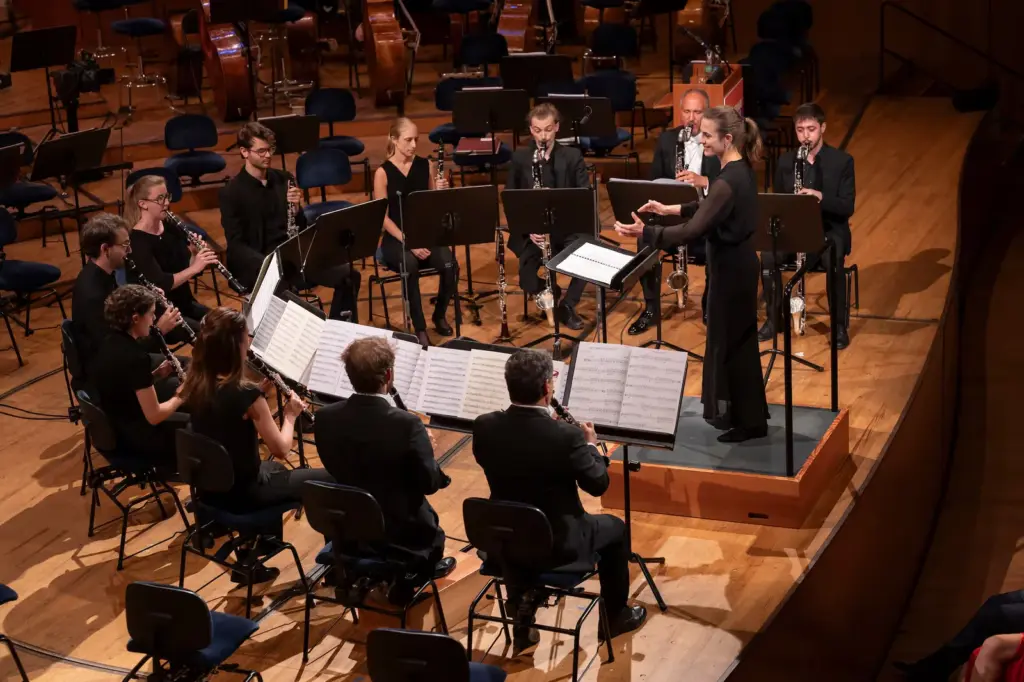
Nordmann also maintains the custom of presenting a motto or generic title that articulates, if not the entire, at least a good part of the festival’s offerings, which this year is, in English, American Dreams. Critical voices have not been lacking at a historical moment when relations between the United States and Europe are not exactly at their best, given the whims and volatility characterizing the erratic behavior of the current occupant of the White House. Nordmann has made it clear that, “as a festival, we support fundamental rights and democratic and humanistic values. At the same time, our role is not to comment on current U.S. politics. The theme is deliberately cultural and non-partisan, focusing on building a cultural bridge and welcoming American artists,” as will be the case with the main guest artist (artiste étoile in the festival’s terminology), violinist Augustin Hadelich, the Pittsburgh Symphony Orchestra, and the Metropolitan Opera Orchestra of New York, as well as writer Amanda Gorman, who will recite her poems in an evening where her verses will alternate with three of Bach’s Suites for solo cello performed by Jan Vogler. From A to Z, from John Adams to Frank Zappa, the United States will set up a great musical embassy in Lucerne for a month.
The opening concert wonderfully summarized the spirit of these American dreams, with a program presenting an extremely conventional three-part structure (overture – concerto with soloist – symphony), but which, in reality, was adorned with very original features, not only because two other works sounded at the beginning of the first and second parts — one announced in the program, the other by surprise — but also because the chosen pieces are not heard every day: George Gershwin’s Cuban Overture and Piano Concerto in F, and Charles Ives’ Symphony No. 1, which was performed for the first time at the Festival and was surely an absolute premiere for much of the audience, both the more and less cultivated, because at an opening like Friday’s, fans of all levels come together.
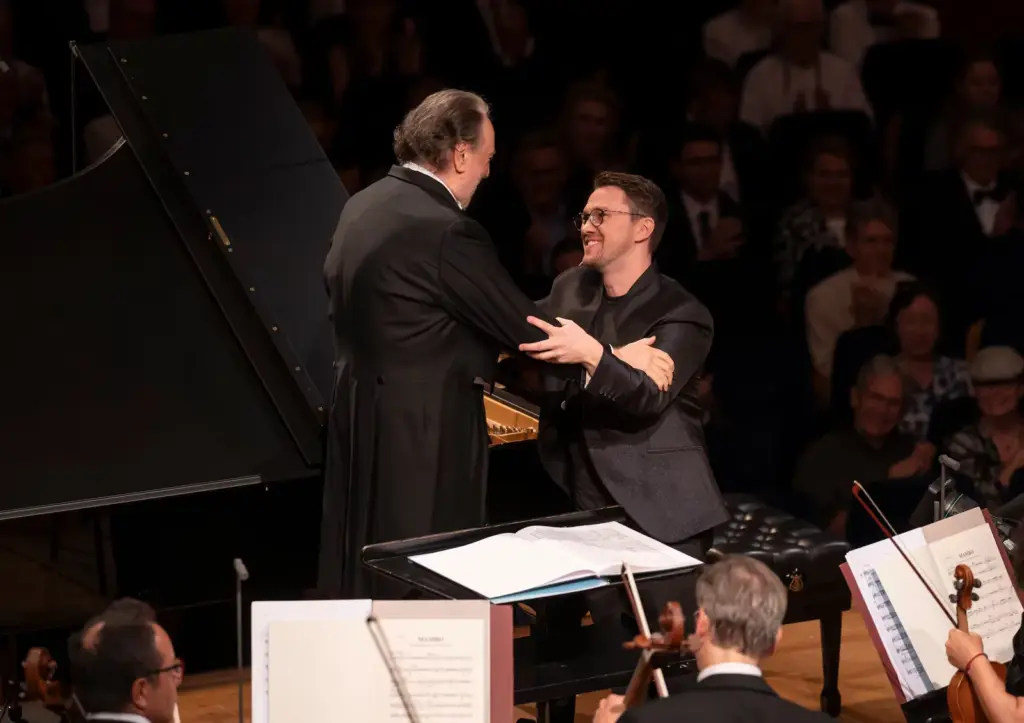
Before the overture, eleven clarinetists played Steve Reich’s New York Counterpoint, which brought together on stage soloists from the Lucerne Festival Orchestra (led by the formidable Alessandro Carbonare and Raphaël Schenkel) and members of the Lucerne Festival Contemporary Orchestra. It was not conducted, as the rest of the concert was, by Riccardo Chailly, but by Nina Haug, who participates in the contemporary music conducting courses also offered by the festival. Besides sending several messages, the choice of the piece symbolically transported us not only to Steve Reich’s hometown but also to that of George Gershwin, who would soon dominate the first part of the concert. After the intermission, to everyone’s surprise, we heard the always moving Fanfare for the Common Man by Aaron Copland, for brass and percussion instruments, which Chailly himself presented as a tribute in memory of Thomas Keller, the tuba player of the Lucerne Festival Orchestra who passed away a few months ago before turning fifty. And with that spirit, the performance of Charles Ives’ First Symphony was approached, nominally in D minor, which gives an idea that we are still far from the disruptive and irreverent composer he would become, as the young man was still studying with Horatio Parker at Yale University while composing it. It is worth recalling once again his aesthetic credo as summarized in a note he left for the copyist in the upper left margin of the manuscript of July 4th, one of his many compositions conceived as a sonic collage: “All wrong notes are correct. Copy everything as it is. That’s how I want it.”
The program thus combined minimalism, one of the great American contributions to 20th-century music; the blending of classical music and jazz, a fusion best represented by Gershwin; the creation of classical music accessible to all with a strong social commitment, a pursuit in which Aaron Copland shone like few others; and undoubtedly the most original American musician of all time, the unpredictable, profound, humorous, libertarian, transcendentalist, and heterodox Charles Ives, although paradoxically represented by a work in which it is difficult to find any of his most distinctive traits. Because in this symphony, a sort of Ives in progress, he shamelessly uses clearly recognizable models from Schubert, Dvořák, Beethoven, or Tchaikovsky, but not, to use terminology coined by Howard Mayer Brown and applied to Renaissance composers, to pay homage or emulate them, but to compete with them, something especially clear in the case of two then relatively recent symphonies like Tchaikovsky’s Pathétique and Dvořák’s New World, who had come into contact with American music during his years as director of the National Conservatory in New York, where he met Horatio Parker, Ives’ teacher and — it seems reasonable to think given the coincidence of dates — his advisor during the gestation of his First Symphony. Ives seems to proclaim: “I can do the same.” Hearing it finally in concert was a real gift for Ives enthusiasts, who would use similar, though more evolved, procedures in his Symphony No. 2, starting here with his characteristic native materials and ending the work with a gigantic and unprecedented cluster in its last bar. By the way, if the First Symphony was not premiered in Washington until 1953, just over a year before Ives’ death, the Second had a similar fate, as it was introduced by Leonard Bernstein — a fervent apostle of his compatriot’s cause — in New York in 1951, almost half a century after it was composed. And what encore was played at the end of the first part of the opening concert? The Mambo from West Side Story, the cherry on top of a long and broad program (it lasted more than three hours), but full of meaning and strongly cohesive, even if its connection was not at all obvious.
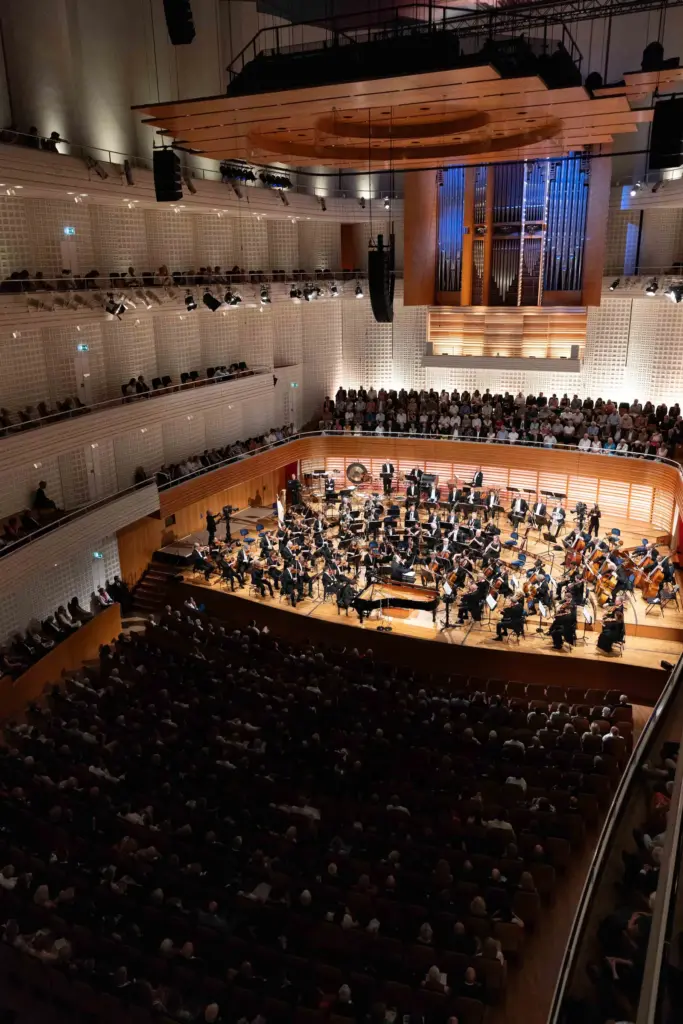
The Lucerne Festival Orchestra is a unique case not only because of its peculiar profile (it is made up of soloists from the best orchestras across Europe and chamber musicians as illustrious as violist Veronika Hagen), but because it has managed to keep alive the spirit instilled by its founder, Claudio Abbado, despite many years having passed since his death. It is undoubtedly the Italian who continues to summon many of its most emblematic instrumentalists, such as flutist Jacques Zoon, Spanish oboist and conductor Lucas Macías Navarro, violist Wolfram Christ, trumpeter Reinhold Friedrich (who reserved himself only for the second part on Friday), or cellist Jens Peter Mainz. And they are the ones who have passed on that spirit to more recent additions, such as oboist Daniel Rodríguez Agúndez (from ADDA Simfònica Alicante), oboist Miriam Pastor (applauded with full merit for her English horn solos in the second movement of Ives’ Symphony), or contrabassoonist Javier Sanz Pascual, the last two soloists of their respective instruments in the Royal Concertgebouw Orchestra, no less.
Read more Luz Casal, a classical with her classics
Somewhat away from his usual repertoire, Riccardo Chailly, to use the popular saying, brought the fire to his own sardine, making the music adapt to his conducting style, not vice versa. The stylistic divergence was most noticeable in Gershwin’s Cuban Overture, which, with its exuberant orchestration, sounded too heavy, lacking flexibility, if you will, although admirably played by the orchestra, which gave us a double feast: for the ear and the eye. Things improved considerably in the Piano Concerto in F, thanks largely to the exceptional soloist, pianist Frank Dupree, who paid more attention to Chailly than vice versa, and who introduced everything that had been missed in the overture: freedom, freshness, agility, spontaneity, surprise, flight. His cadenzas were a model of stylistic appropriateness, and in the penultimate bar of the last movement, he even allowed himself to improvise a small flourish of his own making. The numerous instrumental solos in the orchestra also allowed for greater flexibility, with the trumpeter Sebastian Berner undoubtedly receiving an honorable mention for his extraordinary solo and semi-solo interventions.
With his fabulous technique, Chailly shone especially in Ives’ Symphony, where he trod on seemingly unfamiliar ground, for the reasons already mentioned, since the American transmutes into his classical and romantic models, including the repetition of the exposition in the first movement or the orthodox three-part structure of the Scherzo, with its corresponding Trio. This work perhaps admits a more humorous, less serious approach than that adopted by Chailly, if understood as a great joke carried out with total seriousness. Overall, the Adagio molto was the most rounded movement, although the most moving should be reserved, for both musical and extra-musical reasons, for Copland’s Fanfare. By the way, returning to the beginning of the concert, remembering that Steve Reich is about to turn ninety, like Philip Glass, and that John Adams, despite his eternally youthful appearance, will be eighty in February, it is inevitable to think that being a minimalist composer must be a very healthy and low-risk profession. Gershwin did not live to be forty, and Ives nearly reached eighty, but he never dedicated himself professionally to composition, and most of his works were premiered posthumously.
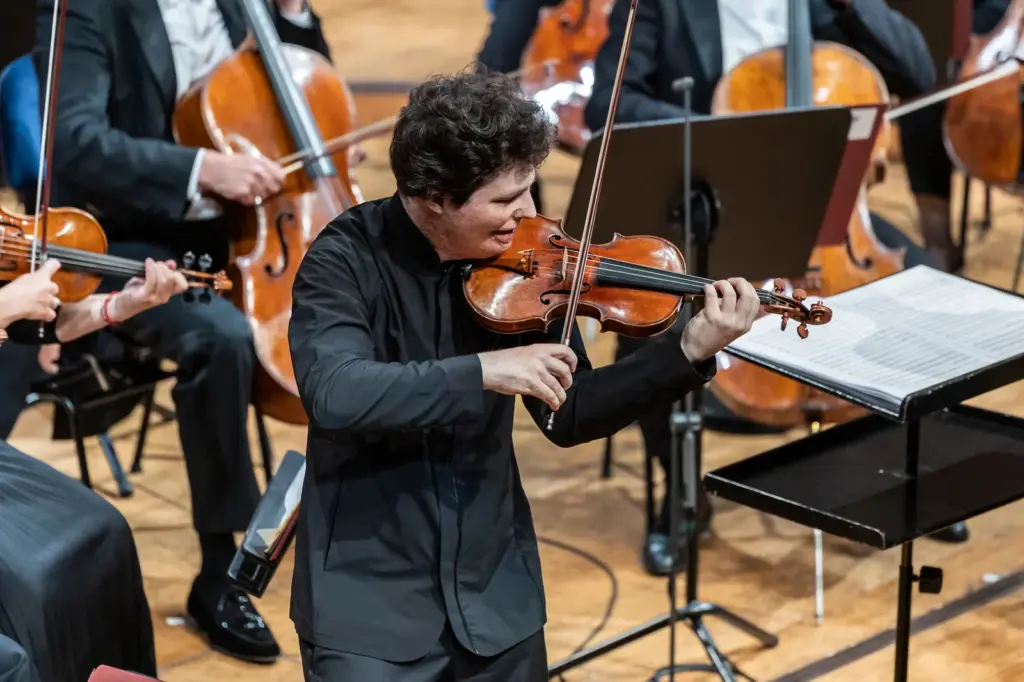
At the opening concert, which included speeches (such as the very witty one by Swiss President Guy Parmelin), Klaus Mäkelä, Augustin Hadelich, Jörg Widmann, and Dieter Ammann could be seen in the audience. The first two would star on Sunday in the second of the six concerts planned by the Lucerne Festival Orchestra in this edition, with a more conventional program in which the American dream was entrusted to Samuel Barber. There is life beyond his ultra-famous Adagio (originally the slow movement of his first string quartet), and here the choice was wisely made for his Violin Concerto, a work that began to take shape in the Swiss mountains in the ominous summer of 1939 and was completed in the Poconos of Pennsylvania. However, its music is not at all rugged, nor does it echo the disaster that had just befallen Europe — and, ultimately, the world — but rather is a refuge, an almost constant lyrical haven during the first two movements that only breaks into a run in the final Presto, described by the composer himself, very aptly, as written in moto perpetuo.
Born in Italy to German parents and residing in the United States, Augustin Hadelich has seen his career accelerate enormously in the last five years, and his presence is common with the best orchestras in the world: in May, for example, he gave a great version of Tchaikovsky’s Violin Concerto with the Royal Concertgebouw Orchestra conducted by Nathalie Stutzmann. Here, as artiste étoile, he will appear four times at the festival: besides Saturday, a chamber recital with Seong-Jin Cho, again as soloist with the Berlin Philharmonic and Kirill Petrenko (with one of the pinnacles of literature for his instrument, Beethoven’s Violin Concerto), and in a program of traditional American music. Barber’s Concerto is not demanding for either the violin or the orchestra, so with such ingredients, we heard a great version. The sound that Hadelich — who curiously plays without a shoulder rest — extracts from his Stradivarius (the instrument once owned by the great Henryk Szeryng) shines more for its quality than quantity, which fits very well with Barber’s almost chamber-like writing, requiring careful, sensitive, almost introverted phrasing, precisely one of the hallmarks of the U.S.-based violinist, the opposite of a diva. Klaus Mäkelä always left him space to expand in the nostalgic tone of a perhaps somewhat insubstantial score with very little traditional brilliance, but one that is pleasant to listen to, especially when played with such conviction and sincerity, without any artifice. As an encore, Hadelich played his own arrangement of Orange Blossom Special, the classic by the Rouse brothers popularized by Johnny Cash: another different version of the American Dreams.
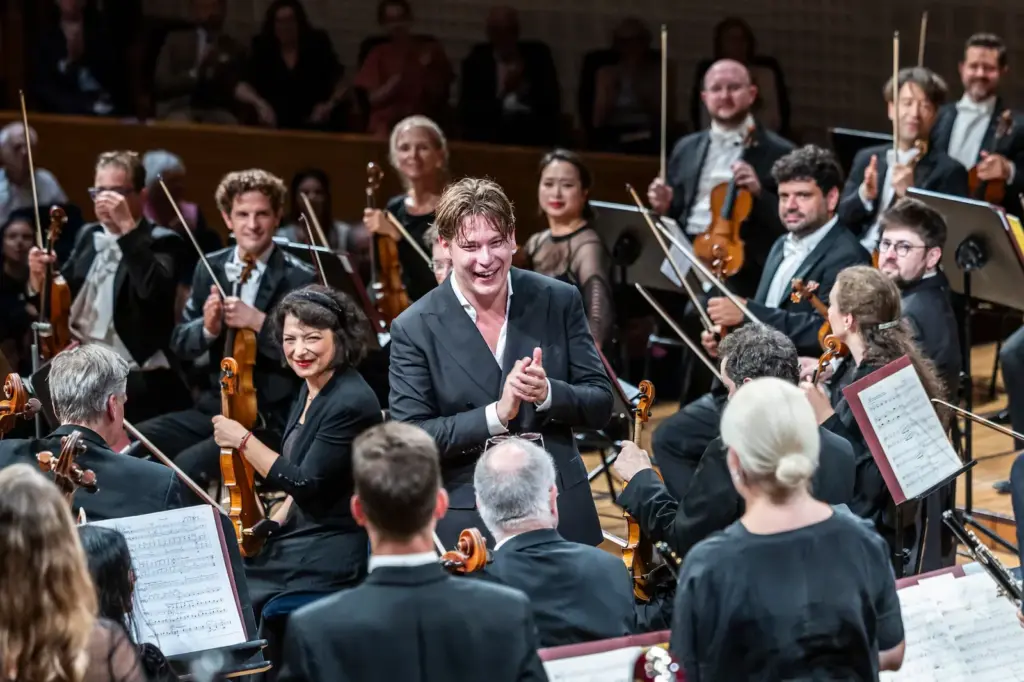
Mäkelä reserved his moment of glory in the second part with a score he knows very well and has already recorded with the Paris Orchestra: the complete music of Igor Stravinsky’s ballet The Firebird, the fruit of his first collaboration with Sergei Diaghilev. “Don’t lose sight of him! He is a man about to become famous,” was the warning the impresario gave his dancers. And we know he was right: only three years later, definitively transcending the 19th century that The Firebird still largely inhabited, The Rite of Spring, his third joint project for the Ballets Russes, shocked all of Europe and fully entered modernity. But on the day of the Paris premiere of The Firebird, with Tamara Karsavina and Mikhail Fokine as solo dancers, with sets by Aleksandr Golovin and Léon Bakst, Igor Stravinsky’s life, and the fate of Western music, had already changed forever. Here, colors are much more important than disjointed rhythms, so the score can only be done justice with an orchestra full of great soloists, which is precisely what defines the Lucerne Festival Orchestra.
Lucas Macías Navarro had already briefly shown his powers in the first part with the simple but emotional oboe solo that opens Barber’s Andante of the Concerto. And in Stravinsky, he again demonstrated his immense class in the several solos entrusted to him by the Russian composer, especially from “The Firebird’s Supplications.” But it was not only him who shone, but also flutist Pirmin Grehl, bassoonist Matthias Racz, trumpeter Ivo Gass (rightly acclaimed at the end), violist Wolfram Christ, again trumpeter Sebastian Berner (Reinhold Friedrich played one of the three trumpet parts sounding offstage this time), and violinist Gregory Ahss, who also acted as concertmaster with great involvement and authority. The Finnish conductor seemed especially inspired in the various appearances (the Firebird, the Enchanted Princess, Ivan Tsarevich, the monsters), highlighting the tremendous descriptive power of this music and showing his control of rhythm in the “Infernal Dance,” as well as, in the second scene, very pictorially translating the disappearance of the Palace and the Kastchei’s Spells. He conducted from memory, demonstrating his total assimilation of the score, and the final celebratory bells, with dynamics completely unleashed, crowned an almost more French than Russian version in which Mäkelä — without a tie or bow tie, for once, although as neat as always — perhaps dispelled some doubts and kept others intact. However, he will have to be careful not to die of success, as his career is moving very fast, even too fast, having reached peaks at thirty years old that are usually not reached until twice that age. His agent, the ubiquitous Jasper Parrott, was among the audience. Even shooting stars need good advice.
Read more Man arrested in Tarragona for stealing tips in four establishments