A question has been circulating for weeks: is there room for a centrist party in Spain? The person responsible is lawyer Miriam González, wife of Nick Clegg, former Liberal Deputy Prime Minister of the United Kingdom, who has registered a party, Democracia 21, with which she is considering running in the general elections. The answer about the prospects of a centrist project that emerges from polling data is not encouraging for any entrepreneur in that space, as they show that the sociological center does exist, yes, but neither its size is as large as is usually said nor is there a strong demand for a party located between the PSOE and the PP, a view that also prevails among researchers in sociology and political science.
Read more Luz Casal, a classic with her classics
To international phenomena, such as the centrifugal effect of polarization, Spain adds local factors that weigh down the expectations of a centrist party, such as the high electoral tension in the final stretch of the legislature, which pushes votes to already established options. However, González, who has insisted that she considers the labels “left” and “right” obsolete, is optimistic. “Spaces are made,” says the lawyer, who believes that society longs for a project of “cleaning,” “modernization,” and “renewal.”
The deceptive spoils of the center. At first glance, the center seems like a large space rich in undecided voters. 20.4% of Spaniards place themselves at 5 on the CIS ideological scale, more than any other position. Also, both in the CIS (22.4%) and in 40dB. (15.1%), the percentages of undecided voters in the center are the highest on the entire ideological scale. With those numbers, one might think there are many fish in the center fishing ground. But it is a mirage. In reality, there are not that many and they are not easy to catch.
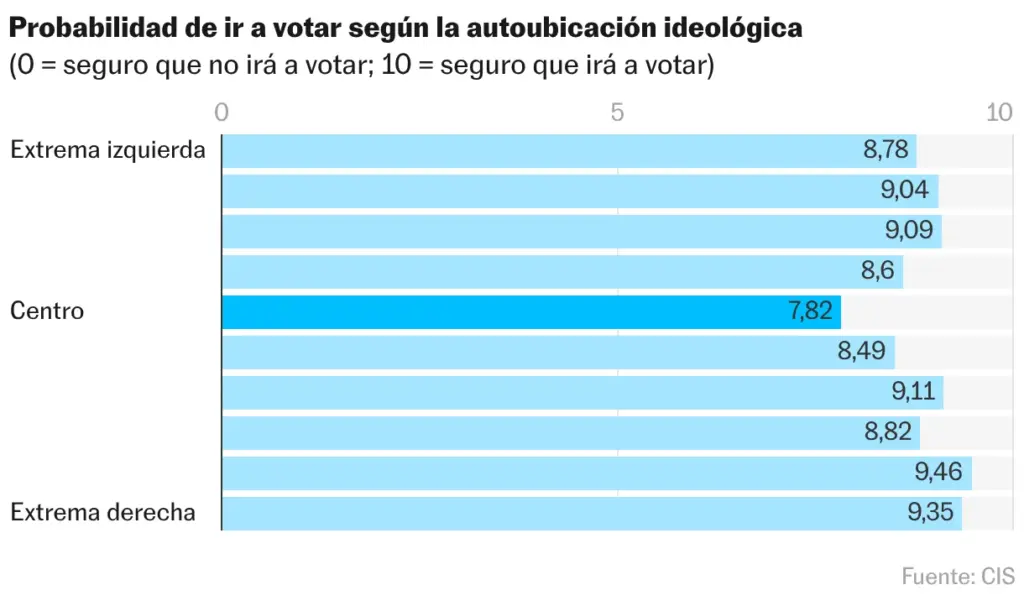
“Positioning around 5 usually means more ‘I don’t care’ than ‘I am liberal, reformist, or centrist’,” explains political scientist Pablo Simón, professor at Carlos III University specializing in participation and political parties. Furthermore, the low voting intention in the center indicates, more than genuine indecision, “strong demobilization,” notes Ignacio Urquizu, Sociology professor at Complutense University, who works for Metroscopia. The CIS confirms this when it shows that the probability of abstention increases the closer voters are to the center.
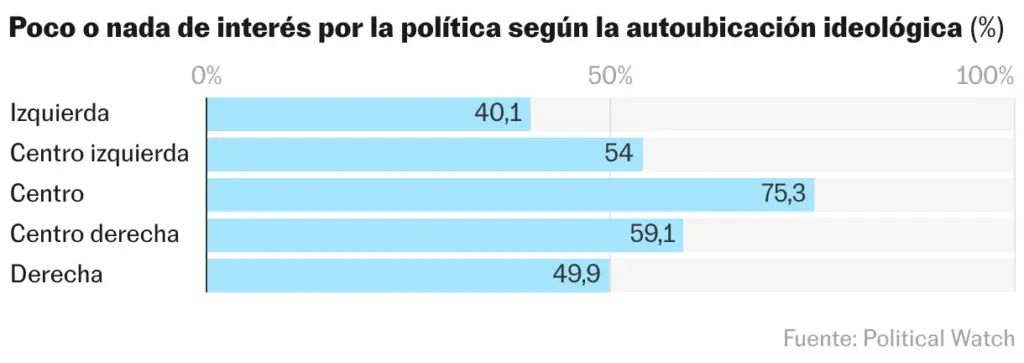
This greater demobilization does not only affect elections. A recent Political Watch survey shows that in Spain those who place themselves in the center are the least politically active, including everything from voting in a consultation to attending a plenary session, and are also the ones who most declare that there is “nothing” that could push them to participate. This fits with a data point from this study. Those who place themselves in the center-center are, by far, those who most declare disinterest in politics (75.3%).
Pablo Simón points out that the pool of self-identified centrists, rather than demanding a centrist force, is characterized by greater “indifference.” Another fact: they do not show a greater awareness that there are irreconcilable positions on the left and right that make a balancing force necessary. According to the CIS, they are the ones who most proportionally (52.7%) believe that “all parties” have similar proposals.
“Thinking that a lot of self-placement in the center means there are many centrists demanding centrist options is a simplification, especially in a context of polarization and strong electoral competition between left and right,” summarizes Xavier Coller, professor of Political Science at UNED and researcher on political parties.
Polarization strengthens the blocks. There is a devastating factor for the center: polarization, which in the electoral sphere translates into a greater tendency of voters to entrench themselves in one of the two major ideological blocks and reject the opposite with similar conviction, making transfers from one side to the other difficult and weighing down the aspirations of those who do not align. Result? Greater strength of the major left-wing party, the PSOE, and right-wing party, the PP, and to a lesser extent Vox.
If before the 2015 general elections, vote loyalty —percentage of voters of a party who expect to vote for it again— was 54.3% for the PP and 46.5% for the PSOE, now it is 68.1% and 65.8%. Vox joins these two parties with 71.6%. With this, the margin for defections is smaller than a little over a decade ago, when the crisis of the party system allowed Ciudadanos to break into the center.
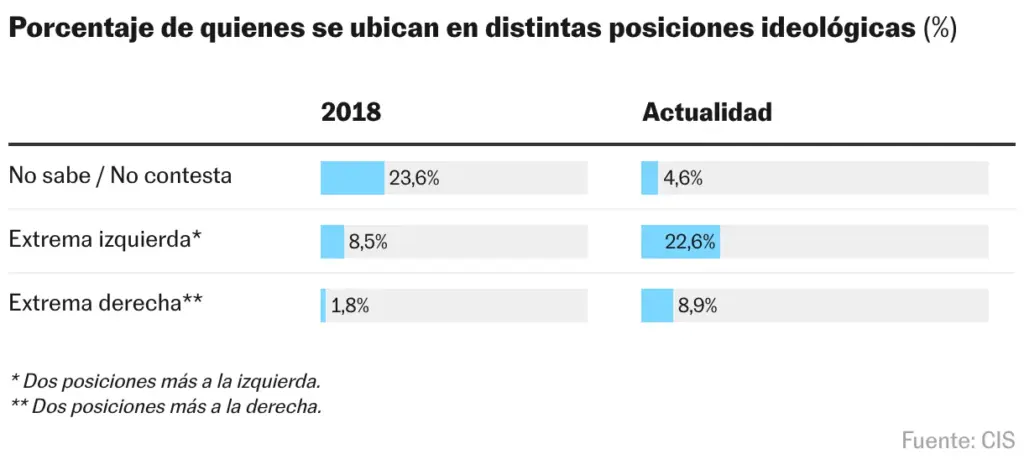
Polarization is also observed in the ideological composition of society. Taking as a reference for comparison the arrival to power of Pedro Sánchez and the present, respondents who resist placing themselves ideologically have dropped from 23.6% to 4.6%. The pool of those who resist fitting into the left-right scheme, a possible market for the center, is emptying. In contrast, the extremes are growing. The two leftmost positions, from 8.5% to 22.6%; on the right, from 1.8% to 8.9%.
There are surveys that point to social weariness of so much polarization, division, and tension. For example, 65% of Spaniards consider that the country is divided, 63% believe the main reason is the confrontation between left and right, and 50% believe it prevents addressing urgent challenges, according to More in Common. Does this open an opportunity for a centrist force that presents itself as overcoming those divisions? Not so fast, warns Pablo Simón, author of The Modern Prince. Democracy, Politics, and Power (Debate, 2018). “Consensus, the founding myth of the Transition, has a good reputation. But when it really matters, when there is confrontation, no one votes for the referee.”
The difficulty of mixing ideas. An effect of polarization is that it consolidates what Mariano Torcal, professor of Political Science at Pompeu Fabra and author of From Voters to Hooligans (Catarata, 2023), calls “mega partisan identities,” sets of firm opinions built from party followership. The result is that it is common for those most favorable to low taxes also to be in favor of abortion restrictions, despite being two issues that in principle have no relation, forming a kind of ideological package of the right, just as there is also an ideological package of the left. Whatever is asked of society —immigration, housing, LGTBIQ+ rights, competencies of the autonomous communities— the left-right axis always appears.
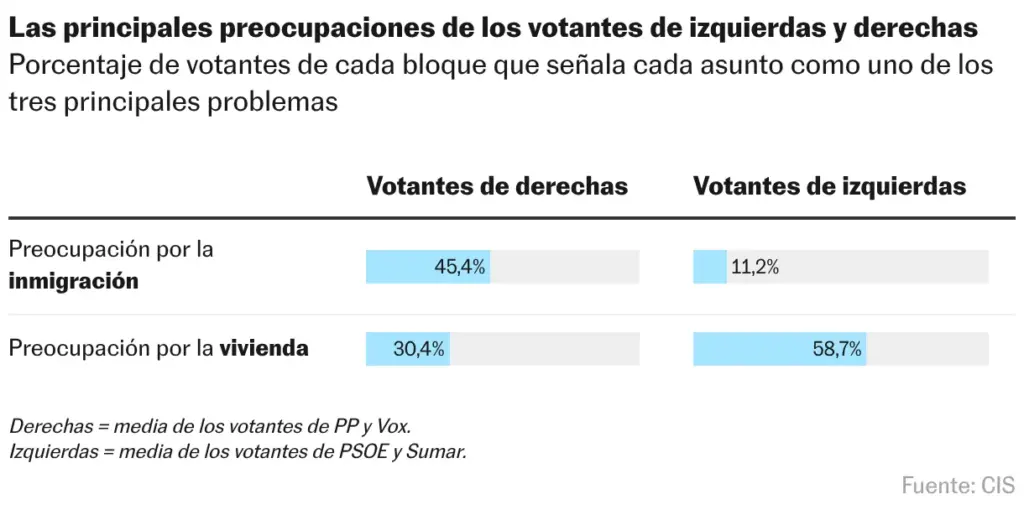
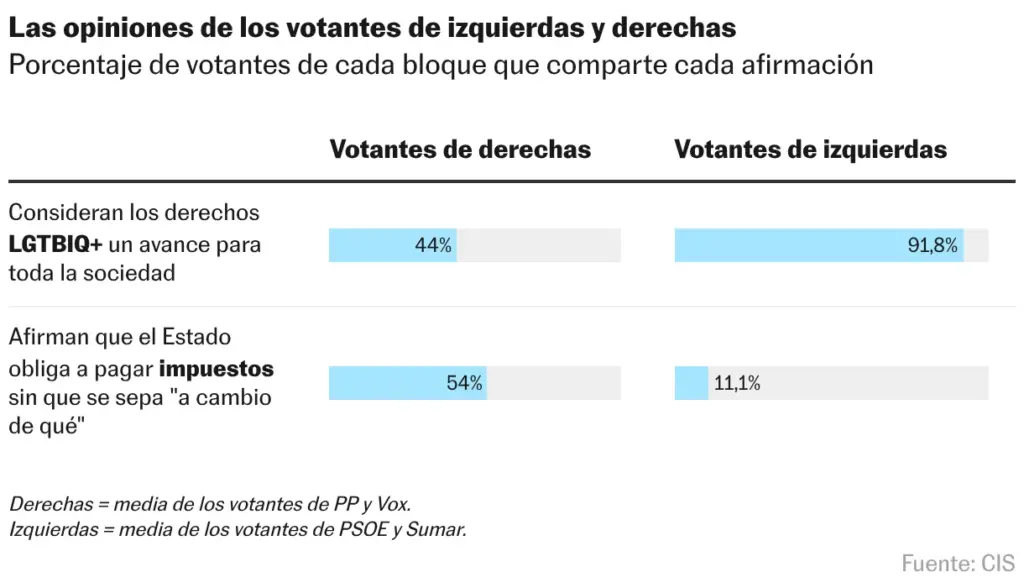
“In Spain, the overlap of opinions considered left-wing, on the one hand, and right-wing, on the other, whether on rights and freedoms or on the territorial issue, is very high, higher than in countries like France or Germany. That narrows the space for parties that can mix positions,” says political scientist Pablo Simón. And he recalls: “Ciudadanos was always in an uncomfortable position. If it went to gay pride, it was criticized for its pacts with the right. If it went to right-wing demonstrations, it was called an orange weather vane.”
Read more Man arrested in Tarragona for stealing tips in four establishments
CSIC sociologist Luis Miller summarizes the consequences this has for a centrist force: “The center in Spain tends to progressivism on issues like climate change or feminism and is more conservative on cultural issues and in the national and economic debate. What is its problem? That if you add to polarization the climate of electoral competition in a plebiscitary key over Pedro Sánchez and the difficulty of mixing left and right proposals, it is very difficult for that offer to sell.”
The difficult Spanish context. Polarization is a general phenomenon that punishes centrist options in almost all of the West. In the last European elections, the liberal family lost more than a quarter of its representation. “Everyone talks about [Emmanuel] Macron, but he is the exception, not the rule,” says Pablo Simón. To this international trend, the center adds another burden in Spain: at most, there will be general elections in about a year. “The tension will be brutal and will benefit the PSOE, the PP, and Vox. What I call lukewarm Spain will have no chance to get a foothold,” says Luis Miller, author of Polarizados (Deusto, 2023).
Currently, the vote of those who place themselves in the center leans to the right. At 5 on the ideological scale, although the PSOE is the party that arouses the most sympathy, the PP is first in voting intention, with 22.4%, ten points more than the socialists. Miller sees it difficult for a centrist force to significantly change that distribution, because the vote will be determined by the will to force or avoid a change. “Right now it is not possible to activate a centrist party, it has no margin to compete,” he analyzes.
In a similar vein, Xavier Coller, author of The Theatricalization of Politics in Spain (Catarata, 2024), expresses: “On paper, centrists are there and so are the undecided. But in the current context of general polarization and with the prospect of elections that are not perceived as already decided in advance, it is very difficult to leave the trench. The probability that a centrist party will be formed within a year is very low.”
There is no “window of opportunity.” When discouraging arguments pile up for a centrist option, a voice usually rises that says: “Well, Ciudadanos managed it.” “Yes —explains Simón—, but because it found a window of opportunity. It started as an anti-nationalist reaction in Catalonia and spread throughout Spain, channeling a demand for regeneration after the great crisis.” That “window,” he adds, is very narrow today.
“The situation is incomparable,” agrees Coller. “Today the electorates of the major parties are more loyal,” and he also cites “the logistical difficulties” González would face. “She would have to form the party, recruit cadres, organize, make herself known…,” he elaborates.
Simón sees it similarly. “If, as now, the moment is cold for a party, it can be compensated with a charismatic leader. But that takes time,” points out the researcher, who believes González’s options would grow in a European election and with a “star signing.”
Miller (CSIC) also points to the European elections as an optimal option, due to their single constituency and the greater tendency of the electorate to experimental voting. But they are far away: 2029. What Miller does believe is that a centrist option would find more favorable ground as opposition to a hypothetical PP and Vox government. “Most Ciudadanos voters went to the PP before the PP began to take positions in line with Vox. With a right-wing government, there could be a split-off of part of that electorate, especially among young people, women, and middle classes.”
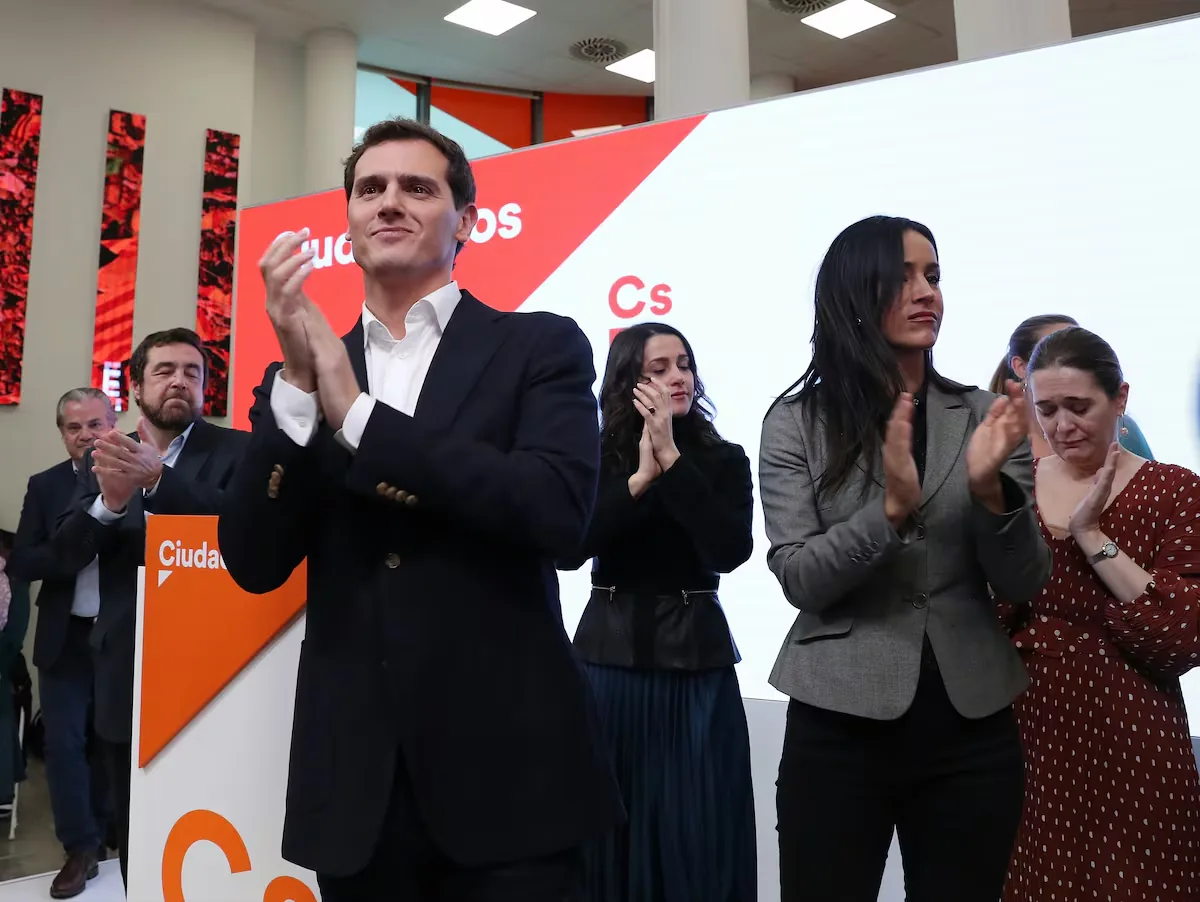
Albert Rivera does not foresee success for Democracia 21
“I am truly out of politics, forever,” says Albert Rivera (Barcelona, 46 years old), former president of Ciudadanos, the party with which in April 2019 he obtained more than 4 million votes, falling less than a point behind the PP. It was the ceiling of a formation that began to fall until its near disappearance de facto. Now, reinvented as a leadership trainer, he neither militates in Ciudadanos nor has —he assures— any relation with Democracia 21. Rivera does not foresee success for the project, because —he states— the difficulties imposed by the electoral system on forces that run throughout Spain without the power of a PSOE or a PP are added to an unfavorable “conjuncture,” marked by “polarization,” which pushes “useful voting.”
Although “sociologically” there is a “majority minority in the center,” Rivera does not see it as “the most opportune moment” for such a project, neither due to the political climate nor due to “strategy.” “Dividing the vote between the center, center-right, could be shooting oneself in the foot,” he points out by phone. He believes the Cs case was different, he analyzes. Then “the Catalonia crisis” was “a catalyst to seek a constitutionalist alternative.” “And although corruption is latent as much or more than when we emerged nationally, polarization today means there is a lot of useful voting,” he adds.
Regarding the causes of the collapse of Cs, he says they are “many” and cites “polarization” and the “six or seven setbacks” his party suffered at the polls after his departure (a departure that occurred after his party dropped from 57 to 10 seats in November 2019). And was it not a mistake to lean towards pacts with the right, sometimes including Vox, to the detriment of the role of kingmaker? After recalling that Cs also made pacts with socialists like Susana Díaz or Emiliano García-Page, Rivera looks at the Prime Minister. “The Sánchez factor changed everything,” he says in relation to what he calls his “iron pact” with “Bildu and [Carles] Puigdemont.” “That agreement is still alive. That is the great change in national politics. The PSOE, which was a center-left state party, made the strategic decision to ally with radical leftists and separatists, which made it incompatible with Ciudadanos.”