









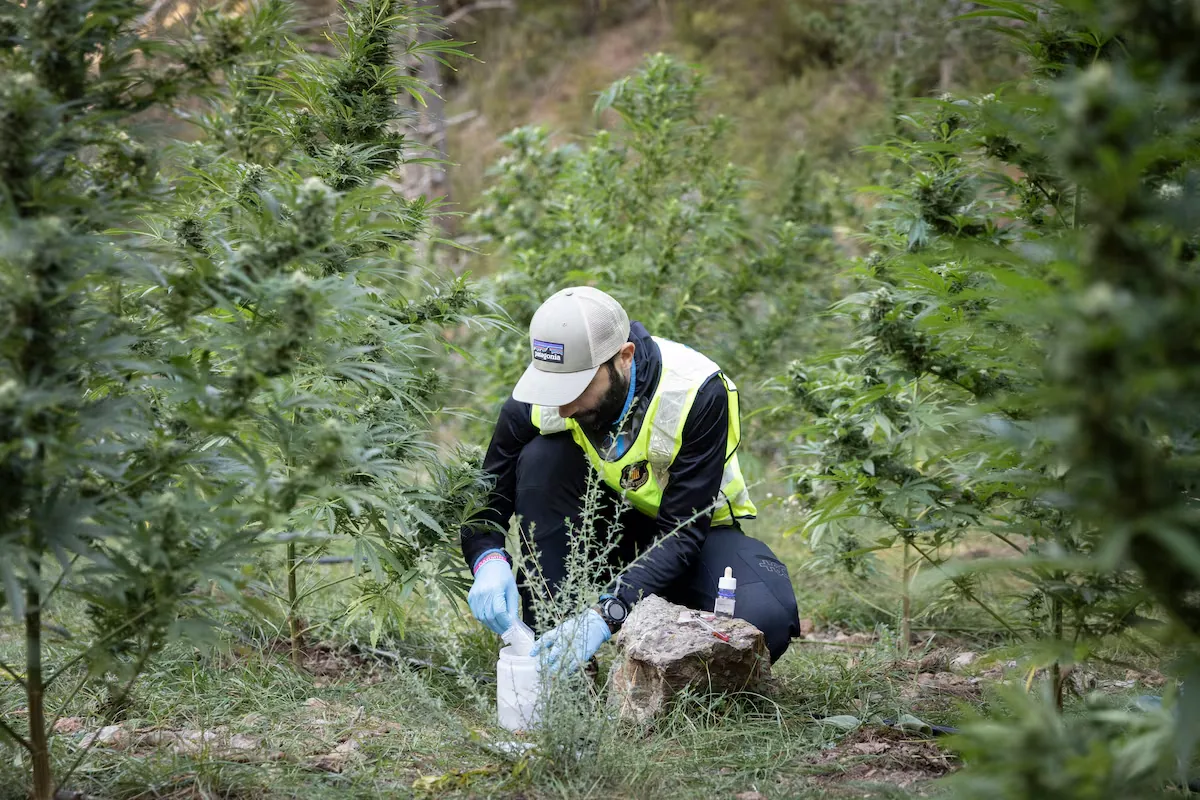
Not even the arrival of the rural agents’ helicopter, with the shredder in tow to lend a hand to the Mossos, solved the police officers’ problem. They had been listening to phones, following suspects, and walking through trails and streams for months to dismantle a marijuana crop in the high mountains. Then, in 2023, they relied on imagination to avoid spending an entire day hand-cutting half-meter plants and smelling like weed. To tackle an unsustainable situation, that same year the Mossos started a pilot test to shred and store the seized marijuana in barrels in a large central drug warehouse (Magatzem Central de Substàncies Estupefaents (MACSE)) in Nou Barris, Barcelona, awaiting its destruction. Three years later, with Catalonia turned into Europe’s garden, marijuana has overwhelmed the Mossos d’Esquadra’s plans. Constant seizures, delays in analyses, and waiting for judicial authorization have saturated what was supposed to be the great solution for storing the drug before destroying it in Catalonia, according to police sources. On average, it takes between one and one and a half years to destroy the seizures. The Mossos trust that advances in new technologies will unblock the bottleneck.
Read more Canada breaks with the United States
The Mossos inaugurated their central warehouse at the end of 2023, after a flood of union complaints. Police found on average two plantations a day, which accumulated in courtyards and police station garages, causing serious space occupation and health problems. The first pilot test – focused on the Metropolitan North police region – consisted of buying 250 high-density polyethylene barrels to store all the seized marijuana, awaiting destruction. The following year, convinced they had found a possible solution to the problem, they tendered a gardening contract divided by regions – specialists to cut, collect, and shred the drug – and calculated how many barrels they needed for an “optimal management” of the marijuana they seized, intending to take it to the MACSE and then destroy it. They concluded that purchasing 1,500 barrels in 2024 and another 1,500 in 2025 would suffice, according to the justification report of the first tender.
After the pilot test, the warehouse took over the management of the drug from four police regions (Barcelona, Metropolitan South, Metropolitan North, and Girona), in addition to the central services. The intention was to gradually take charge of the drug seized by the Mossos throughout Catalonia. But in 2026, the facilities are at their limit and cannot handle more marijuana, according to police sources. “The saturation is maximum,” says Fepol spokesperson, one of the major police unions, Toni Castejón.
The marijuana seized by the Mossos takes between one and one and a half years to be destroyed, as admitted by the Department of the Interior in a parliamentary response in January. And even then, it pointed out the three requirements that condition faster processing: an analytical report from the central laboratories on the drug, a judicial order authorizing its destruction, and the availability of the incineration plant they work with.
Read more Narcoviolence in Andalusia
Police sources indicate that the main bottleneck is in the Mossos’ own laboratories. “We can’t keep up,” lament these same sources, who trust that soon, thanks to technological advances, they will solve it. The second problem is the authorization to incinerate the plants. Legislation contemplates a way to destroy the drug without indefinitely waiting for an express judicial authorization. Once the analysis is done and the necessary samples preserved, the police notify the court of their intention to destroy the rest. If a month passes without a resolution preventing it, they can proceed. “But almost no one risks carrying it out without the judge’s authorization,” says Uspac spokesperson, Albert Palacio, another of the most representative unions in the Mossos. “Ideally, they would let us destroy the drug on site, when we seize it,” he adds, a possibility they do manage to apply in some operations.
Meanwhile, storage problems continue to grow. Another example is the tender for 2,106 new barrels for marijuana carried out this year, with the possibility of a two-year extension. The figure represents more than 600 additional barrels compared to the initial calculation made by the Mossos in 2024. Despite this, the trend in recent years points to containment in marijuana cultivation: the Catalan police seized 20% fewer plants last year (432,000) compared to the previous year, and 14% fewer plantations (375). Only the kilos of this seized drug increased (9,300, 34% more).
“We need a regulation that allows us to carry out ipso facto destruction,” requests Palacio, from USPAC. “The key is that the judicial authorization is for destruction, by protocol. Conversations are needed, to explain the system well, and for them to accept immediate destruction,” adds Toni Castejón, from Fepol, about a problem that has been on the table for more than a decade. Since 2018, there is a guide that binds all police forces in Spain on how to destroy drugs. It explicitly points out the cannabis problem through an addendum. The protocol – maintained in a new 2025 agreement – recommends judicial authorization for destruction at the start of the process (saving the necessary samples for trial). And, if not, it appeals to the route that allows police to destroy the drug within a month from notifying the judge of the intention to do so. Although, it adds, this formula “should be the exception.”
Read more ‘Little Perfect War’, return to the bloody nationalism of the nineties in the Balkans